Research Article: 2026 Vol: 30 Issue: 4
AN EMPIRICAL STUDY ON PERCEPTION OF WOMEN EMPLOYEES TOWARDS FACTORS INFLUENCING WORK-LIFE BALANCE WITH REFERENCE TO IT COMPANIES AT BENGALURU CITY
Rekha N Patil, Department of Management Studies, VTU CPGS, Kalaburagi
Bhagyalaxmi Koti, Department of MBA, Sharnbasva University, Kalaburagi
Citation Information: Patil.N.R., & Koti, B. (2026). An empirical study on perception of women employees towards factors influencing work-life balance with reference to it companies at bengaluru city. Academy of Marketing Studies Journal, 30(4), 1-8.
Abstract
The paper analyzes the perception of women employees towards factors influencing work life balance with reference to IT companies at Bengaluru City. Using convenience sampling data were collected through the questionnaire. The survey questionnaire covered various domains, including factors affecting the perceptions of women employees and perception towards factors influencing work-life balance. The study employed a sample consisting of 512 women employees from IT companies located at Bengaluru. Data analysis has done using simple linear regression tests using SPSS to assess the data. The results reveals that there is a significant relationship between the effect of various factors on perceptions of women employees and also the factors significantly affecting perception towards factors influencing the work life balance. This analysis reveals how women employee’s perceptions towards work-life balance relate to their attitude level, health aspects, personal, family and organizational factors. The 32 elements on the scale are four-factor instruments intended to measure three dimensions: work environment, job satisfaction and quality of life. Three components were scored on a five-point Likert scale for reliability.
Keywords
Performative marketing, Street vendors, Experiential retail, Quick commerce, Cooperative retail, Consumer trust.
Introduction
Work life balance, in its broadest sense, is defined as a satisfactory level of involvement or ‘fit’ between the multiple roles in a person’s life (Hudson, 2005). In order to define the harmony between a person's professional and personal life, the phrase "work-life balance" is often employed. It is widely acknowledged that achieving a work-life balance is crucial for a person's psychological health and that signs of a successful balance between work and family responsibilities include strong self-esteem, satisfaction, and a general sense of harmony in one's life. Work-life balance, or WLB, is the smooth integration of work and life. The need for multiple earners is growing as a result of rising education costs, increased service options, and rising living expenses (Movilla et al., 2025; Shavit,2025). Because to technological advancements, globalization, and increased career options, the desire for empowerment is growing every day. Women are now much more devoted to their families, and as their careers have advanced, they have begun providing financial support for their well-being (Judge, Zhang & Glerum, 2020).
Every profession has stress, workload, work pressure and unsatisfied employees but the percentage is very high in service-oriented industries like Information Technology. The Information Technology (IT) industry has become the most robust industries in the world. IT, more than any other industry or economic facet, has an increased productivity, particularly in the developed world, and therefore is a key driver of global economic growth. Owing to its easy accessibility and the wide range of IT products available, the demand for IT services has increased substantially over the years (Jones & McMillan,2018).
The existing study highlights the direct link between perception and work life balance with factors influencing WLB including work environment, job satisfaction and quality of life. Key research questions include:
RQ1: Which are the factors significantly affecting the perception of women employees towards work-life balance?
RQ2: Which factors significantly affect the perception towards factors influencing women employees’ work-life balance in IT companies?
The remainder of this research paper is structured as follows: With a review of significant literature and the creation of hypotheses, the second section discusses work-life balance in the IT companies. Data analysis is covered in the fourth section before discussion of the findings and their implications is covered in the fifth section. The study is concluded in the final section, along with recommendations for further research.
Research Objectives
• To reveal the factors significantly influencing the perception towards work-life balance.
• To understand the perception towards factors influencing women employees’ work-life balance in IT companies.
Literature Review
Authors in their research study ―Work-life balance perceptions of women in the IT and ITes sectors in Kerala: A Research Study‖ found that s that a healthy work-life balance will lead to employee job satisfaction, which will lead to organizational performance and establish a competitive edge for IT enterprises. The human resources department of the business should take the lead in advocating for suitable work-life balance policies and ensuring that the workers are benefited by them. Employees should practice self-management in order to minimize some of the imbalances between work and life that are caused by stress, burnout, family responsibilities, etc. They might gain from yoga, meditation, extracurricular activities, accurate job evaluation, beneficial training, and other things. IT executives should focus on developing, outlining, putting into practice, and assessing suitable work-life balance policies in order to build a sustainable and fulfilling organization (Greenhaus & Powell, 2006).
In their research paper it is analyzed that female university employees have different opinions on work-life balance. Thus, we can draw the conclusion that individuals from different departments have a range of ideas about their work environments, as well as their family environments and work-life balance. Even though the employees express their pleasure with the work environment and the family environment, there is dissatisfaction with the employees' ability to balance their professional and personal lives (Miglioretti,2020).
Their exploratory methodology has been used to identify the different obstacles that Moroccan organizational context presents for women's WLB. The results of this study showed that women are disproportionately burdened by their demanding professional and family responsibilities, making it harder for them to balance both roles and leading to an unbalanced work-life. The study provides insightful information on women's perceptions of their existing WLB and considers potential ways to make it better (Jyoti Dave, 2016; R. LaPointe & H. Glazer,1992).
In their research paper the authors have reflected that most female employees do not exhibit low WLB, challenges, and problems caused by work pressure. Motivations to work, demographic factors, marital status, number of hours per week, working overtime, management's commitment to improve WLB, time for personal wellbeing do not affect WLB perception in female employees; instead, satisfactory compensation is a distinguishing factor influencing WLB perception. The study suggests that female employees do not perceive higher challenges or work pressure as much as they consider their satisfaction with their compensation (Hasan & Teng, 2017; Liu et al., 2021) Figure 1.
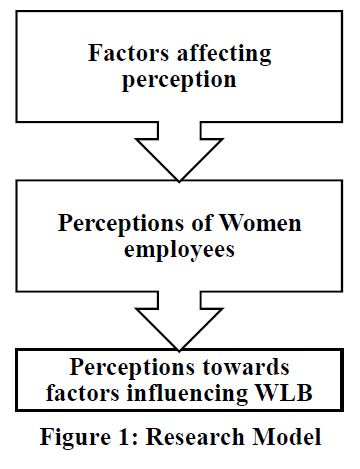
Figure 1 Research Model
Research Methodology
Research Model
The research model used in this study is depicted below
Type of research
The descriptive research and exploratory research type have been used in this study. The descriptive research design component focuses specifically on analyzing the attitude and perception of women IT employees. Attitude means the how women employees in IT companies feels work life balance and its issues. The exploratory research design, on the other hand, delves deeper into understanding the various factors that influence work-life balance among the sample population (Prerana Mishra, 2020).
Data Collection
Primary data is original information collected directly by a researcher; these was used for the study to draw first-hand information and insights regarding women employees’ perceptions towards work life balance and strategies followed by them to maintain WLB (Lee & Lin,2019).
Sampling Techniques
The study concentrated on large IT firms located in Bengaluru's well-known technology parks, including Electronic City, ITPL, Global Village Tech Park, Manyata Embassy Business Park, and Infosys, Wipro, TCS, Capgemini, and Cognizant, among others. However, the stringent corporate HR practices and data privacy regulations that many of these firms uphold made it difficult to gain accurate demographic data and direct access to female employees. Through professional networking sites, recommendations from other participants, or lunchtime interactions at food courts, the researcher has made contact with female IT professionals (Patel Sahilkumar Girishbhai, 2025).
Sample Size
The sample size for this study was determined based on power analysis using G*Power software (Mihir Dash, 2012). For a power of 0.95 with a 0.05 level of significance and 0.50 population size (when population size is not sure), the minimum sample size requirement was 385. A sample of 512 women employees was drawn from the total population women employees
Statistical Tools Used
• The descriptive statistics frequencies, percentages, minimum, maximum mean and standard deviation are obtained.
• Simple linear regression was carried out to see
a. the factors significantly influencing the perception towards work life balance.
b. the perception towards factors influencing women employees’ work life balance in IT companies.
Hypotheses Development
H1There is no significant relationship between the attitude level of women employees and perception
H2There is no significant relationship between the health aspect of women employees and perception.
H3There is no significant relationship between personal, family and organizational factors and perception.
H4There is no significant relationship between perception towards factors influencing women employees’ work life balance
Results and Discussion
Sociodemographic Variables
The above Table 1, presents the distribution of respondents for various Socio-demographic factors in the research study. Each variable is categorized, and the table shows the frequency / counts (number of respondents) and percentage for each response within the given category.
| Table1 The Summary of Sociodemographic Variables: Counts and Percentages | |||
| Variables | Responses | Count | Percentage (%) |
| Age | Up to 25 years | 164 | 32 |
| 26-35 years | 272 | 53.1 | |
| 36-50 years | 74 | 14.5 | |
| 50 and above | 2 | 0.4 | |
| Total | 512 | 100 | |
| Marital Status | Single | 198 | 38.7 |
| Married | 310 | 60.5 | |
| Divorced | 4 | 0.8 | |
| Widowed | 0 | 0 | |
| Total | 512 | 100 | |
| Educational qualification | Under-Graduate | 61 | 11.9 |
| Diploma | 213 | 41.6 | |
| Graduate | 183 | 35.7 | |
| Post-Graduate | 55 | 10.7 | |
| Total | 512 | 100 | |
| Type of family | Nuclear | 342 | 66.8 |
| Joint | 170 | 33.2 | |
| Total | 512 | 100 | |
| Family Values | Orthodox | 67 | 13.1 |
| Moderate | 373 | 72.9 | |
| Liberal | 72 | 14.1 | |
| Total | 512 | 100 | |
| Spouse working | Yes | 285 | 91.6 |
| No | 26 | 8.4 | |
| Total | 311 | 100 | |
| Type of shift | General shift | 378 | 73.8 |
| Morning shift | 112 | 21.9 | |
| Evening shift | 12 | 2.3 | |
| Night shift | 10 | 2 | |
| Total | 512 | 100 | |
| Number of children | None | 131 | 42.4 |
| One | 140 | 45.3 | |
| Two | 38 | 12.3 | |
| More than two | 0 | 0 | |
| Total | 309 | 100 | |
| Dependents | Parents/in laws | 236 | 46.1 |
| Siblings | 166 | 32.4 | |
| Others | 69 | 13.5 | |
| None | 41 | 8 | |
| Total | 512 | 100 | |
The majority of respondents 53.1% falls in the age group of 26-35 years, followed by 32% falls in up to 25 years age group, 14.5% falls in 36 to 50 years and only 04% where of 50 and above age groups. The study consists of 60.5% married respondents, followed by 38.7% single, 0.8% divorced respondents. The majority of respondents 41.6% falls in the diploma course followed by graduate course with 35.7%, 11.9% for under graduate course and 10.7% post graduate. The study includes the 66.8% respondents falls in nuclear family followed by 33.2% falls in joint family.
The majority of 72.9% respondents belongs to moderate family value followed by 14.1% are from liberal vales and 13.1% respondents are from orthodox vales. Study reveals that 91.6% respondents’ spouses are working. The 73.8% of respondents spouse works in general shift followed by 21.9% working in Morning shift, 2.3% and 2.0% for evening and Night shift respectively. The study also consists of 45.3% of respondents are having one child followed by 42.4% having no child and 12.3% having two children. The study says that 46.1% of respondents having parents/in laws as dependents followed by 32.4% siblings are dependent.
The factors significantly influencing the perception of women employees towards work life balance.
The above table 2 reveals that there is a significant influence of all the perception aspects which includes attitude level, health aspects, personal factors, family factors and organizational factors on the perception of women employees towards work life balance with p<0.01. Attitude level and health aspects of women employees in IT companies have more significant influence on their perception.
| Table 2 Simple Linear Regression: Perception Towards Work- Life Balance | ||||||||
| Dependent Variable | R value | F | df (Regression, Residual) | Coefficient values (a, b) | t | p value | Significance | Hypothesis |
| Attitude Level | 0.45 | 128.5 | 1 | 14.82 | 7.56 | 0.000** | <0.01 | H1 Accepted |
| 510 | 0.43 | 11.34 | 0.000** | <0.01 | ||||
| Health Aspects | 0.26 | 36.67 | 1 | 9.75 | 8.59 | 0.000** | <0.01 | H2 Accepted |
| 510 | 0.13 | 6.06 | 0.000** | <0.01 | ||||
| Personal Factors | 0.17 | 14.39 | 1 | 11.74 | 6.34 | 0.000** | <0.01 | H3 Accepted |
| 510 | 0.14 | 3.79 | 0.000** | <0.01 | ||||
| Family Factors | 0.17 | 16.07 | 1 | 11.82 | 6.33 | 0.000** | <0.01 | |
| 510 | 0.14 | 4.01 | 0.000** | <0.01 | ||||
| Organization Factors | 0.2 | 21.14 | 1 | 12.72 | 5.69 | 0.000** | <0.01 | |
| 510 | 0.20 | 4.60 | 0.000** | <0.01 | ||||
The perception towards factors influencing women employees’ work life balance in IT companies.
From the above table 3 it is found that there is an effect of perception towards factors influencing women employees’ work life balance including work environment, job satisfaction and quality of life with p<0.01. Job satisfaction factor has more significant influence on the work life balance of women employees.
| Table 3 Simple Linear Regression on Effect of Perception Towards Factors Influencing Women Employees’ Work Life Balance | |||||||||
| Independent Variable | Dependent Variable | R Value | F | df (Regression, Residual) | Coefficient Value (a, b) | t | p value | Significance | Hypothesis |
| Perception towards factors influencing WLB | Work Environment | 0.50 | 170.12 | 1 | 15.22 | 8.09 | 0.000** | <0.01 | H4: Accepted |
| 510 | 0.21 | 13.04 | 0.000** | <0.01 | |||||
| Job Satisfaction | 0.63 | 332.78 | 1 | 0.82 | 0.81 | 0.416 | >0.05 | ||
| 510 | 0.16 | 18.24 | 0.000** | <0.01 | |||||
| Quality of life | 0.57 | 240.82 | 1 | 3.83 | 2.17 | 0.030* | <0.05 | ||
| 510 | 0.24 | 15.52 | 0.000** | <0.01 | |||||
Conclusion
The study provides a comprehensive overview of the number of variables that affect women employees' perceptions of work-life balance in Bengaluru's IT enterprises. It comes to the conclusion that a variety of social, organizational, and individual factors greatly influence perception.
The results unequivocally show that how women employees view their work-life balance is greatly influenced by their attitude level, health-related factors, personal obligations, family commitments, and organizational support networks. Organizational elements including job atmosphere, flexibility, and workplace policies stand out as having a significant impact on improving or limiting balance.
The statistical research demonstrates a strong correlation between employee perception and influencing factors, which in turn has a substantial impact on work-life balance outcomes like productivity, job satisfaction, and general quality of life. Regression analysis is used to further demonstrate that positive views result in increased employee satisfaction and well-being.
The survey also emphasizes that work-life balance is a multifaceted concept that is represented by important aspects including quality of life, job satisfaction, and work environment. The total experience of female employees in the workplace is determined by several interrelated characteristics.
In order to improve work-life balance among female employees, IT companies in Bengaluru are advised to adopt flexible work policies, foster a supportive work environment, and implement employee-friendly practices like remote work options, flexible schedules, and wellness programs. By lowering work-related stress and promoting a positive workplace culture, organizations should also concentrate on improving job satisfaction and quality of life. Women can also manage their personal and professional obligations more effectively if support mechanisms like childcare centres, counselling services, and career development opportunities are made available. All things considered, a comprehensive strategy that addresses organizational, individual, and family aspects will favourably affect perception and result in increased productivity and well-being.
References
Greenhaus, J. H., & Powell, G. N. (2006). When work and family are allies: A theory of work-family enrichment. Academy of management review, 31(1), 72-92.
Indexed at, Google Scholar, Cross Ref
Hasan, N. A. B. B., & Teng, L. S. (2017). Work-life balance and job satisfaction among working adults in Malaysia: The role of gender and race as moderators. Journal of Economics, Business and Management, 5(1), 18-24.
Indexed at, Google Scholar, Cross Ref
Movilla, J. M., Munoz, H. F., Rodriguez, L. P. S., & Sevilla, Y. M. (2025). Perception on work-life balance and job satisfaction among employees in a higher education institution. Int. J. Res. Sci. Innov, 12, 1903-1910.
Indexed at, Google Scholar, Cross Ref
Jones, F., & McMillan, C. (2018). Organizational support systems and their impact on work-life balance. Human Resource Management Journal, 28(4), 584–600.
Judge, T. A., Zhang, S. C., & Glerum, D. R. (2020). Job satisfaction. Essentials of job attitudes and other workplace psychological constructs, 207-241.
Jyoti Dave, H. P. (2016). Work life balance and perception: A conceptual framework. The Clarion – International Multidisciplinary Journal, 98–104.
Indexed at, Google Scholar, Cross Ref
Lee, S. Y., & Lin, J. (2019). Work-life balance and job satisfaction: An empirical analysis. Management Science, 65(8), 333–350.
Liu, D., Wu, Y., Jiang, F., Wang, M., Liu, Y., & Tang, Y. L. (2021). Gender differences in job satisfaction and work-life balance among Chinese physicians in tertiary public hospitals. Frontiers in public health, 9, 635260.
Indexed at, Google Scholar, Cross Ref
Miglioretti, A. G. (2020). Work–life balance: Weighing the importance of work–family and work–health balance. International Journal of Environmental Research and Public Health, 1–20.
Indexed at, Google Scholar, Cross Ref
Mihir Dash, V. A. (2012). Perceptions of work-life balance among IT professionals. The IUP Journal of Organizational Behavior.
Patel Sahilkumar Girishbhai, D. B. (2025, November). A study on employees' perception of work-life balance in selected IT companies of Gujarat. International Education & Research Journal (IERJ), 5–10.
Prerana Mishra, D. V. (2020, December). Employee's perception toward work life balance and its impact on job satisfaction in education industry. International Journal of Management (IJM), 1902–1909.
Indexed at, Google Scholar, Cross Ref
R. LaPointe & H. Glazer (Executive Producers) (1992). H. Ross Perot: A vision for success in the ‘90s. Boston, MA: Goldhirish Group, Inc. Garcia, H., & Johnson, R. (2017). Gender-specific policies and work-life balance. Journal of Gender Studies, 26(2), 142–156.
Shavit, E. L. (2025, June). The perceived impact of current work–life balance on one's financial future. Journal of Behavioral and Experimental Finance, 1–9.
Indexed at, Google Scholar, Cross Ref
Received: 10-July-2026, Manuscript No. AMSJ-26-17334; Editor assigned: 13-July-2026, PreQC No. AMSJ-26-17334(PQ); Reviewed: 27-July-2026, QC No. AMSJ-26-17334; Revised: 03-Aug-2026, Manuscript No. AMSJ-26-17334(R); Published: 11-Aug-2026