Research Article: 2026 Vol: 30 Issue: 5
Assessing the Efficiency of the Unified Payment Interface (UPI) and Its Impact on Customer Satisfaction in the Retail Sector
Raghavendra Babu, Research Scholar, Department of MBA, Bangalore Institute of Technology, Visvesvaraya Technological University
Dr. Mahesh. K, Research Supervisor, Professor, Department of MBA, Bangalore Institute of Technology, Visvesvaraya Technological University
Citation Information: Babu, R., & Mahesh. K.,(2026). Assessing the efficiency of the unified payment interface (upi) and its impact on customer satisfaction in the retail sector. Academy of Marketing Studies Journal, 30(5), 1-11.
Abstract
India's retail payment ecosystem has been profoundly transformed by digital payment technologies, with UPI (Unified Payments Interface) playing a central role. This study examines UPI's performance and it’s impact on customer satisfaction in the retail sector. It focuses on convenience, perceived security, and ease of transactions in explaining consumers' satisfaction and intention to use UPI. A quantitative approach was used, and 250 retail customers who regularly use UPI for retail transactions provided primary data via a standardized questionnaire. Multiple regression analysis, Pearson correlation, reliability analysis, and descriptive statistics were employed. The results demonstrate that customer payment experience and satisfaction are positively and strongly correlated with convenience, security, transaction speed, and ease of use. The most important factors were transaction speed, convenience, usability, and security. The findings also imply that the intention to continue using UPI is associated with a favorable payment experience. Based on the Unified Theory of Acceptance and Use of Technology (UTAUT) and the Technology Acceptance Model (TAM), the study provides insight into how consumers respond to digital payment services. These findings carry practical implications for payment service providers, retail businesses, financial institutions, and policy makers aiming to improve payment quality, reliability, and consumer trust in digital payments.
Keywords
Unified Payments Interface (UPI), Digital Payments, Consumer Satisfaction, Retail Sector, Transaction Speed, Payment Convenience, Perceived Security, Ease of Use, FinTech.
Introduction
Digital technology has changed the payment landscape, speeding up the shift from cash to electronic payments in developed and developing economies alike. In India, the government's push for digitalization and financial inclusion has accelerated that move away from traditional cash. The National Payments Corporation of India introduced the Unified Payments Interface (UPI) in 2016, and it has become a major real-time payment system. Users can transfer money between bank accounts directly from their smartphones. Because UPI is highly interoperable, accessible, and convenient, transaction volumes have climbed significantly. One application that is especially relevant for the retail trade is that UPI enables people to pay without using cash and quickly. Retailers also gain from lower risks associated with cash, better efficiency and a smoother checkout process. Digital payment methods are getting more popular due to the convenience, ease of use, reduced transaction friction and processing speed (Dahlberg, Guo & Ondrus, 2015).
The success and sustainability of a digital payment system is heavily dependent on consumer satisfaction.Consumers' evaluation of a payment service can be affected by the convenience, speed of transactions, perceived security and system reliability.The positive payment experience could help build trust in digital financial services and foster usage.Meanwhile, failures of transactions, connectivity issues, and cybersecurity and privacy concerns can erode confidence (Oliveira et al., 2016).
While UPI is increasingly adopted, the need of the hour is to analyze how effective it is from the consumer's point of view.Knowing the sensitivity of the various satisfaction metrics to the various service characteristics can assist in defining the positive and negative characteristics of UPI-based retail payments (Mallat, 2007).The study thus focused on four key dimensions, namely, convenience, perceived security, transaction speed and ease of use, and assessed these four dimensions for their impact on the customer satisfaction and continued intention to use UPI (Agarwal & Gupta, 2021; Chawla & Joshi, 2019). The study is based on the framework of Technology Acceptance Model (TAM) proposed by (Davis, 1989) and Unified Theory of Acceptance and Use of Technology (UTAUT) by (Venkatesh et al., 2003).The focus of TAM is perceived usefulness and perceived ease of use, whereas UTAUT includes performance expectancy, effort expectancy, facilitating conditions and social influence.
Theories from these viewpoints serve as a valuable framework for analyzing consumer reactions to UPI-based payment services (Patel & Joshi, 2023; Liébana et al., 2018).
Payment is particularly important in the retail context since it is a part of the shopping experience. A fast, convenient, secure, and easy-to-use payment system can help decrease friction at the point of sale. On the other hand, if the service or product is satisfactory, but the transaction fails or takes longer than expected, it will be detrimental to the satisfaction.
Literature Review
Digital payment platforms have revolutionized the way consumers make purchases. They are easily accessible and highly efficient, which can help decrease reliance on the traditional cash system. According to Davis (1989), two important elements in the adoption and sustained Perceived usefulness and perceived easy of use are two aspects of technology use. These concepts are relevant from the aspect of UPI as consumers check for ease of transactions and ease of operation of this payment method (Kumar & Singh, 2022; Kumar et al.,2018).
UPI merges the characteristics of real-time processing, interoperability and mobile access. Users can wire bank accounts via participating applications, and pay people or merchants instantly. It may also result from simplifying payments and increasing perceived ease-of-use.
The previous studies cited for this study suggest that customers would like payment methods with lower effort, less time, and greater flexibility.Convenience would also be an important factor for customer satisfaction. Payment stage is easier to do by consumers who do not need much effort while making their purchases at retail stores. Security is another important factor. Consumers would be more likely to use a credit card if they believe that there is enough security for authentication, fraud prevention.
According to this paper’s literature review, perceived security plays a role on trust and willingness for upsi usage. However, cybersecurity, phishing and unauthorized access are problems that could affect the trust. Speed of transactions and reliability of systems are part and parcel to customer’s shopping experience. Payment should usually be quick, easy for customers at a retail level.
The cost of waiting at the checkout may result in customer dissatisfaction and cause the shopping experience to be interrupted (Gupta & Sharma, 2023; Mehta, 2024). While UPI's speed of processing can help cut down transaction times and make retail payments more efficient, it could also have challenges arising from technical failures and server issues, which could undermine the trust and confidence in the system.
Based on the UTAUT model, (Venkatesh et al., 2003) proposed that performance expectancy, effort expectancy, facilitating conditions and social influence have an impact on technology adoption behavior. Perceived usefulness, ease of use and trust can positively influence the intention of the consumers to continue using digital payment services in the context of UPI. The provided literature can thus be used to explore the synergic impact of convenience, security, speed and usability, instead of the adoption of the UPI as a one-dimensional phenomenon.
Research Gap
The studies found for the present study reveal that past studies have mostly focused on adoption, acceptance and usage of digital payment systems. Few studies focus on the joint effect of convenience, security and ease of transaction on consumer satisfaction in retail UPI transactions, compared to other studies. This study aims to fill this gap by investigating the associations between these service attributes and consumer satisfaction as well as future usage intention for UPI.
Research Methodology
The study employs a quantitative research approach to evaluate the effectiveness of UPI and its impact on consumer happiness in the retail industry. Convenience and security, transaction time, ease of usage, and customer happiness are all examined in the technique. A structured questionnaire with measurement items based on the study constructs was the main tool.
Objectives of the Study
• To evaluate how convenience affects customers' happiness with UPI payments.
• To assess how customer happiness with UPI transactions is impacted by perceived security.
• To examine how customer happiness is impacted by transaction speed and usability.
• To ascertain whether customer happiness and the decision to continue using UPI for retail payments are related.
Hypotheses of the Study
H1: Convenience has a major advantageous impact on customer happiness.
H2: Perceived security has a major beneficial influence on customer satisfaction.
H3: Transaction speed has a major beneficial impact on customer satisfaction.
H4: Ease of use has a major beneficial impact on customers satisfaction.
H5: Customer satisfaction has a substantial positive impact on the intention to continue using UPI.
Conceptual Framework
In this conceptual framework, the convenience, perceived security and transaction speed/ease of use are independent variables affecting consumer satisfaction. The intention to use UPI for retail payments is then hypothesized to be positively related to consumer satisfaction. This framework combines the service attributes found in the literature with the outcome of the consumer, which is satisfaction Figure 1.
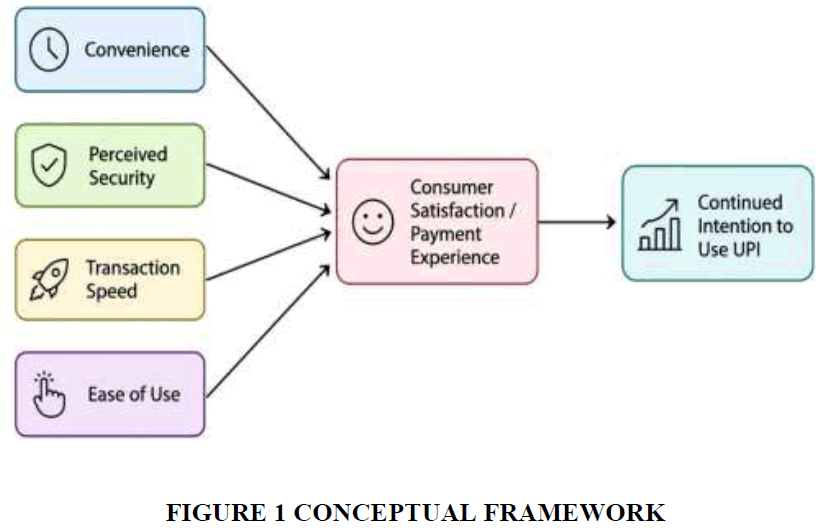
Figure 1 Conceptual Framework
Research Design
A descriptive and analytical research design is used in the study. The element of description gives a general description of the characteristics of the respondents and how they use the Upi’s. The analytical part investigates the relationships between the study variables, through reliability and correlation/regression.
Data Sources
Primary Data: A structured questionnaire was used to gather primary data from respondents who frequently use UPI for retail payments. Demographic questions and measuring variables pertaining to convenience, security, transaction speed, ease of use, customer satisfaction, and desire to continue using were included in the instrument.
Secondary Data: Academic literature, books, Reserve Bank of India (RBI) papers, National Payments Corporation of India (NPCI) publications, government publications, and other sources mentioned in the submitted manuscript were used to gather secondary data.
Sampling Design
A total of 250 survey respondents were included in this study. The pre-designed study framework had already determined that this sample size was sufficient to support the implementation of two core statistical analyses, namely correlation analysis and multiple regression analysis, with no risk of insufficient sample size.
Statistical Tools Used
This study first identified the target population for the survey, which are ordinary retail consumers who actively use the UPI payment application to purchase various goods and pay for various service fees. To efficiently locate users who consistently use UPI, the study adopted the convenience sampling method.
The research process employed a comprehensive set of statistical analysis techniques, which are listed one by one as follows: first, the demographic data of the respondents was gathered to create a basic profile; next, Cronbach's alpha was used to test the reliability of the research instrument; next, means and standard deviations were applied for descriptive analysis to sort out the basic conditions of the data; next, Pearson correlation analysis was used to clarify the associations between various research variables; finally, multiple regression analysis was used to assess the impact of the set independent variables on customer satisfaction and payment experience; and, based on the statistical significance of the regression analysis.
Measurement and Instrument Quality
The questionnaire was designed in terms of the main constructs of the study. For convenience there were four items, for security four items, for transaction speed there were three items, for ease of use there were four items, for consumer payment experience/satisfaction there were five items and for continued usage intention there were three items. Perception items can be scored on a 5-point response scale ranging from complete disagreement (1) to complete agreement (5).
Reliability and Validity
Cronbach's alpha was used to assess internal consistency. (Cronbach, 1951) defined a coefficient of more than 0.70 as acceptable. Content validity of the questionnaire was dealt with by expert validation and by checking relevant literature to see that the questionnaire was representative of the constructs being studied (Zhao et al., 2010).
Ethical Considerations
Participation was voluntary and respondents were informed about the purpose of the study. The reported methodology states that respondents were anonymous and confidentiality was maintained throughout the research process. The collected information was used only for academic purposes.
Results and Discussion
Reported analysis includes characteristics of respondents, reliability of measurement scales, description of data, correlation analysis, multiple regression and hypothesis testing. The results below cited are kept from the provided manuscript, and given a new interpretation focusing on consumer satisfaction and the new title.
Demographic Profile of Respondents
In the table 1, shows the profile summary of the sample population. The largest age group was 26 to 35 years (38.0%), followed by 18 to 25 years (32.8%). Postgraduates represented 50.4% of the sample, while employees formed the largest occupational group at 48.8%.
| Table 1 Showing Demographic Analysis Result | |||
| Variable | Category | Frequency | Percentage (%) |
| Gender | Male | 137 | 55.2 |
| Female | 111 | 44.8 | |
| Age | 18 to 25 years | 82 | 32.8 |
| 26 to 35 years | 95 | 38 | |
| 36 to 45 years | 47 | 18.8 | |
| Above 45 years | 26 | 10.4 | |
| Education | Undergraduate | 74 | 29.6 |
| Postgraduate | 126 | 50.4 | |
| Others | 50 | 20 | |
| Occupation | Student | 58 | 23.2 |
| Employee | 122 | 48.8 | |
| Business | 46 | 18.4 | |
| Others | 24 | 9.6 | |
Reliability Analysis
As shown in the table 2, 3, The reported measurement scales have good internal consistency, as indicated by the Cronbach's alpha values ranging from 0.785 to 0.867.
| Table 2 Showing Reliability Test Results | ||
| Construct | No. of Items | Cronbach's Alpha |
| Convenience | 4 | 0.824 |
| Security | 4 | 0.801 |
| Transaction Speed | 3 | 0.785 |
| Ease of Use | 4 | 0.842 |
| Consumer Payment Experience | 5 | 0.867 |
| Continued Usage Intention | 3 | 0.816 |
Descriptive Statistics
| Table 3 Showing Descriptive Statistics Results | ||
| Variable | Mean | Std. Deviation |
| Convenience | 4.32 | 0.61 |
| Security | 4.05 | 0.69 |
| Transaction Speed | 4.41 | 0.57 |
| Ease of Use | 4.28 | 0.63 |
| Consumer Payment Experience | 4.26 | 0.59 |
| Continued Usage Intention | 4.38 | 0.55 |
Correlation Analysis
The reported correlations in table 4, shows positive and statistically significant. The Transaction speed has the strongest correlation with consumer payment experience (r = 0.736), followed by convenience (r = 0.721). These results indicate that efficient and convenient payment processes are closely associated with positive consumer evaluations.
| Table 4 Showing Correlation Output | |||||
| Variables | Convenience | Security | Transaction Speed | Ease of Use | Consumer Payment Experience |
| Convenience | 1 | ||||
| Security | 0.612** | 1 | |||
| Transaction Speed | 0.654** | 0.581** | 1 | ||
| Ease of Use | 0.673** | 0.604** | 0.621** | 1 | |
| Consumer Payment Experience | 0.721** | 0.642** | 0.736** | 0.698** | 1 |
Multiple Regression Analysis
Multiple regression analysis was reported to assess the influence of convenience, security, transaction speed and ease of use on consumer payment experience. The results are interpreted here as evidence concerning the effectiveness of UPI in shaping consumer satisfaction/payment experience (Singh, Srivastava & Sinha, 2020).
The reported model explains 70.9% of the variability in consumer payment experience (R2 = 0.709) as shown in table 5. Transaction speed is the strongest predictor (β = 0.332), followed by convenience (β = 0.287), ease of use (β = 0.251) and security (β = 0.214). All reported predictors are statistically significant at the 1% level.
| Table 5 Showing Regression Result | ||||
| Variable | Beta | t-value | p-value | |
| Convenience | 0.287 | 4.812 | 0 | |
| Security | 0.214 | 3.965 | 0 | |
| Transaction Speed | 0.332 | 5.428 | 0 | |
| Ease of Use | 0.251 | 4.376 | 0 | |
| R | R2 | Adjusted R2 | F-value | Sig. |
| 0.842 | 0.709 | 0.704 | 148.326 | 0 |
Hypothesis Testing
As shown in the table 6, all five hypotheses are reported as accepted. The results support the argument that convenience, security, transaction speed and ease of use are important determinants of positive consumer evaluations of UPI-based retail payments.
| Table 6 Showing Hypothesis Testing | ||
| Hypothesis | Statement | Result |
| H1 | Convenience positively influences consumer satisfaction/payment experience. | Accepted |
| H2 | Security positively influences consumer satisfaction/payment experience. | Accepted |
| H3 | Transaction speed positively influences consumer satisfaction/payment experience. | Accepted |
| H4 | Ease of use positively influences consumer satisfaction/payment experience. | Accepted |
| H5 | Consumer satisfaction/payment experience positively influences continued intention to use UPI. | Accepted |
Discussion of Findings
The results show that UPI holds a positive value for consumers' payment experience and satisfaction in the retail environment. The transaction speed is the most significant factor in the reported regression model, which indicates that consumers prefer smooth and fast transactions. With a speedy payment, checkout time can be cut down and can help to make the shopping experience more efficient in a retail environment.
Convenience also is a major positive influence. What consumers appreciate is easy-to-use and effortless payment options. The mobile nature and interoperability of UPI can facilitate the payment process in various e-commerce environments. User-friendliness also plays a role in satisfaction, also in the sense that easy payment interfaces will decrease the work needed to finish the transaction.
Although the regressions coefficient of perceived security is lower than the regression coefficient of speed, convenience and easy of use, perceived security has a statistically more positive effect. This result highlights the importance of trust in digital payment services. They need to know that their transactions are secure and risks are effectively managed. The results support the concept of the Technology Acceptance Model and UTAUT in general. Transaction speed and convenience are perceived usefulness while effort expectancy is ease of use. An extra security and trust dimension is important for services in financial transactions, which can be perceived.
Conclusion
Digital payment technologies are transforming the retail purchasing and payment behavior in India. The ease, speed, convenience and interoperability make UPI an important payment mechanism. The effectiveness of UPI was evaluated in the present study by analyzing the impact of convenience, security, speed to transaction and ease of use on consumer satisfaction/payment experience and continued intention to use.
The reported results show that all four factors have positive and statistically significant relationships with consumer payment experience. The best predictor is speed, meaning that speed of retail transactions is a high priority for consumers. Convenience and ease of use are also crucial, as it lowers down friction in the payment procedure. Trust increases due to security perceptions; it also improves customer satisfaction with payment services.
Overall, the data from this paper shows that upsi has an impact on customer satisfaction and retail payment process. With better services reliability, security and transaction speed customers may also feel more secure so they would use it more.
Theoretical Implications
This research extends TAM and UTAUT to the UPI-based retail payment behavior. These outcome shows that perceived usefulness, ease-of-use and other aspects of technology acceptance are important for predicting consumer’s response to a digital payment system. Also convenience, safety and speed of transactions are some of those elements that affect customers’ satisfaction
Practical Implications
According to this research. The payment service companies should continue to improve their speed of processing, reliability of services and usability of their websites. Trust of consumers may also be increased by strong security measures, identity verification processes and fraud detection mechanisms. The retail company should have an easy-to-use UPI payment feature available for customers’ convenience with a smooth transaction experience. Financial institutions and policymakers could contribute towards promoting efficient and secure use of electronic payment systems through infrastructure development, financial literacy and financial inclusion.
Limitations of the Study
There are some limitations to this research that need to be considered while interpreting its findings. A convenience sample technique was used and this may limit the Adaptability of the results to the larger demographics of users of UPI. Secondly, the number of respondents (250) may not be representative of the variety of consumers in India.
Third, the study centered on consumers without taking into account the perspectives of retail merchants. Fourth, the study does not measure changes in behavior over time. Fourth, the research reflects consumers' perceptions at one specific point in time, so it does not show changes in behavior over time. Fifth, there are some factors that could be relevant but were not included in the reported model, such as reward programs, social influence and technological infrastructure.
Future Research Directions
Future studies could use larger and more diverse sample sizes from other geographical areas in India. Comparative analysis between customers in urban and rural areas can show variance in their UPI adoption; satisfaction and confidence in digital payments. Application of UPI can also be compared to mobile wallet, debit card, credit card and Central Bank Digital Currency (CBDC) system. It may be possible to monitor change in consumer perceptions and continued use over time through longitudinal study. The study could also consider other factors like rewards, perceived value, social influence, grievance redressal, privacy, service recovery and merchant acceptance in future studies. Digital payment security and efficiency will continue to be a subject of study as emerging technologies like artificial intelligence, blockchain and biometric authentication become increasingly part of the payment landscape.
Managerial and Policy Recommendations
Based on the results as reported, the following recommendations are made:
• Speed-up transactions and avoid unnecessary delays in payments.
• Improve system reliability and be clear while providing service outages.
• Improve cybersecurity, fraud monitoring, and consumer education and awareness on safe payment practices.
• Simplify and make UPI payment interfaces user-friendly in UPI apps.
• Promote acceptance of UPI by retailers and its integration at the point of sale.
• Enhance grievance resolution systems for non-compliant and/or disputed transactions.
• Promote digital literacy and financial inclusion efforts, especially for consumers less used to digital payment technologies.
Overall Contribution of the Study
The study provides a unified view of the effectiveness of UPI in retail payments from a consumer viewpoint. It does not focus on adoption alone, but relates some key payment attributes (convenience, security, transaction speed and ease of use) to consumer satisfaction/payment experience and continued intention to use. Such a system can help managers and policy makers to determine the dimensions of services that are most strongly linked with positive consumer ratings.
Transaction speed, convenience, ease of use and security are the major empirical evidence of the reported results. The order provides an easy-to-follow plan to improve services first and then address issues with customer satisfaction, which is complicated; however, security will still be an important factor for ensuring trustworthiness of customers’ loyalty towards this product/service.
References
Agarwal, S., & Gupta, P. (2021). Adoption of digital payment systems in India: A study of consumer perceptions. International Journal of Business Innovation and Research, 25(4), 512–528.
Chawla, D., & Joshi, H. (2019). Consumer attitudes and intentions toward mobile wallet adoption in India. International Journal of Bank Marketing, 37(7), 1590–1618.
Cronbach, L. J. (1951). Coefficient alpha and the internal structure of tests. psychometrika, 16(3), 297-334.
Dahlberg, T., Guo, J., & Ondrus, J. (2015). A critical review of mobile payment research. Electronic commerce research and applications, 14(5), 265-284.
Davis, F. D. (1989). Perceived usefulness, perceived ease of use, and user acceptance of information technology. MIS quarterly, 319-340.
Indexed at, Google scholar, Cross Ref
Gupta, S., & Sharma, R. (2023). Consumer adoption of UPI-based payment systems in India. International Journal of Finance and Economics, 28(4), 4215–4228.
Kumar, A., Adlakaha, A., & Mukherjee, K. (2018). The effect of perceived security and grievance redressal on continuance intention to use M-wallets in a developing country. International Journal of Bank Marketing, 36(7), 1170-1189.
Kumar, P., & Singh, A. (2022). Digital payment satisfaction and consumer behavior in the retail sector. Journal of Retailing and Consumer Services, 67, 102981.
Liébana-Cabanillas, F., Marinković, V., Ramos de Luna, I., & Kalinić, Z. (2018). Predicting the determinants of mobile payment acceptance. Technological Forecasting and Social Change, 129, 117–130.
Mallat, N. (2007). Exploring consumer adoption of mobile payments: A qualitative study. Journal of Strategic Information Systems, 16(4), 413–424.
Mehta, V. (2024). UPI and financial inclusion: Emerging trends in India's digital payment ecosystem. Indian Journal of Commerce and Management Studies, 15(1), 45–56.
National Payments Corporation of India. (2024). UPI annual report and transaction statistics. Mumbai: NPCI.
Oliveira, T., Thomas, M., Baptista, G., & Campos, F. (2016). Mobile payment: Understanding the determinants of customer adoption and intention to recommend the technology. Computers in human behavior, 61, 404-414.
Indexed at, Google scholar, Cross Ref
Patel, R., & Joshi, N. (2023). Impact of digital payment systems on retail business performance. Asian Journal of Management Research, 14(2), 89–102.
Reserve Bank of India. (2024). Report on trends and progress of banking in India 2023–24. Mumbai: RBI.
Sharma, S. K., & Sharma, M. (2019). Examining the role of trust and quality dimensions in mobile banking adoption. International Journal of Bank Marketing, 37(2), 557–582.
Singh, N., Srivastava, S., & Sinha, N. (2020). Consumer preference and satisfaction toward digital payment platforms in India. Journal of Public Affairs, 20(4), e2133.
Venkatesh, V., Morris, M. G., Davis, G. B., & Davis, F. D. (2003). User acceptance of information technology: Toward a unified view. MIS Quarterly, 27(3), 425–478.
World Bank. (2022). Digital financial services and financial inclusion: Global developments and policy implications. Washington, DC: World Bank.
Zhao, A. L., Koenig-Lewis, N., Hanmer-Lloyd, S., & Ward, P. (2010). Adoption of internet banking services in China: Is it all about trust? International Journal of Bank Marketing, 28(1), 7–25.
Received: 01-Sep-2026, Manuscript No. AMSJ-26-17373; Editor assigned: 01-Sep-2026, PreQC No. AMSJ-26-17373(PQ); Reviewed: 15-Sep-2026, QC No. AMSJ-26-17373; Revised: 22-Sep-2026, Manuscript No. AMSJ-26-17373(R); Published: 30-Sep-2026