Research Article: 2026 Vol: 30 Issue: 2
Celebrity Endorsement Effectiveness In Packaged Food Brands: Brand Credibility As A Mediator And Consumer Skepticism as A Moderator In An Emerging Market
Jagadish Tulimelli, Vignan's Foundation for Science, Technology and Research, Guntur, India
Sarita Satpathy, Vignan's Foundation for Science, Technology and Research, Guntur, India
Ashok Kumar Samminga, Vignan's Foundation for Science, Technology and Research, Guntur, India
Citation Information: Tulimelli., J, Satpathy., S & Samminga., A.K.. (2026) Celebrity endorsement effectiveness in packaged food brands: brand credibility as a mediator and consumer skepticism as a moderator in an emerging market. Academy of Marketing Studies Journal, 30(2), 1-15.
Abstract
The willingness to pay price premium (WTPP) after satisfaction is significant for managers, marketer and customers of products and services. Based on existing literature on the impact of persuasion by credibility and effectiveness of endorsement, the study employs elaboration likelihood model to assess impact of attributes of celebrity endorsement on consumers’ willingness to pay price premium through brand credibility (BC) and moderating impact of consumer skepticism towards celebrity endorsement (CS). It has been proposed that celebrity authenticity (CA), celebrity moral credibility (CMC), the fit between celebrity and brand values (CBVC), and celebrity familiarity (CF) combine to enhance brand credibility which positively and directly influences. Data was gathered from 512 individuals. The hypothesis relationship was tested using structural equation modelling. The measurement model’s fit results are satisfactory. Specifically, there is a good fit (χ2/df = 2.41, CFI = 0.942, TLI = 0.934, RMSEA = 0.052, SRMR = 0.041) and reliable measurement (Cronbach’s α = 0.83–0.90; CR = 0.88–0.93). Furthermore, there is convergent and discriminant validity (AVE = 0.65–0.77; HTMT < 0.85). According to the structural findings, when consumer skepticism is high, β = −0.13, p. The relationship between brand carbon footprint and willingness to pay a premium weakens due to low situation-specific moral evaluation. It is observed that celebrity endorsement lowers value salience.
Keywords
Celebrity Endorsement, Celebrity–Brand Congruence, Familiarity, Brand Credibility, Willingness To Pay Premium, Consumer Skepticism, Structural Equation Modeling (SEM).
Introduction
One of the most popular marketing communications is the celebrity endorsement. Many researchers have found that celebrities improve brand outcomes, including awareness, attitudes and purchase intentions due to the transfer of their symbolic meaning and desirable traits to the endorsed brand (Chung & Cho, 2017); (Knoll & Matthes, 2017). The use of celebrities often goes along with other promotional tools. This strategy is particularly popular in consumer markets. Moreover, this popularity occurs when competition is relatively stiff. In these markets, organizations attempt to gain attention; improve credibility; enhance consumer trust and influence purchase decisions. Consumers, however, do not always react similarly to celebrity endorsers and a credible endorsement message. Consumers evaluate both the endorser and the message. Thus, it can impact the effectiveness. Consumers use brand marks and other external signals on the packaging of packaged food products to reduce the perception of risk. Accordingly, marketers often utilize the usage of celebrities in order to create a positive Corporate Social Responsibility Perceptions to Influence Consumer Behavior towards the brand.
The effectiveness of strategies of celebrity endorsement will depend upon the personality of the celebrity endorser. Consumers do not simply go by what celebrities offer. They first assess the perceived authenticity, morality and congruence of the celebrity and then evaluate the product offered. For instance, authenticity is becoming an important quality in the contemporary marketing environment. That is, audiences increasingly expect transparency and authentic self-presentation from public figures and influencers (Audrezet et al., 2020). When consumers perceive a celebrity to be honest and genuine, they are more likely to think the endorsement is honest which has a positive effect on the credibility of the endorsed brand. In other words, moral credibility is becoming an increasingly important attribute as consumers desire that celebrities and brands act as ethical responsible actors – as agents of integrity who have moral courage, especially in markets where trust and safety is part of purchase. Also, congruence refers to a match between the values of a celebrity and a brand. Research reveals that consumers evaluate the credibility of celebrity endorsed products and in turn the believability and persuasiveness of the message is more credible and persuasive when the celebrity “fits” the brand (Jun et al., 2023), (Knoll & Matthes, 2017). Celebrity familiarity is relevant, and therefore of importance. Frequent exposure and familiarity help consumers feel at ease and accept the messages. Also, it aids in brand assessment and outcomes related to purchasing.
Consumers are willing to pay a price premium (WTPP) which is an important outcome Variable in branding research. Brand equity is the degree to which consumers are willing to pay a price premium for a preferred brand over an alternative due to its perceived value, trust and quality assurance. The packaged food categories are considered as suitable candidates for behaviour of purchase intending and behaviour of WTPP as lot of product differentiation is usually not possible for food types on packages and brands basically compete on perceived quality and credibility basis. How some brand-related psychological constructs like brand experience (Dwivedi et al., 2018) and perceived uniqueness (Dwivedi et al., 2018) increase consumers’ willingness to pay premium prices for the mechanisms of brand credibility has been demonstrated by studies. Brand credibility is the degree to which consumers perceive a claim, statement or brand to be credible, trustworthy, reliable and capable of delivering its promise. When it comes to endorsement cases, credibility acts as a central route by which celebrity cues will yield any effect. Numerous studies established a strong relationship between endorser credibility and brand credibility, and therefore a joint impact of endorsement credibility and brand credibilities on purchase intention and consumer behaviour (Atta et al., 2024),(Singh & Banerjee, 2021). Nevertheless, it is still needed to understand how specific.
In addition, marketers face the uphill task of persuading consumers because today, consumers are more skeptical of various appealing marketing strategies including celebrities’ endorsements (Amawate & Deb, 2021);(Kang, 2020). As a result, skepticism refers to the doubt and resistance towards the marketers’ arguments. It includes doubts regarding endorser’s/marketer’s underlying motive. Further, it affects the effectiveness of persuasive communication. According to a research paper, SR comes up due to various reasons, but it always makes the endorsements/ marketing schemes less powerful, irrespective of the endorser or the brand looking credible on face value (Amawate & Deb, 2021). When it comes to influencer marketing, the skepticism of consumers coming up with the question about whether the particular influencer is actually using the advertised products or not is a form of commercial intent skepticism that is increasingly being seen. According to (Ki et al., 2023), due to influencer marketing in social media platforms for celebrity endorsements; the rise of skepticism can further dilute the effectiveness of endorsement on brand choice.
The current saturation of celebrity endorsements along with a gap in understanding the mechanism of creation of consumers’ willingness-to-pay a price premium through endorsements require a conceptual framework which can include various constructs pertaining an endorsement. According to prior literature on the topic, the study developed a framework that considers celebrity authenticity, celebrity moral credibility, celebrity–brand goodness of fit and celebrity familiarity as dimensions of endorsements credibility. The article also examines how brands consciously endorse their credibility, which directly influences their consumers’ willingness to pay a price premium. In addition, the conceptual framework attempts to incorporate the mediation of brand credibility and moderation of consumer skepticism in the credibility-premium nexus. Hence, the present article will develop a model for the advertisement which will combine all three dimensions of endorsement.
Literature Review
Celebrity Endorsement in Contemporary Marketing
One of the most popular ways to promote goods and services across the globe is celebrity endorsement. The celebrity’s fame, good looks, skill set and socio-cultural meaning to the marketer are used; in turn, the brand uses the image and social influence of the celebrity. As such, celebrity endorsements are distinct from advertising because they have a character from the real world as the symbolic carrier of meaning of the brand. Consequently, from this premise, we obtain a reasonably robust framework for the impact of celebrity endorsers on marketing outcomes. Many researchers have done much research on celebrity endorsement and have argued that the use of celebrity endorsement can produce positive outcomes regarding brand attitude, purchase intention, eWOM, etc. (Knoll & Matthes, 2017); (Chung & Cho, 2017). As social media websites are really playing an important role in the everyday life of consumers, the influence of celebrities has increased. Today’s consumers are not just.
People nowadays find it much easier to disbelieve celebrities. Consumers doubt the effectiveness of the celebrity endorsement. The endorsement is then submitted to an evaluation status whereby it will be checked for it compatibility and validity with the image and values of the brand. Research indicates that celebrity endorsement might not guarantee success. Instead, it may rely on the consumers’ assessment of whether or not the endorsement is a legitimate or plausible attempt by the brand to promote the product (Jun et al., 2023). Celebrity endorsement strategies are actually effective but depend on contextual factors like product categories. Consumer involvement, skepticism integrated, 2020. Thus, we need to understand the celebrity attributes driving brand outcomes. This will explain how these endorsements enhance consumers’ willingness to pay premium prices for high-quality products that include celebrity endorsements.
Celebrity Endorsement Attributes and Consumer Evaluation
Celebrity Authenticity
Using authentic endorsement is an essential element of modern marketing. The degree to which a consumer perceives a celebrity or influencer to be true to its own self or identity is called Authenticity. Furthermore, many studies look at the authenticity credentials of the celebrity (Audrezet et al., 2020) Audrezet and his collaborators say authenticity has arguably become a key determinant of the success of digital endorsements. This is due to the exposure of consumers to highly crafted promotional content. To illustrate, there are claims that ‘authenticity’ is always ‘at risk’ in influencer and celebrity marketing, that is, consumers can see it as an exercise in strategic self-presentation rather than a genuine endorsement of the product. So, consumers consider genuine endorser as being less motivated by business interests and more credible and so authenticity plays an important role in credibility formation. Authors (Ki et al., 2023) emphasized the importance of gaining trust and lowering distrust of consumers through transparency and authenticity cues to convince their audiences in influencer marketing settings. Furthermore, authenticity may play a greater role in the branding of packaged foods as consumers may seek reassurance regarding the product’s quality, safety, and reliability. H1 is justified in the sense that celebrity authenticity will enhance brand effectiveness.
Celebrity Moral Credibility
Moral credibility has been defined as consumers' perception of the ethical integrity, responsibility and moral standing of the celebrity. More and more consumers in many markets are judging brands and endorsers on the grounds of ethical expectations, social responsibility and perceived honesty. This moral credibility may be especially relevant in product categories linked with health and consumption like packaged food. If consumers notice that the celebrity selected by the brand seems real and competent, it enhances their trust in the brand and the likelihood that they will purchase the brand’s product. According to studies (Hossain et al., 2025) celebrity credibility factors, such as attractiveness, and influence may have an impact on trustworthiness and quality, which serve as important criteria for consumer evaluation. Similarly, the research by (Singh & Banerjee, 2021) indicates that celebrity credibility has a positive effect on brand outcomes through the mediating effect of brand credibility. According to these findings, moral credibility is an important dimension of credibility transfer and hence the logic of the mediating role strengthens. Moral endorsers increase the credibility of the brand and motivate consumers to have faith in it and the brand. Celebrity moral credibility is aligned with these claims.
Celebrity–Brand Value Congruence
The concept of celebrity-brand value congruence examines how well the celebrity’s values, and lifestyles align with the brand’s values in the eyes of consumers (Jun et al., 2023). For a long time, congruence has been considered an important factor in endorsement effectiveness because consumers perceive the endorsement as more credible when the celebrity “fits” with the brand. According to Jun et al., 2023, celebrity endorsements work best when they enhance a brand's powerful associations. A match occurs when the endorser and brand have a clear fit in image, attitude and values. The meta-analysis by (Knoll & Matthes, 2017) also evidences endorsement effectiveness under match-up conditions that experts refer to. When there is a high level of congruence, we find the endorsement to be more natural and believable. This ultimately results in questioning the commercial motive and endorser’s credibility. The value congruence of a packaged food brand assures the consumer that the brand endorses the same health, lifestyle or quality beliefs as the celebrity, thereby increasing the confidence of the consumer in the brand. Therefore, celebrity endorsement can lead to better brand credibility for many brands.
Celebrity Familiarity
Familiarity refers to the extent to which the consumer recognizes and feels comfortable with the endorser. Parasocial interaction and perceived credibility of digital endorsers influence consumer purchase intentions (Sokolova & Kefi, 2020). Familiarity can enhance the effectiveness of a person’s endorsement because repeated exposure creates recognition, cognitive ease, and perceived closeness. Being familiarized can make consumers react stronger. It can strengthen the perceived relationship and trust of a consumer. According to (Chung & Cho, 2017), the existence of parasocial relationships may increase endorsement impact due to a sense of familiarity and intimacy. The same could be true that familiarity is not adequate to develop credibility in case authenticity and congruence attributes develops lack of it. Nevertheless, it is assumed that acquaintance positively affects a brand’s credentials (H4). Because the endorser is known, they may lessen risk and heighten acceptance of brand claims.
Brand Credibility as a Key Mechanism in Endorsement Outcomes
Brand credibility refers to the degree to which consumers perceive that a brand is trustworthy. It also refers to the extent to which they believe that the brand is reliable and is capable of delivering the benefits that it promises. Consumer decision making has been highly affected through the credibility of information. Brand credibility plays a central role in categories of packaged food, recent study suggests. This is a product category where consumers often rely on brand power and reputation to measure quality. Furthermore, credibility of a brand is a cognitive mechanism which helps.
Studies show that brand credibility is very crucial for marketers. According to an article by (Dwivedi et al., 2018), brand credibility plays a mediating role in brand experience on willingness to pay. This indicates that consumer perception, i.e., brand experience, conveys their willingness to pay through brand credibility. Likewise, (Singh & Banerjee, 2021) states that brand credibility mediates the effect of celebrity credibility on brand equity and customer relationship. The credibility of an endorser has a major impact on brand credibility and consumer purchase intentions (Atta et al., 2024). Besides, their research shows that endorser credibility enhances consumer purchase intentions through brand credibility mechanisms. The outcomes indicate the importance of brand credibility as an intervening variable to convert credible celebrity endorsement characteristics into consumer outcomes. As a result, the brand was studied today.
Willingness to Pay Premium (WTPP) as a Strategic Consumer Outcome
Willingness to pay premium price (WTPP) means consumers’ readiness to pay premium price for branded product or service. Consumers’ general indication refers to the overall qualitative assessment of a commodity or service. In addition, it can also be associated with different beliefs, feelings and association that could be send to its audience. WTPP is specially of utmost importance in packaged foods, the most competitive market where thousands of brands compete.
In their study, (Dwivedi et al., 2018) discover that credibility and perceived uniqueness enhance consumers’ conviction that the brand offers superior quality, ultimately leading to a higher premium WTP. In addition, celebrity endorsement has an impact on the willingness to pay a premium price in the realm of green skincare (Al Mamun et al., 2023). Based on this finding, we can say for the different product endorsement attribute can influence WTPP for premium pricing outcome. The reasoning here is quite clear - celebrity endorsement can enhance consumer credibility. The study by (Vidyanata et al., 2018) also indicates that the brand credibility mediates endorsement effects on purchase intention such that processes based on credibility affect the brands’ willingness to pay. Consequently, it is predicted that brand credibility has a positive effect on WTPP (H5), as well as mediating the impact of the celebrity attribute on WTPP (H6-H9)
Brand Credibility as a Mediator (H6–H9)
According to the theory of credibility transfer, an endorser’s credibility can transfer to a brand and then to consumer outcomes. In simpler terms, celebrity endorsement attributes serve as cues that aid in building brand credibility, which in turn affects consumer outcomes. The above mechanism thus highly supports the mediating role of brand credibility. According to (Singh & Banerjee, 2021), the credibility of a brand has the power to moderate the influence of the celebrity’s credibility on brand equity and customer relationships. The paper, (Dwivedi et al., 2018) , illustrates that brand credibility does mediate the relationships of the premium willingness confirming that credibility is very much linked to the WTP outcomes.
In the same way, (Atta et al., 2024) view credibility of the brand to be an important explanation factor of purchase intention when credibility of the endorser exists. This adds further validation to the idea that WTPP occurs through brand credibility via celebrity authenticity, moral credibility, congruence and familiarity. In light of this, this study suggests that brand credibility mediates the relationships between each attribute and WTPP (H6–H9).
Consumer Skepticism as a Moderator in Celebrity Endorsement Contexts
Consumer skepticism is defined as the consumers who doubt the veracity of advertising claims and question the motives behind communicating marketing communications. Very little sales and marketing psychologists and managers of strategy have got concern about the skepticism of buyers in today’s marketing environments. Whereas, this goes beyond to just persuasion knowledge of buyer in relation to tactic of marketers. It involves paid endorsement claims.(Kang, 2020) discusses how ad skepticism affects the brand attitude change in celebrity endorsing advertising in New Zealand.
As per (Amawate & Deb, 2021), consumer skepticism arguably influences reactions in the context of cause-related marketing and further their attitude and conduct. You can take it as sceptics which play major role. (Nguyen et al., 2023) provide a detailed and useful overview of doubts about corporate social responsibility, including its key dimensions and measurement methods, and its links to reduced consumer trust.
Influencers and celebrities are used in marketing messages these days to a very large extent, which is making the consumers more skeptical in this era. Brands can close the trust gap in influencer marketing, according to (Ki et al., 2023) They point out that two things happen to bring this about; trust sustaining and distrust reducing. (Audrezet et al., 2020) further claim that it is the threats to authenticity posed by consumers that is most risky with skepticism. Thus, consumers in this situation become more skeptical. Consequently, they ask whether the endorsement is authentic or simply fake. As a result, we expect skepticism to negatively affect the association of brand credibility with willingness to pay premium. A consumer may still be skeptical even when the brand has credibility.
Celebrity Endorsement and Packaged Food Context
The packaged food sector is an appropriate context for studying the effectiveness of endorsement. A person eats a food product under its quality, trust, and social influence. (Calvo-Porral et al., 2021) celebrity endorsing a particular food product influences consumption of that individual Celebrity effects are relevant for food decision-making according to this. Also, a celebrity presence in your food post can influence eating intentions and engagement, further established the (Sajjad & Pasha, 2025). It reveals the significance of celebrity cues in food.
A prominent food marketing trend appears to be guided by the endorsement of celebrity branded food and beverages. According to (Zhou et al., 2019), these marketing campaigns are extensively used, and the celebrities brand endorsed products are the major players. (Turnwald et al., 2022) analyses how endorsements impact attitudes towards food products. They specifically examined the nutritional quality of foods promoted on celebrities’ social media profiles. The two findings further support the importance of investigating celebrity endorsements in a food marketing context and support the investigation of endorsement attributes’ role in willingness to pay for luxury.
Research Gap
All things considered; the foregoing research suggests that celebrity endorsements impact consumers’ responses through credibility-related processes. However, knowledge of the translation of specific endorsement attributes to premium price outcomes in a packaged food setting is limited. Research success has long relied on measurement of key phenomena like credibility, brand experience and purchase intentions (Dwivedi et al., 2018); (Singh & Banerjee, 2021), (Atta et al., 2024). The former study has used only source credibility as an attribute. It is clear from the previous study that examining multiple attributes can yield concrete results. However, fewer studies employ multiple celebrity attributes and test WTPP as a key economic outcome together with skepticism as a boundary condition.
Thus, the present study contributes to celebrity marketing literature by developing and testing an integrated model where celebrity authenticity, moral credibility, value congruence and familiarity predict brand credibility which drives willingness to pay premium whereas consumer skepticism moderates the credibility–premium relationship. The framework could help us understand how celebrity endorsements create economic value for packaged foods brands under different levels of consumer skepticism better.
Objectives of the Study
1. To examine how celebrity endorsement attributes influence consumer’s willingness to pay a price premium through the mediating role of brand credibility and the moderating effect of consumer skepticism.
2. To examine the impact of celebrity endorsement attributes – namely celebrity authenticity, moral credibility, celebrity brand value congruence, and celebrity familiarity on brand credibility.
3. To investigate the effect of brand credibility on consumer’s willingness to pay a price premium.
4. To examine the mediation role of brand credibility in the relationship between celebrity endorsement attributes and consumer’s willingness to pay a price premium.
5. To analyze the moderating effect of consumer skepticism toward celebrity endorsements on the relationship between brand credibility and consumers’ willingness to pay a price premium Figure 1.
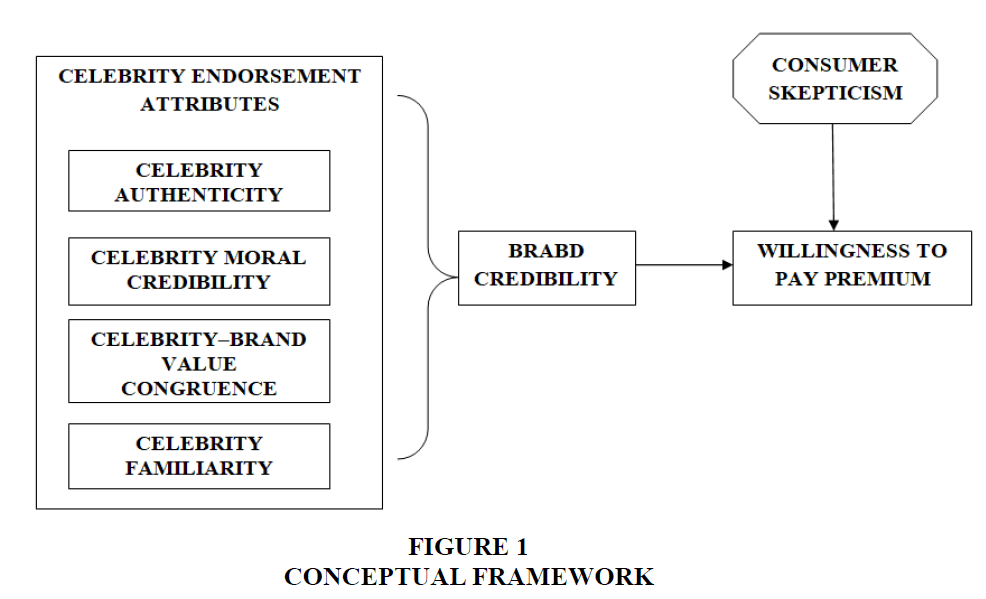
Figure 1 Conceptual Framework
Hypothesis of the study
H1: celebrity authenticity has a significant positive effect on brand creditability.
H2: celebrity moral credibility has a significant positive effect on brand credibility.
H3: Celebrity brand value congruence has a significant positive effect on brand credibility.
H4: Celebrity familiarity has a significant positive effect on brand credibility.
H5: Brand credibility has a significant positive effect on consumer’s willingness to pay price premium.
H6: Brand credibility mediates the relationship between celebrity authenticity and willingness to pay a price premium.
H7: Brand credibility mediates the relationship between celebrity moral credibility and willingness to pay a price premium.
H8: Brand credibility mediates the relationship between celebrity brand value congruence and willingness to pay a price premium.
H9: Brand credibility mediates the relationship between celebrity familiarity and willingness to pay a price premium.
H10: Consumer skepticism toward celebrity endorsements moderates the relationship between brand credibility and willingness to pay a price premium, such that relationship is weaker when consumer skepticism is high.
Methodology
Research Design
This research utilized cross-sectional research design. The nature of the study was quantitative. The conceptual framework was tested using Structural Equation Modeling (SEM). A conceptual framework incorporates direct effects that establish connections between variables. We will also test mediation effects through the mechanism of brand credibility. The consumer skepticism will be subjected to moderation effects testing. Consumers hope to pay a price premium for packages food brands.
Sampling and Data Collection
The researchers used digital modes such as emails and social media channels to approach the participants. This approach to collecting data helped to gather greater response from a diversified target population. The sampling technique used non-probability sampling approach (convenience sampling) due to accessibility and time bound factors. A Comprehensive Review of Consumer Behavior Studies: The Impact of Sample Selection and Experimental Design shows the majority of consumer behaviour studies use non-probability sampling. The consumer has already been aware about celebrity endorsement in a packaged food product and branded packaged food.
The final analysis included a total of 512 valid responses obtained from the survey. The sample is considered sufficiently large for the SEM, which gives it adequate power for parameter estimation and stability in complicated models. All incomplete responses and unqualified survey participants were eliminated via simple screening, based on responses given on awareness, the fame of the celebrity endorser and use (by self/anyone/someone) of the packaged food brand.
Measurement of Constructs
All constructs were assessed using multi-item scales that were adapted from prior research that was proven and were re-formed according to the context of packaged food branding. The questionnaire items were measured on a five-point Likert scale from 1 (“Strongly disagree”) to 5 (“Strongly agree”). The study made use of the following constructs.
• Celebrity Authenticity (CA): measured consumers’ perceptions of the endorser’s genuineness, sincerity, and realness.
• Celebrity Moral Credibility (CMC): assessed the celebrity’s ethical image, integrity, and moral trustworthiness.
• Celebrity–Brand Value Congruence (CBVC): captured the perceived alignment between the celebrity’s values and the brand’s values.
• Celebrity Familiarity (CF): measured the level of recognition, awareness, and comfort consumers felt toward the celebrity.
• Brand Credibility (BC): measured consumers’ belief that the brand is trustworthy, reliable, and capable of delivering promised quality.
• Willingness to Pay Premium (WTPP): assessed consumers’ readiness to pay a higher price for the endorsed packaged food brand.
• Consumer Skepticism (CS): measured consumers’ doubt and resistance toward celebrity endorsements and advertising claims.
Data Analysis Procedure and SEM Steps
The analysis was done in a stepwise SEM approach. In an investigation first part screening was carried on to check for missing values and response consistency and data suitability for multivariate analysis. The CFA was analyzed on the measurement model. The retained items were confirmed with the factor loadings above 0.70 which is acceptable. The measures’ reliability and validity were assessed using Cronbach’s alpha, CR and AVE. Using HTMT criteria, assessment of discriminant validity was done.
To test the hypothesized direct relationships H1–H5, the researcher applied the structural model. In addition, the model fit indices indicated an overall model adequate (i.e., χ2/ df, CFI, TLI, RMSEA, and SRMR). Fourth, we tested the mediation analyses of WTPP using bootstrapping (H6–H9). Bootstrapping procedures led to 5000 resamples with bias-corrected confidence intervals. The fifth test was test moderation analysis (H10) by generating an interaction term (BC CS). The interaction term in question was employed to assess whether consumer skepticism.
Discussion
This study examines consumers’ willingness to pay a price premium (WTPP) for packaged food brands bearing endorsements by a celebrity. An exploration of the effect of characteristics of celebrity endorsement on the WTPP through brand credibility (BC) mechanism. Also, the study looked at consumer skepticism toward celebrity endorsements (CS) as a boundary condition. The research employed a solid sample of 512 respondents and examination via full-SEM approach. The findings strongly confirm the conceptual framework and present important theoretical and managerial implications regarding the efficacy of celebrity endorsement in emerging market and packaged food contexts.
Validation of the Measurement Model
According to the CFA fit indices, the measurement model fits quite well (χ2/df = 2.41, CFI = 0.942, TLI = 0.934, RMSEA = 0.052, SRMR = 0.041). The measurement model of each scale showed satisfactory psychometric quality for subsequent structural interpretation. All constructs had better levels than the recommended ones, signaling reliability and convergent validity (Cronbach’s α = 0.83 – 0.90; CR = 0.88 – 0.93; AVE = 0.65 – 0.77). In addition, none of the value exceeded 0.85 confirming that the metrics measure distinct conceptual domains thus establishing discriminant validity. The way celebrity authenticity, moral credibility, celebrity-brand value congruence, familiarity, brand credibility, skepticism and WTPP operationalized are correct form the statistical point of view allowing one to test the relationships in the conceptual model Table 1.
| Table 1 Model Fit Indices (CFA) | ||
| Fit Index | Recommended Cut-off | Obtained Value |
| χ2/df | < 3.00 | 2.41 |
| CFI | ≥ 0.90 | 0.942 |
| TLI | ≥ 0.90 | 0.934 |
| RMSEA | ≤ 0.08 | 0.052 |
| SRMR | ≤ 0.08 | 0.041 |
Celebrity Endorsement Attributes as Drivers of Brand Credibility (H1–H4)
The study's results showed that every attribute of celebrity endorsement enhances brand credibility significantly. The authenticity of ‘celebrity’ has a significant positive effect on brand credibility (β = 0.21, p < 0.001) Consumers are likely to buy into brands if the celebrity endorsing the brand generates an impression of being real. In the sphere of packaged food, where quality check gets possible only after purchase, authenticity minimizes risk and enhances brand credibility. Similarly, the effect of celebrity moral credibility on brand credibility (β = 0.26, p < 0.001) was significant and thus H2 was supported. customers pay attention not just to what the celebrity officially endorses but also to the endorser’s ethical and moral stature. A person of integrity with social responsibility can be perceived as a morally credible endorser and the same can transfer to the brand. Safety, trust and responsibility are must in given the food category. Consumers may not prioritize this factor in the product but rather do so Table 2.
| Table 2 Reliability and Convergent Validity | |||
| Construct | Cronbach’s α | Composite Reliability (CR) | AVE |
| CA | 0.85 | 0.89 | 0.66 |
| CMC | 0.87 | 0.91 | 0.71 |
| CBVC | 0.86 | 0.90 | 0.68 |
| CF | 0.84 | 0.89 | 0.66 |
| BC | 0.90 | 0.93 | 0.77 |
| WTPP | 0.85 | 0.89 | 0.67 |
| CS | 0.83 | 0.88 | 0.65 |
The most potent predictor of brand credibility was the celebrity–brand value congruence (β = 0.33, p < 0.001), thus H3 is confirmed. The perceived values of a celebrity and that of the brand should be aligned. Consequently, this result generates strong support for the congruence-based arguments, such as the match-up hypothesis that an endorsement will be more effective when consumers perceive a natural fit endorser and brand. Consumers assume a congruent endorsement to be more authentic and less pushed for commercial reasons which enhances credibility further. According to the analysis, it was determined that celebrity familiarization has a positive effect on brand credibility (β = 0.17, p < 0.001) which supports H4. Although the weakest celebrity quality, it is still a quality nonetheless. When people become familiar with something, it makes processing that item easier but also a lot more comfortable. This allows the audience to accept the endorser’s message easily. But because the size is comparatively smaller, it is suggested that mere recognition may not be enough unless authenticity, moral credibility and congruence are also present. The results, overall, show that brand credibility relates to a wide variety of celebrity-based cues though the audience appears to attach more importance to psychological evaluations like value congruence Table 3.
| Table 3 Direct Effects (Hypothesis Testing) | ||||
| Path | Std. β | S.E. | t / CR | p-value |
| H1: CA → BC | 0.21 | 0.04 | 5.25 | <0.001 |
| H2: CMC → BC | 0.26 | 0.04 | 6.41 | <0.001 |
| H3: CBVC → BC | 0.33 | 0.05 | 7.12 | <0.001 |
| H4: CF → BC | 0.17 | 0.04 | 4.18 | <0.001 |
| H5: BC → WTPP | 0.44 | 0.05 | 8.91 | <0.001 |
Brand Credibility as a Predictor of Willingness to Pay Premium (H5)
According to the findings of the structural model, brand credibility has a positive effect on the willingness to pay a premium (β = 0.44, p < 0.001). Thus, H5 is supported. The relationship is not only statistically significant but managerially significant which indicates that credibility is an important mechanism which is associated with brands to charge a premium price of packaged food products. When consumers have faith in the brand’s experience and trustworthiness, they perceive an extra asset of buying premium priced products. Consequently, the reasoning behind value-based pricing can substantiate the impact of credibility on the readiness to pay premium pricing. Because credibility is a quality-related construct, it leads the consumers to view the branded packaged foods as possessing higher quality and hence accept premium pricing.
The model contributes 62% of the variance in brand credibility (r2 = 0.62) and 48% of the variance in WTPP (r2 = 0.48) and further corroborates the results. Celebrity endorsement attributes have a substantial impact on credibility, which in turn shapes the consumers' willingness to pay premium price.
The Mediating Role of Brand Credibility (H6–H9)
Research shows that the credibility of brand mediates relationship between attributes of endorsement and willingness to pay premium. The research analyzed several indirect effects which resulted in all the indirect effects being significantly different from zero. The attributes of the bootstrapped confidence interval excluded zero. Consequently, H6 H9 supports the hypotheses Table 4.
| Table 4 Indirect Effects (Mediation Results) | ||||
| Mediation Path | Indirect Effect (β) | Boot SE | 95% CI (LL, UL) | p-value |
| H6: CA → BC → WTPP | 0.092 | 0.021 | (0.054, 0.137) | <0.001 |
| H7: CMC → BC → WTPP | 0.114 | 0.024 | (0.071, 0.164) | <0.001 |
| H8: CBVC → BC → WTPP | 0.145 | 0.028 | (0.095, 0.202) | <0.001 |
| H9: CF → BC → WTPP | 0.075 | 0.019 | (0.041, 0.116) | <0.001 |
The indirect β of celebrity–brand value congruence (0.145, p < 0.001) possessed the highest mediation effect size, followed closely by celebrity moral credibility (0.114, p < 0.001), then celebrity authenticity (0.092, p < 0.001), and lastly celebrity familiarity (0.075, p < 0.001). Ordering indicates that congruence and moral credibility may influence credibility-based premium price outcomes in specific ways. This set of findings contributes to endorsement literature by showing that the domain of effectiveness of celebrity endorsement is not limited to brand awareness or attitude formation. It can manifest other economic outcomes as well. According to mediation, consumer responses to celebrity’s traits are impacting the inferences about brand credibility dimensions that amplify the willingness to pay. Consequently, consumer treated celebrity endorser as an information signal is a reasonable conclusion.
Consumer Skepticism as a Moderator (H10)
The identification of consumer skepticism as a key boundary condition is one of the main contributions of this research. The findings regarding moderation corroborate H10, where the positive link of brand credibility with willingness to pay premium is significantly weakened by consumer skepticism (BC×CS → WTPP: β = −0.13, p < 0.001). Those results imply that even when the brand was perceived as credible, the skeptic customers were discounting credibility cues based on endorsement and thus, still resists paying higher price Table 5.
| Table 5 Moderation (Interaction Effect) | ||||
| Path | Std. β | S.E. | t / CR | p-value |
| BC → WTPP | 0.41 | 0.05 | 8.21 | <0.001 |
| CS → WTPP | -0.19 | 0.04 | -4.62 | <0.001 |
| BC×CS → WTPP | -0.13 | 0.03 | -3.94 | <0.001 |
The conditional effects elucidate this relationship further. At low skepticism levels, credibility has a strong effect on WTPP (β = 0.52, p < 0.001). The effects remain significant with average levels of skepticism (β = 0.41, p < 0.001), while high levels of skepticism reduce the size of the effect (β = 0.29, p = 0.002). To put it differently, a positive translation of credibility is undermined by scepticism Table 6.
| Table 6 Conditional Effects | ||
| Consumer Skepticism Level | Effect of BC → WTPP | p-value |
| Low CS (-1 SD) | 0.52 | <0.001 |
| Mean CS | 0.41 | <0.001 |
| High CS (+1 SD) | 0.29 | 0.002 |
People nowadays are more likely to see through a paid endorsement or influencer because their marketing and promotional tactics are known. With increasing skepticism, consumers may begin to view endorsements as much less informative and more commercial in nature. That is, consumers will discount what they hear and hence brands, however credible they may be will not benefit from premium pricing when consumer skepticism is high.
Conclusion
The main aim of this study is to investigate the influence of main celebrity endorsement variables on consumers’ willingness to pay a premium for packaged food brands through Brand Credibility as a mediator and Consumer Skepticism towards celebrity endorsement as a moderator. We used a sample of 512 respondents. Structural equation modelling helped analyses data. The findings substantiate previous predictions of the model. Furthermore, they serve as validation of credibility-based pathways, which are significant in an endorsement-based brand context for premium price outcomes.
The results indicate that it is the perception of celebrity as authentic, morally credible, value congruent and familiar and not simply celebrity visibility or popularity which drives celebrity endorsement effectiveness. In particular, all four celebrity attributes have a significant positive impact on brand credibility. Thus, they support the Hypotheses (H1-H4). Of the four celebrity predictors, the strongest driver of brand credibility was celebrity–brand value congruence followed by celebrity moral credibility, celebrity authenticity and celebrity familiarity. This indicates that an endorser merely being known is not adequate to be effective in the context of food purchase. When judging the credibility of packaged food brands, consumers take a lot of notice of consistency and ethical credibility. Results of this study confirm that marketers need a proper match between the endorser and the brand to communicate appropriate trust-relevant signals that the consumers can use to evaluate the brand and rely on to make purchase decisions. Brand credibility was also a significant driver of premium payment (0.226), lending support to H5. According to the strong positive link between BC and WTPP, we can conclude that credibility is not just a psychological asset but a brand outcome with a price tag. To put it differently, if a packaged food brand projects sincerity, consumers will be prepared to pay a premium for it. In consumer products markets, where products are difficult to differentiate, BC is perhaps the most important driver of WTPP, as it helps in building trust, perceived reliability and confidence in brand claims. Willingness to pay a premium is important for the packaged food brands and brand credibility is a strong determinant of WTPP.
The prediction made by H6-H9 is a mediation mechanism that has through this mediation a number of important effects through the mediator. The analysis of the mediation probe indicated that mediation was indeed present for the influences of endorsement characteristics and WTPP through all the indirect impacts (H6–H9). The suggestion indicates that celebrity authenticity, moral credibility, value congruence and familiarity influence WTPP indirectly through brand credibility rather than directly impacting WTPP. In addition, it indicates that authenticity, moral credibility, value congruence and familiarity of celebrity raise WTPP of consumers as a result of raise in credibility of the endorsing brand. In particular, the mediation result was highest for celebrity–brand value congruence as compared to other paths. In simpler terms, a “match” between the endorser and the endorsed brand builds credibility which transfers endorsement effectiveness to the finding pitch premium. In general, the outcomes show the way in which celebrity endorsement influence economic shopper response and underlines that credibility is an important factor.
Another important contribution is the reaffirmation of the moderating effect of consumer skepticism toward celebrity endorsements. As shown by Table 3, the interaction term effect (between brand credibility and skepticism on WTPP) is negative and significant. We can say that H10 gets support. Even when consumers view the brand as credible, the credibility-premium relationship weakens as consumer skepticism of celebrity endorsement increases. Moreover, the conditional impacts exhibit that brand credibility’s conditional effect on WTPP with low skepticism is positive & significant, as seen in Table 3. By contrast, this effect is significantly weaker but still significant under moderate skepticism. Ultimately, this conditional effect becomes non-significant when skepticism is high. In combination, these findings represent a new reality in the modern ie, consumers are aware endorsements are paid for and they often question or don’t believe it. The skepticism represents a counter-reaction (or opposition) to activation of persuasion knowledge and limits credibility to be at a premium advantage. In this case, this is celebrity endorsement. Thus, the implication of the finding is that only credibility.
The findings seem to suggest that the celebrity endorsers attribute brand credibility which in turn influences willingness to pay a premium price while skepticism negatively moderates this mediation. The brand credibility of the model published in this paper explains 61.3% of the variance. Plus, the premium price willingness of consumers explains 69.5% of the variance. Statistical analyses show that the entire structural model constructs possess excellent explanatory and predictive relevance. From the academic perspective, it has made it possible for academician to go for direct, mediation, moderation effects from a model which is established and validated. According to a practitioner point of view, it enables managers to there are certain dos and don’ts under the issues of selection of a celebrity endorser, strengthening the brand credibility, and reducing the skepticism of better premium price willingness. In other words, the study offers academician and manager useful theoretical and practical implications for a deep understanding of celebrity endorser.
Future scope of the study
1. Extend to other product categories (Luxury, services, electronics, Healthcare, etc.) to test whether the relationships remain consistent beyond packaged food brands.
2. Conduct cross cultural and regional studies to compare how consumers in different countries/markets perceive celebrity credibility, brand credibility, and skepticism.
3. Add more mediators and moderators such as perceived quality, brand trust, perceived value, involvement, price sensitivity and advertising literacy for a deeper model.
4. Compare different endorser types (Celebrities vs, Influencers vs. experts) and study the impact of digital/social media endorsement factors like disclosure and engagement.
5. Use advanced research designs such as longitudinal/ experimental studies and include negative events (celebrity scandals) to understand credibility changes over time and risk effects.
References
Amawate, V., & Deb, M. (2021). Antecedents and consequences of consumer skepticism toward cause-related marketing: Gender as moderator and attitude as mediator. Journal of Marketing Communications, 27(1), 31-52.
Indexed at, Google Scholar, Cross Ref
Atta, H., Ahmad, N., Tabash, M. I., Al Omari, M. A., & Elsantil, Y. (2024). The influence of endorser credibility and brand credibility on consumer purchase intentions: Exploring mediating mechanisms in the local apparel sector. Cogent Business & Management, 11(1), 2351119.
Indexed at, Google Scholar, Cross Ref
Audrezet, A., De Kerviler, G., & Moulard, J. G. (2020). Authenticity under threat: When social media influencers need to go beyond self-presentation. Journal of business research, 117, 557-569.
Indexed at, Google Scholar, Cross Ref
Calvo-Porral, C., Rivaroli, S., & Orosa-González, J. (2021). The influence of celebrity endorsement on food consumption behavior. Foods, 10(9), 2224.
Indexed at, Google Scholar, Cross Ref
Chung, S., & Cho, H. (2017). Fostering parasocial relationships with celebrities on social media: Implications for celebrity endorsement. Psychology & marketing, 34(4), 481-495.
Indexed at, Google Scholar, Cross Ref
Dwivedi, A., Nayeem, T., & Murshed, F. (2018). Brand experience and consumers’ willingness-to-pay (WTP) a price premium: Mediating role of brand credibility and perceived uniqueness. Journal of Retailing and Consumer Services, 44, 100-107.
Indexed at, Google Scholar, Cross Ref
Hossain, M. S., Islam, T., Babu, M. A., Moon, M., Mim, M., Alam, M. T. U., ... & Akter, M. M. (2025). The influence of celebrity credibility, attractiveness, and social media influence on trustworthiness, perceived quality, and purchase intention for natural beauty care products. Cleaner and Responsible Consumption, 17, 100277.
Indexed at, Google Scholar, Cross Ref
Jun, M., Han, J., Zhou, Z., & Eisingerich, A. B. (2023). When is celebrity endorsement effective? Exploring the role of celebrity endorsers in enhancing key brand associations. Journal of Business Research, 164, 113951.
Indexed at, Google Scholar, Cross Ref
Kang, J. (2020). The effect of ad skepticism and celebrity preference on brand attitude change in celebrity‐endorsed advertising. Japanese Psychological Research, 62(1), 26-38.
Indexed at, Google Scholar, Cross Ref
Ki, C. W., Chow, T. C., & Li, C. (2023). Bridging the trust gap in influencer marketing: Ways to sustain consumers’ trust and assuage their distrust in the social media influencer landscape. International Journal of Human–Computer Interaction, 39(17), 3445-3460.
Indexed at, Google Scholar, Cross Ref
Knoll, J., & Matthes, J. (2017). The effectiveness of celebrity endorsements: a meta-analysis. Journal of the academy of marketing science, 45(1), 55-75.
Indexed at, Google Scholar, Cross Ref
Nguyen, N., Priporas, C. V., McPherson, M., & Manyiwa, S. (2023). CSR-related consumer scepticism: A review of the literature and future research directions. Journal of Business Research, 169, 114294.
Indexed at, Google Scholar, Cross Ref
Sajjad, A., & Pasha, F. M. (2025). Beauty and the beast: an experimental study on the effect of Instagram food posts featuring a celebrity vs. without a celebrity on the eating intention of healthy vs. unhealthy food. BMC Public Health, 25(1), 4116.
Indexed at, Google Scholar, Cross Ref
Singh, R. P., & Banerjee, N. (2021). The mediating role of brand credibility on celebrity credibility in building brand equity and immutable customer relationship. IIMB Management Review, 33(2), 119-132.
Indexed at, Google Scholar, Cross Ref
Sokolova, K., & Kefi, H. (2020). Instagram and YouTube bloggers promote it, why should I buy? How credibility and parasocial interaction influence purchase intentions. Journal of retailing and consumer services, 53, 101742.
Indexed at, Google Scholar, Cross Ref
Turnwald, B. P., Anderson, K. G., Markus, H. R., & Crum, A. J. (2022). Nutritional analysis of foods and beverages posted in social media accounts of highly followed celebrities. JAMA network open, 5(1), e2143087.
Indexed at, Google Scholar, Cross Ref
Vidyanata, D., Sunaryo, S., & Hadiwidjojo, D. (2018). The role of brand attitude and brand credibility as a mediator of the celebrity endorsement strategy to generate purchase intention. Jurnal aplikasi manajemen, 16(3), 402-â.
Indexed at, Google Scholar, Cross Ref
Zhou, M., Rajamohan, S., Hedrick, V., Rincón-Gallardo Patiño, S., Abidi, F., Polys, N., & Kraak, V. (2019). Mapping the celebrity endorsement of branded food and beverage products and marketing campaigns in the United States, 1990–2017. International journal of environmental research and public health, 16(19), 3743.
Indexed at, Google Scholar, Cross Ref
Received: 03-Feb-2026, Manuscript No. AMSJ-26-16928; Editor assigned: 04-Feb-2026, PreQC No. AMSJ-26-16928(PQ); Reviewed: 28-Feb-2026, QC No. AMSJ-26-16928; Revised: 17-Mar-2026, Manuscript No. AMSJ-26-16928(R); Published: 07-Apr-2026