Research Article: 2026 Vol: 30 Issue: 3
Evading the Eye: Impact of Evil Eye Belief on Choice of Inconspicuous Products Across Cultures
Tanvi Gupta, Indian Institute of Management Ahmedabad, Gujarat
Preeti Krishnan Lyndem, Goa Institute of Management, Goa
Citation Information: Gupta, T., & Lyndem, K.P (2026). Evading the eye: impact of evil eye belief on choice of inconspicuous products across cultures. Academy of Marketing Studies Journal, 30(S3), 1-11.
Abstract
The belief in the evil eye is seen across cultures. It reflects a cultural notion that another person’s envious gaze can cause misfortune. Across two experiments run with consumers in India and United States, this research empirically shows that belief in the evil eye heightens preference for visually inconspicuous product designs, an effect mediated by the motive to avoid attention. This relationship is grounded in the presence of public gaze, as the influence of evil eye belief emerges only in public, not private, consumption contexts. Overall, the findings demonstrate that lay cultural beliefs involving magical thinking can shape how individuals perceive the affordances of visual design features, thereby guiding their product choices.
Keywords
Evil Eye, Magical Thinking, Inconspicuous Consumption, Product Design.
Introduction
Susan wore a beautiful, eye-catching dress at the party last night. She caught everyone’s attention – some gazing with admiration, others with envy. This morning, Susan woke up feeling violently ill. Did the dress that was meant to catch people’s eye made her catch the evil eye instead? Although many consumers may deliberately purchase products and display them prominently to make others envious, other consumers may fear that their conspicuous purchases may subject them to bad luck, calamities, or hardships, brought on by the envious looks of begrudging others. The recognition that invisible hostile properties can be transferred from an envious onlooker to other consumers simply by looking at them constitutes the essence of evil eye belief one of “humanity’s most enduring and profound beliefs” (Hargitai, 2018). 42% of the population of Sub-Saharan Africa believe in the evil eye, as do 16% of Americans, and 90% of Tunisia (Gershman, 2015). Indeed, beliefs in the evil eye exist the world over, from Indian (“dhristi” or “buri nazar”) and Japanese (“jashi”) to German (“böser Blick”) and Arabic (“eayan alsharu”) societies.
Despite its deep-rooted and pervasive nature, belief in the evil eye is inherently irrational, as it lacks objective veracity and any empirically or scientifically verified connection to the outcomes it is presumed to affect (Kramer& Block, 2011). While anthropologists have extensively documented both the belief itself and the cultural practices used to mitigate its perceived harm. For Example (Elworthy, 2003; Foster et al., 1972; Schoeck, 1981; Woodbourne, 1945), experimental research investigating its implications for individual psychology and consumer behavior remains surprisingly scarce. This lacuna in the literature is even more remarkable given that evidence of evil eye belief is still ubiquitous in many of today’s societies. For example, to deflect evil eye through superstitious objects, consumers often hang amulets, lemons, and chillies at doorsteps. Further, mothers may place black spots on their child’s face to make it look less beautiful, eliciting less envy and thereby protecting the child from the evil eye cast from others (Lyndem & Gupta, 2016). In addition, belief in the evil eye has serious detrimental effects on economic activity, discouraging effort and engendering lower investments and unproductive behaviors, such as concealment of assets (Gershman,2015) and hiding whatever may provoke the envy of others (Lykiardopoulos, 1981). Yet, an empirical investigation into evil eye beliefs, their impact on consumer behavior, and the underlying process, is still absent from the literature (Freud, 1950).
Our research aims to address this gap by examining how beliefs in the evil eye influence consumer choices specifically, preferences among options that vary in their degree of conspicuousness, or their capacity to attract visual attention. Aligning with an attention-avoidance strategy as a means of protection against the evil eye, we propose that stronger evil eye beliefs lead to a greater preference for inconspicuous options. Supporting this framework, two studies demonstrate that individuals with stronger evil eye beliefs show increased preference for inconspicuous over conspicuous products (Studies 1 and 2), but only when the products are consumed publicly rather than privately (Study 2). This work extends the growing body of research on how magical thinking shapes consumer decision-making.
Theoretical Background
Evil Eye Belief
Believing in the evil eye trusting that harm may be caused to other persons, animals, or objects just by a gaze, through some kind of magic – represents a common irrational belief. Belief in the evil eye is so ancient that it is thought to precede all major world religions. The earliest reported use of amulets to guard against harm cast by the evil eye dates back to 3,300 BC and was excavated in one of the oldest regions of Mesopotamia (Hargitai, 2018).
Not every look, gaze, or stare is associated with the evil eye or intended to bring about harm. Rather, what activates the evil eye from the sender’s side, and evokes fear of harm in the receiver, is the sender’s experience of envy the aversive, painful emotion marked by feelings of inferiority and resentment in response to another’s good fortune (Van de Ven, Zeelenberg &Pieters,2009). In this sense, fear of the evil eye rests on a belief in the supernaturally destructive power of envy, projected through the eyes of the person who begrudges another’s good fortune (Gershman, 2015; Schoeck, 1981). Indeed, the English term “envy” itself derives from the Latin invidere, meaning “to look closely at” (Elworthy, 2003).
The Catching of the Evil Eye as Magical Thinking
The law of contagion in the area of magical thinking involves perceived transfer of an invisible essence from one person to another when they come in actual or perceived contact with each other (Nemeroff & Rozin, 2000). The concept of magical thinking was first articulated in late nineteenth century by anthropologists who observed cultural rituals related to the transfer of unseen properties (Frazer, 1990; Mauss, 2005). While the original idea of contagion was based on touch, recent literature has shown that contagion can occur even in the absence of actual or perceived touch for a review, see (Huang, Ackerman& Newman 2017; Morales, Dahl & Argo, 2018). For example, (Stavrova et al., 2016) showed that people are less likely to purchase products designed by an immoral person, despite the absence of any physical contact with the product. The current research proffers the catching of the evil eye as a novel type of contagion that involves contagion not through touch but through exposure to a potentially envious gaze. Indeed, (Patrick, Atefi & Hagtvedt, 2017) recently speculated about the possibility of essence transfer by vision. Specifically, these researchers found that unveiling objects, such as towels, from opaque (vs. transparent) packaging enhances their value because such unveiling signals their pristine nature pristineness that might be contaminated by transparent packaging. On similar lines, we argue for the cultural belief of evil eye as a driver of inconspicuous choice. Of course, not all possessions are subject to the evil eye to the same degree. Instead, it is those options most likely to arouse envy in others that are subject to the transfer of harmful essence through their gazes. For example, anything that is new, valuable, fragile, and beautiful has been perceived as highly vulnerable to the evil eye (Woodburne, 1945), including not just physical possessions but also new marriages, new-born children, and business ventures (Foster et al., 1972; Lyndem & Gupta, 2016).
Evading Evil Eye Through Inconspicuous Consumption
Conspicuous consumption for vertical differentiation from other groups clearly links to the emotion of envy (Dommer, Swaminathan, & Ahluwalia, 2013). Conspicuously displaying products that are expensive, rare, and exclusive is likely to generate envy among other consumers who are unable to own the same products (Belk, 2011). Observations hint at the rise of inconspicuous luxury consumption to avoid signalling ostentatiousness during times of economic hardship (Eckhardt, Belk & Wilson, 2015). In this research, we operationalize inconspicuous consumption in terms of nondescript or low-key visual product design. Visually conspicuous options are characterized by their ability to grab visual attention by using prominent designs, such as saturated colors (Hagtvedt & Brasel, 2017; Orth & Malkewitz, 2008), or salient visual elements such as large logos (Berger & Ward, 2010). Products that are low in conspicuousness are characterized by nondescript designs using muted colors that are low on excitement (Orth &Malkewitz, 2008). Marketers conventionally try to design products that visually ‘stand out’ in a competitive retail space, thereby drawing consumer attention. Prior research has shown that the attention-drawing ability of a product may indeed increase the probability of purchase (Garber, 1995), and provides a competitive advantage in the marketplace (Hammer, 1995). However, conspicuous options may also draw the attention of other consumers and engender envy, resulting in the casting of the evil eye. In this research, we show how the perceived ill-effects of generating an envious evil eye may nudge some consumers towards visually inconspicuous consumption – manifested in choice of low-key product designs.
Research on coping with others’ envy has demonstrated appeasement as one coping strategy (Rodriguez et al., 2010; Romani, Grappi & Bagozzi, 2016; Van de Ven, Zeelenberg & Pieters, 2010). When consumers outperform others in a performance task, they tend to behave pro-socially with the outperformed individuals by helping them pick up fallen objects (Van de Ven, Zeelenberg & Pieters, 2010). (Romani, Grappi & Bagozzi, 2016) demonstrate that when consumers possess products that evoke envy from friends, they try to mitigate their envy by being nice to them. Additionally, being a target of envy can cause people to engage in socially-motivated under-achievement when being observed by a poor performer (White et al., 2002), and tendencies to downplay achievements when talking to outperformed individuals (Parrott & Rodriguez Mosquera, 2008).
More importantly, ethnographic observations have documented several coping strategies to evade evil eye. For Example (Elworthy, 2003; Foster et al., 1972; Schoeck, 1981; (Woodburne, 1945; Foster et al., 1972), organizes these strategies into four categories, (a) concealment, (b) denial, (c) symbolic sharing and (d) true sharing. According to (Foster et al., 1972), concealment involves seeking to avoid attention by hiding or underplaying one’s assets; denial involves the discounting of the advantage of one’s possession; symbolic sharing involves placating the envier with a token gift; and true sharing involves actual sharing of the good fortune with envious have-nots through charity. In addition to these social practices, consumers also deploy powerful cultural objects, such as amulets and devilish faces, as superstitious tools to combat evil eye (Foster et al.,1972; Lyndem & Gupta, 2016).
In this paper, we focus on attention-avoidance as a coping strategy, which involves evading attention by concealing or underplaying one’s assets, by, for example, downplaying one’s achievements (Parrott & Rodriguez, 2008), wearing a veil to hide one’s beauty (Schoeck, 1981), or wearing tight abdominal garments to hide one’s pregnancy (Foster et al.,1972). We propose that in the marketplace, attention-avoidance is likely to manifest in systematic shifts in preferences among those with strong belief in the evil eye. One way to avoid attention is through physical concealment by veiling the product (Patrick, Atefi & Hagtvedt, 2017; Budge, 2019). The current research extends our understanding of attention-avoidance strategies by exploring choices of inconspicuously designed products (Smith, Newman & Dhar, 2016; Newman & Dhar, 2014).
In sum, we expect that belief in the evil eye impacts consumer preferences, such that those with a strong versus weak belief in the evil eye are more likely to choose inconspicuous options, mediated by an attention avoidance motive. We establish this hypothesis through two studies. Study 1 examines the relationship between belief in the evil eye, attention avoidance, and consumer preferences. In study 2, we further investigate the relationship between belief in the evil eye and consumer preferences, in addition to manipulating the public versus private consumption context. The data that support the findings of this study are available from the first author upon reasonable request. Informed consent was obtained from all participants in the studies. A formal institutional ethics approval was not required due to the minimalriskassociatedwiththestudies.
Method 1
Two hundred and eighteen Indian mothers (Mage = 30.5 years, SD = 5.52) were recruited from Facebook groups of Indian mothers for example,(First Moms Club, Super Mums of India, Super Mums of Bangalore, Wonder moms, and Delhi Circle of Moms) to participate in an online research study in exchange for compensation. Participants were first informed that the study sought to examine cultural beliefs and choices of baby products, and were then instructed to answer all questions while keeping their youngest child in mind (in case they had more than one child). The study introduction stated, “Many people believe that babies have the risk of getting affected by evil eye. Thinking about this cultural belief on “Evil Eye,” also known as Dhristi or Buri Nazar, please indicate whether you agree or disagree with each statement.” Participants then responded to each of the following five statements (where 1 = strongly disagree, and 7 = strongly agree; α = .91), developed based on a review of archival discussion threads on the topic of evil eye belief in online forums: “The phenomenon of evil eye exists,” “There are some people who cast evil eye on children,” “Evil eye concept is nonsense (R),” “I do not believe in evil eye (R),” “Elders are right when they ask us to follow evil eye protection rituals.
The introduction to the next task informed participants that mothers differ in their preferences when it comes to showing or hiding their baby's cuteness / attractiveness in public or in front of strangers. Then, to measure attention avoidance, they were asked to express their agreement to each of the following four statements (where 1 = strongly disagree, and 7 = strongly agree; α = .68): “I do not feel comfortable when my baby becomes the center of attraction in public places,” “I do not want my baby to capture too much attention from onlookers in public places,” “I want others to pay attention to my baby when I take him/her outside (R),” and “I want my baby to be the spotlight in the crowd (R).” The first two items were based on the words used by participants in online discussion threads on evil eye belief. The last two items (reverse coded) were adapted from (Huang, Dong & Wyer Jr.'s, 2017) measures to assess desire to receive visual attention from others.
This was followed by a hypothetical choice task for baby-wear. In particular, participants were asked to imagine that it was winter time and that they were planning to take their baby outside to a local restaurant or mall where there would be many outsiders and strangers. They were browsing through the cupboard of their baby’s clothes to decide which sweater and cap they wanted their baby to wear that day. “You need to choose between two sweaters/caps that you would prefer to make your baby wear outside. Both the options are of same quality, softness, warmth, comfort, and size. Which of the two sweaters/ caps would you prefer to make your baby wear outside? Whatever your baby wears would be seen by many outsiders and strangers in the public place.” They were first shown images of the two pre-tested sweaters (Figure 1; see appendix for pre-test) differing in conspicuousness and then indicated their relative preference (where 1 = I will definitely choose Sweater A, and 7 = I will definitely choose Sweater B). They were then shown the two pre-tested caps (Figure 1; see appendix for pre-test) and indicated their relative preference (where 1 = I will definitely choose Cap A, and 7 = I will definitely choose Cap B). The sweater preference scale was reverse-coded such that a higher score on this scale implies higher preference for inconspicuousness. The mean score of the sweater and cap preferences was used as an index of preference for inconspicuous options Figure 1.
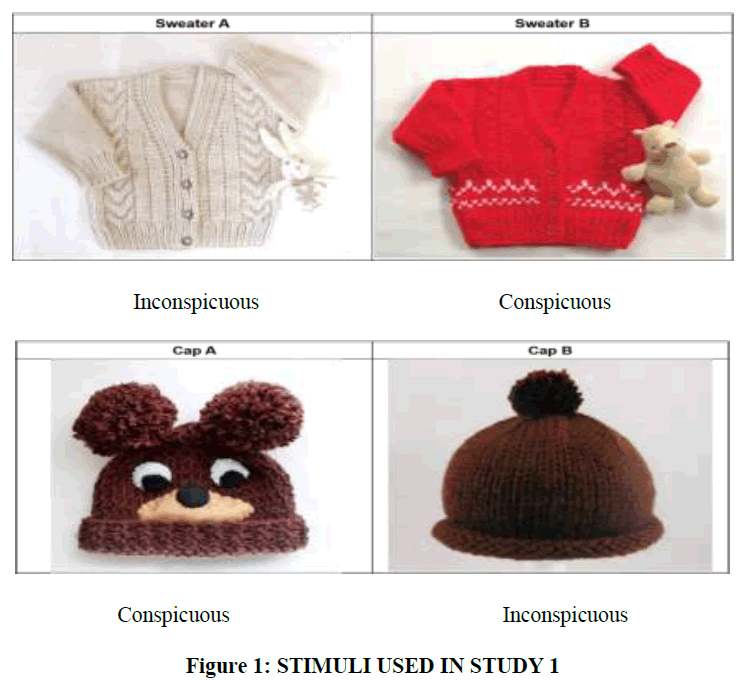
Figure 1 Stimuli Used in Study 1
Results
To test for the direct effect of evil eye belief on relative preferences for conspicuous versus inconspicuous options, we conducted a linear regression. Results revealed that evil eye belief significantly increases relative preference for the inconspicuous options (B = .18, SE = .08, p = .008). To examine the effect of evil eye belief on attention avoidance, we conducted a linear regression with evil eye belief as the independent variable and attention avoidance as the dependent variable, which showed that evil eye belief significantly increased attention avoidance (B = .29, SE = .05, p < .001).
Lastly, to examine whether attention avoidance mediated the effect of evil eye belief on preferences, we ran Process Model 4 (Hayes, 2017) with relative preferences as the dependent variable, evil eye belief as the independent variable, and attention avoidance as the mediating variable. As shown in Figure 2, the indirect effect of evil eye belief on preferences via attention avoidance was significant (B = .08, SE = .03; 95% CI = .0221, .1493). This effect is fully mediated by attention avoidance, with the direct effect becoming insignificant (95% CI = -0.0240, 0.3117). Further, re-running the analysis with relative preferences as the mediator and attention avoidance as the dependent variable showed a relatively weaker indirect effect of evil eye belief on attention avoidance via inconspicuous choice (B = .03, SE = .03; 95% CI = .0041, .0646), and a highly significant direct effect of evil eye belief on attention avoidance (B = .21, SE = .05; p = .0001; 95% CI = .1054, .3153). Hence, inconspicuous choice does not seem to mediate the effect of evil eye belief on attention avoidance Figure 2.
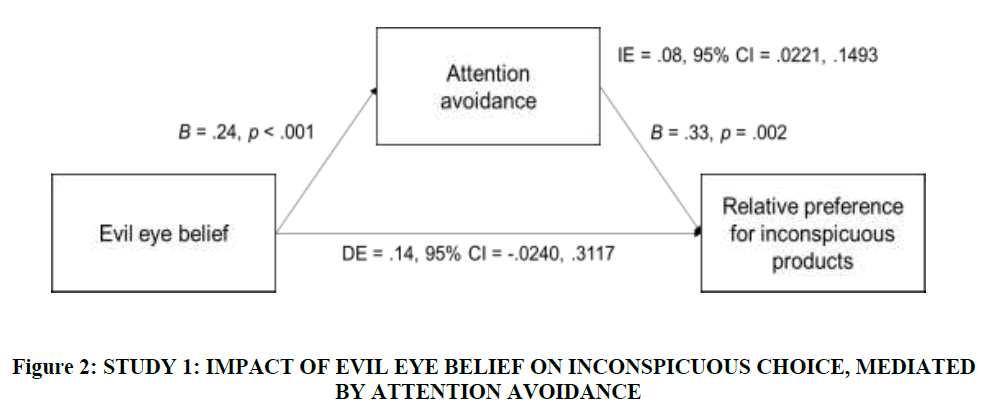
Figure 2 Study 1: Impact of Evil Eye Belief on Inconspicuous Choice, Mediated by Attention Avoidance
Discussion
Study 1 provided initial evidence that mothers who believe in the evil eye tend to have a relative preference for inconspicuous products in order to avoid attention. However, a strong limitation of this study was that we had measured evil eye belief and attention avoidance before the choice task, potentially leading to demand artefacts. Our subsequent study addresses this shortcoming by measuring evil eye beliefs after the main dependent variable. Further, study 1 used a very narrow context of Indian mothers choosing infant products; we expanded the contextual scope in the next study using a task in which participants chose products for themselves. In addition, and although the results of study 1 were consistent with our expectations, further evidence for our account would be found if stronger evil eye beliefs no longer shifted preferences to inconspicuous options when these are to be consumed in private away from prying eyes. Thus, study 2 examines the moderating role of public versus private consumption context.
Method 2
Two hundred and five adults were recruited from Prolific to participate in a study with one manipulated factor (consumption context: private vs. public) and one measured factor (strength of evil eye belief, continuous). Participants were instructed that the study involved choices between types of reading eyeglasses. Next, we manipulated consumption context following (Huang, Ackerman & Newman, 2017), and informed participants that the reading glasses were to be worn either in their bedroom (private) or in their office (public). Specifically, the private condition stated, “Suppose you are purchasing reading glasses to be worn while reading in yourown bedroom. Your own bedroom is yourprivate area and normally no one except you will enter it.” Conversely, the public condition stated, “Suppose you are purchasing reading glasses to be worn while reading at youroffice desk. Your office desk is in apublic area that many people will pass byevery day.”
Next, participants were asked to choose between the two pre-tested types of reading glasses (Figure 3; see appendix for pre-test). This was followed by a consumption context manipulation check (α = .69) in which they marked to what extent they would use the reading glasses in private or public (where 1 = definitely private, and 9 = definitely public) and to what extent they felt that their reading glasses would be seen by others (where 1 = not at all, and 9 = very much). Participants were then introduced to the belief in the evil eye and then responded to a measure of evil eye belief using the same scale as the previous study (α = .91), but generalized outside of the baby context Figure 3.
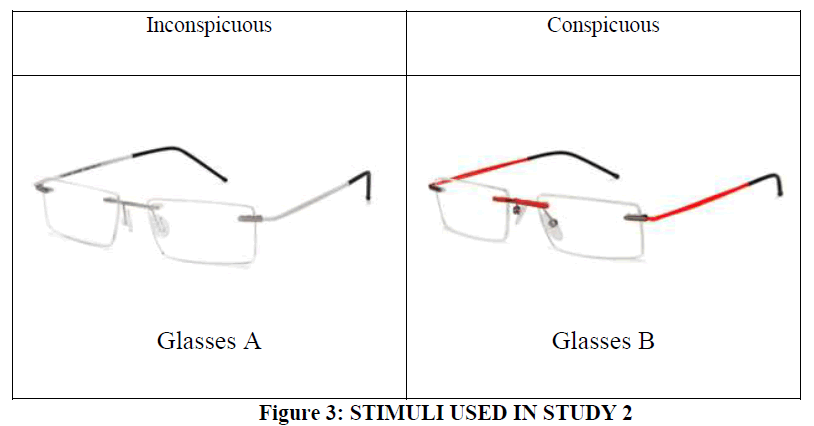
Figure 3 Stimuli Used in Study 2
Results
We coded eyeglass choice as a binary variable (0 = conspicuous choice, 1 = inconspicuous choice). To test if our consumption context manipulation was successful, we ran PROCESS Model 1 with the binary variable of public versus private context manipulation as the independent variable, the consumption context manipulation check as the dependent variable, evil eye belief as a moderator, and narcissism as a covariate. As expected, participants rated the eyeglasses would be significantly more public in the public (M = 6.68, SD = 1.73) versus private (M = 5.24, SD = 2.15) consumption context condition (B = 2.71, p < .0005).
In order to test for the two-way interaction of evil eye belief (EEB) and consumption context on eyeglasses choice, we ran PROCESS Model 1 with EEB as the independent variable, eyeglasses choice as the dependent variable, and public versus private consumption context as the moderator. Results reveal the expected significant two-way interaction between evil eye belief and consumption context (B= .38, SE = .17, p = .029). That is, in the public consumption context, participants were more likely to choose the inconspicuous pair of eyeglasses as their evil eye belief strengthened, albeit only marginally (B= .25, SE = .14, p = .07). However, strength of evil eye beliefs did not impact eyeglasses choice in the private consumption context (B= -.13, SE = .10, p = .21, Figure 4).
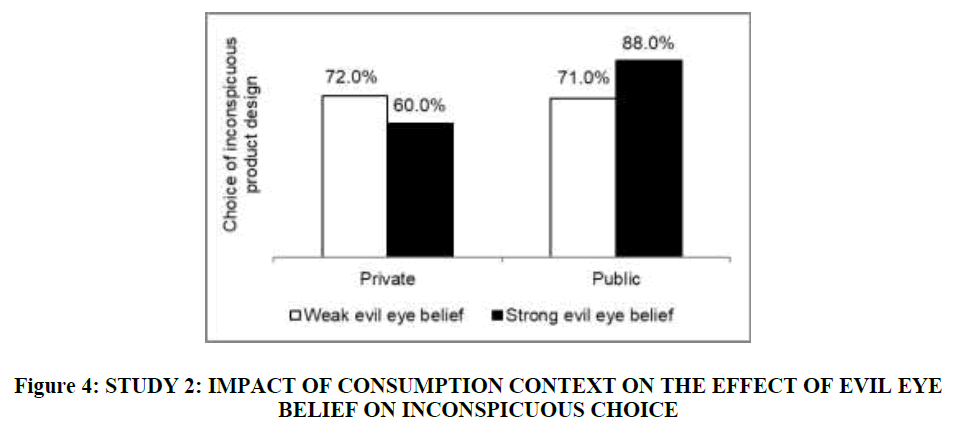
Figure 4 Study 2: Impact of Consumption Context on the Effect of Evil Eye Belief on Inconspicuous Choice
Discussion
Study 2 showed that evil eye beliefs increase the choice likelihood of inconspicuous over conspicuous options only when they are subject to public attention. By demonstrating that the evil eye effect is obtained only in the presence of public gazes, and not when the product is used in private, we thereby provides additional evidence that inconspicuous options are chosen to avoid attention among those with strong evil eye beliefs.
Therefore, the results thus far have been consistent with our hypothesis.
General Discussion
Summary of Findings
Two experiments, with participants spanning two continents (Asia and Europe), provide converging evidence that evil eye belief increases consumer preference for inconspicuous products. With a quasi-experiment among Indian mothers, study 1 shows that this effect is mediated by attention-avoidance motive. Study 2, my manipulating public vs. private consumption context, demonstrates that evil eye effect increases preference for inconspicuous products only when the product is to be consumed in public context.
Implications and Future Research
By being the first to empirically test the phenomenon of evil eye belief, this paper establishes this belief as real with significant impact on consumer preferences in the marketplace. All prior publications on the topic of evil eye are restricted to observational accounts of anecdotal evidence (Foster et al., 1972, Schoeck, 1981) and there has not been any empirical investigation of evil eye belief in the current consumer context. This research demonstrates that evil eye belief leads to choices of inconspicuous designs which contributes to the growing topic of consumer research to understand psychological drivers of inconspicuous consumption. Prior research has shown that subtle designs that connote cultural capital motivate consumers to purchase inconspicuous products (Berger & Ward, 2010). This research extends our understanding of inconspicuous consumption by showing contexts outside of luxury products, with mechanisms beyond cultural capital or taste. The findings of this research also contribute to the extant literature on product design (Bloch, 1995; Creusen & Schoormans, 2005), by suggesting how conspicuous product designs can lead to unfavorable affordances. So far, there has been only one study by (Patrick, Atefi & Hagtvedt, 2017) that has shown how transparent vs. opaque packaging affords visual contamination. We also extend the emerging literature on consumer responses to being envied. While prior research has focused only on appeasement as a coping strategy (Romani, Grappi & Bagozzi, 2016; Van de Ven, Zeelenberg & Pieters, 2010), we demonstrate attention-avoidance through inconspicuous product designs as an alternate strategy.
When we look at retail shelves, we see multiple eye-catching products fighting for our attention. (Orth &Malketwitz, 2008) have shown that nondescript product designs are unfavoured by consumers because they connote low competence and excitement. By showing that evil eye belief leads to preference for inconspicuous products, this research provides a counter-intuitive finding suggesting that marketers of products in vulnerable domains would benefit from designing nondescript or inconspicuous products. Our findings apply especially to product categories that are culturally believed to be prone to the evil eye because they constitute new beginnings for example, (weddings, entering a new home, launching a new business, etc.). Marketers involved in managing the constellation of products and services consumed across these vulnerable domains can benefit from their awareness of the rampant belief in evil eye.
While this paper focused on attention avoidance as a coping strategy to evade visual contagion, future research can test how the other coping strategies of appeasement, concealment, and superstitious rituals influence consumer choices of products in the marketplace. It has been argued (Gershman, 2015) that “evil eye beliefs and other superstitions are beneficial for society because they constitute a useful cultural response in environments conducive to destructive manifestations of envy.” Future research can directly study the effects of perceived envy on consumers’ choices. The intriguing phenomenon of evil eye belief is ripe for further investigation.
References
Belk, R. (2011). Benign envy. AMS review, 1(3), 117-134.
Indexed at, Google Scholar, Cross Ref
Berger, J., & Ward, M. (2010). Subtle signals of inconspicuous consumption. Journal of consumer research, 37(4), 555-569.
Indexed at, Google Scholar, Cross Ref
Bloch, P. H. (1995). Seeking the ideal form: Product design and consumer response. Journal of marketing, 59(3), 16-29.
Indexed at, Google Scholar, Cross Ref
Budge, E. W. (2019). Amulets and superstitions. Leonardo Paolo Lovari.
Indexed at, Google Scholar, Cross Ref
Creusen, M. E., & Schoormans, J. P. (2005). The different roles of product appearance in consumer choice. Journal of product innovation management, 22(1), 63-81.
Indexed at, Google Scholar, Cross Ref
Eckhardt, G. M., Belk, R. W., & Wilson, J. A. (2015). The rise of inconspicuous consumption. Journal of marketing management, 31(7-8), 807-826.
Indexed at, Google Scholar, Cross Ref
Elworthy, F. T. (2003). The evil eye: The classic account of an ancient superstition. Courier Corporation.
Foster, G. M., Apthorpe, R. J., Bernard, H. R., Bock, B., Brogger, J., Brown, J. K., ... & Whiting, B. B. (1972). The anatomy of envy: A study in symbolic behavior [and comments and reply]. Current anthropology, 13(2), 165-202.
Indexed at, Google Scholar, Cross Ref
Frazer, J. G. (1900). The Golden Bough: A Study in Magic and Religion (Vol. Revue des Traditions Populaires, 15, 471.
Freud, S. (1950). Totem and taboo (J. Strachey, Trans.). New York: W. W Norton.
Garber Jr, L. L. (1995). The Package Appearance in Choice. Advances in Consumer Research, 22(1).
Gershman, B. (2015). The economic origins of the evil eye belief. Journal of Economic Behavior & Organization, 110, 119-144.
Indexed at, Google Scholar, Cross Ref
Hagtvedt, H., & Brasel, S. A. (2017). Color saturation increases perceived product size. Journal of Consumer Research, 44(2), 396-413.
Indexed at, Google Scholar, Cross Ref
Hammer, N. (1995). Testing design via eye-movement analysis—Perspectives and problems. In Proceedings of the Seminar on Successful Product Engineering: Testing for Optimal Design and Function (pp. 155- 172).
Hargitai, Q. (2018). The strange power of the ‘evil eye..’ BBC Culture.
Hayes, A. F. (2017). Introduction to mediation, moderation, and conditional process analysis: A regression- based approach. Guilford publications.
Huang, J. Y., Ackerman, J. M., & Newman, G. E. (2017). Catching (up with) magical contagion: A review of contagion effects in consumer contexts. Journal of the Association for Consumer Research, 2(4), 430- 443.
Indexed at, Google Scholar, Cross Ref
Huang, X. I., Dong, P., & Wyer Jr, R. S. (2017). Competing for attention: The effects of jealousy on preference for attention-grabbing products. Journal of Consumer Psychology, 27(2), 171-181.
Indexed at, Google Scholar, Cross Ref
Kramer, T., & Block, L. (2011). Nonconscious effects of peculiar beliefs on consumer psychology and choice. Journal of Consumer Psychology, 21(1), 101-111.
Indexed at, Google Scholar, Cross Ref
Lykiardopoulos, A. (1981). The evil eye: Towards an exhaustive study. Folklore, 92(2), 221-230.
Indexed at, Google Scholar, Cross Ref
Lyndem, P. K., & Gupta, T. (2016). Evil Eye: The business of anticipated malicious envy in India.
Mauss, M. (2005). A general theory of magic. Routledge.
Morales, A. C., Dahl, D. W., & Argo, J. J. (2018). Amending the law of contagion: A general theory of property transference. Journal of the Association for Consumer Research, 3(4), 555-565.
Indexed at, Google Scholar, Cross Ref
NEMEROFF, C., & ROZIN, P. (2000). 1 The Makings of the Magical Mind. Imagining the impossible: magical, scientific, and religious thinking in children, 1.
Newman, G. E., & Dhar, R. (2014). Authenticity is contagious: Brand essence and the original source of production. Journal of marketing research, 51(3), 371-386.
Indexed at, Google Scholar, Cross Ref
Orth, U. R., & Malkewitz, K. (2008). Holistic package design and consumer brand impressions. Journal of marketing, 72(3), 64-81.
Indexed at, Google Scholar, Cross Ref
Parrott, W. G., & Rodriguez Mosquera, P. M. (2008). On the pleasures and displeasures of being envied.
Indexed at, Google Scholar, Cross Ref
Patrick, V. M., Atefi, Y., & Hagtvedt, H. (2017). The allure of the hidden: How product unveiling confers value. International Journal of Research in Marketing, 34(2), 430-441.
Indexed at, Google Scholar, Cross Ref
Rodriguez Mosquera, P. M., Parrott, W. G., & Hurtado de Mendoza, A. (2010). I fear your envy, I rejoice in your coveting: On the ambivalent experience of being envied by others. Journal of personality and social psychology, 99(5), 842.
Indexed at, Google Scholar, Cross Ref
Romani, S., Grappi, S., & Bagozzi, R. P. (2016). The bittersweet experience of being envied in a consumption context. European Journal of Marketing, 50(7-8), 1239-1262.
Indexed at, Google Scholar, Cross Ref
Schoeck, H. (1981). The evil eye: Forms and dynamics of a universal superstition. The evil eye: A casebook, 192-200.
Smith, R. K., Newman, G. E., & Dhar, R. (2016). Closer to the creator: Temporal contagion explains the preference for earlier serial numbers. Journal of Consumer Research, 42(5), 653-668.
Indexed at, Google Scholar, Cross Ref
Stavrova, O., Newman, G. E., Kulemann, A., & Fetchenhauer, D. (2016). Contamination without contact: An examination of intention-based contagion. Judgment and Decision making, 11(6), 554-571.
Indexed at, Google Scholar, Cross Ref
Van de Ven, N., Zeelenberg, M., & Pieters, R. (2009). Leveling up and down: the experiences of benign and malicious envy. Emotion, 9(3), 419.
Indexed at, Google Scholar, Cross Ref
Van de Ven, N., Zeelenberg, M., & Pieters, R. (2010). Warding off the evil eye: When the fear of being envied increases prosocial behavior. Psychological science, 21(11), 1671-1677.
White, P. H., Sanbonmatsu, D. M., Croyle, R. T., & Smittipatana, S. (2002). Test of socially motivated underachievement:“Letting up” for others. Journal of Experimental Social Psychology, 38(2), 162-169.
Indexed at, Google Scholar, Cross Ref
Woodburne, A. S. (1945). The evil eye in South Indian folklore. International review of mission, 34(2), 237- 247.
Appendix
Study 1
Pretest
We pre-tested the study stimuli (woollen baby sweaters and caps; see Figure 1 in manuscript) to ascertain that they differed in conspicuousness but not in other, potentiality confounding, characteristics.
The two sweaters were identical in material, styling, and shape, but differed in their beige versus red color. The two caps were identical in color and material, but differed in their styling – with one being plain and the other featuring the face of a bear. In particular, 32 students from a business school were asked to rate each sweater and each cap on a 7-point scale (where 1 = not at all, and 7 = very much) on how attention-grabbing and how eye-catching they were (combined into a conspicuousness index; rBeigeSweater = .87, rRedSweater = .90, rAnimatedCap = .73, rRegularCap = .96). Participants also rated the perceived quality of each of the products by indicating the degree to which they were of good fabric quality (where 1 = not at all, and 7 = very much).
Pair-wise comparisons of means revealed that participants rated the red sweater (M = 5.56, SD = 1.53) to be significantly more conspicuous than the beige sweater (M = 3.86, SD = 1.91; t(31) = -3.40, p = .002). The red versus beige sweaters did not differ in perceived quality (M = 4.97, SD = 1.38 vs. M = 5.38, SD = 1.16; respectively; t(31) = 1.63, p > .10). Similarly, the cap featuring the face of a bear (M = 6.19, SD = 1.91) was rated significantly more conspicuous than the plain cap (M = 3.03, SD = 1.53; t(31) = 8.49, p < .001), but there more differences in perceived quality between the two (M = 4.94, SD = 1.27 vs. M = 5.31, SD = 1.38, respectively; t(31) = -1.44, p ≥ .1).
Study 2
Pretest
We selected images of two eyeglasses from an online shopping website – one with a red frame and one with a grey frame. To control for other product design effects, we chose variants of the same product that only differed on color (see Figure 3 in manuscript). In a separate pre-test, forty-two individuals rated the two images of eyeglasses on conspicuousness as before (where 1= not at all, 7= very much; rgrey = .87, rred= .92). As expected, paired comparison of means reveals that the glasses with the red frame (M = 3.95, SD = 1.68) were rated to be more inconspicuous as compared to the grey framed glasses (M = 2.44, SD = 1.41; t(41) = 7.33, p < .001).
Measure of Evil Eye Belief
Participants were informed that evil eye was a belief that someone's glance was capable of inflicting harm, and while some people believed in the concept of evil eye, others did not. Keeping evil eye beliefs in mind, they were then asked to indicate the extent to which they agreed with each of the following statements (where 1 = strongly disagree, and 7 = strongly agree; α = .91), “The phenomenon of evil eye exists,” “There are some people who cast evil eye,” “Evil eye concept is nonsense (R),” “I do not believe in evil eye (R),” “Elders are right when they ask us to follow evil eye protection rituals”.
Received: 25-April-2026, Manuscript No. AMSJ-26-17223; Editor assigned: 27-April-2026, PreQC No. AMSJ-26-17223(PQ); Reviewed: 11-May-2026, QC No. AMSJ-26-17223; Revised: 15-May-2026, Manuscript No. AMSJ-26-17223(R); Published: 22-May-2026