Research Article: 2025 Vol: 29 Issue: 5
Evolving Mall Culture and Mall Preferences on Shopping Behavior of Shoppers in India
Rakesh K, ICFAI Law School, IFHE, Hyderabad
Arun Kumar A, ICFAI Law School, IFHE, Hyderabad
Pavani Kanaparthi, ICFAI Law School, IFHE, Hyderabad
Yaduvamsi Sai Krishna C, ICFAI Law School, IFHE, Hyderabad
Citation Information: Rakesh, K., Arun Kumar, A., Kanaparthi, P., Sai Krishna, Y.C. (2025). Evolving mall culture and mall preferences on shopping behavior of shoppers in india. Academy of Marketing Studies Journal, 29(5), 1-9.
Abstract
This study examines the evolving mall culture and shopping preferences in India, focusing on how these factors influence consumer behavior. The investigate goals to link the gap in existing literature by providing insights specific to the Indian retail market, where most studies focus on Western models of consumer behavior. The research highlights the reputation of understanding the determinants of mall culture and preferences to cater to consumers' evolving needs and desires. The aims of the research include identifying the determinants of mall culture and preferences and measuring their impact on shoppers' behavior. The research suggests that shopping center managers should focus on experiential marketing, effective promotions, and robust customer service to maintain and increase footfall. Ensuring a safe and enjoyable shopping environment is essential for fostering customer loyalty and satisfaction. Overall, the study offers valuable perceptions into the evolving mall culture and emphasizes the need for strategic management to navigate the dynamic retail landscape successfully.
Key words
Mall Culture, Consumer Behavior, Shopping, Preferences; Retail Environment.
Introduction
Businesses and industries are essential in today's global economy because they help organize economic activity to meet basic human requirements. An important turning point in our knowledge of consumer culture was the rise of business anthropology in the 1980s, when anthropologists started to contribute as experts in marketing and consumer behavior (Rasa Gudonaviciene, & Alijosiene, 2013). Since then, the business sector has embraced anthropological views more and more, especially when it comes to examining retail spaces like malls. These days, shopping malls are more than just places to buy things; they are complex social and cultural centers that represent shifting consumer tastes and lifestyles (Ortegon-Cortazar and Royo-Vela, 2017). This is particularly noticeable in major cities in India, where mall culture has grown quickly to accommodate the city's expanding urban population and rising standard of living. The malls in major cities in India are changing, which reflects larger patterns in Indian consumer behavior. Shopping habits have been greatly impacted by factors like population expansion, changing attitudes toward consumption, and an increasing focus on personal well-being (Doreen Chze Lin Thang & Benjamin Lin Boon Tan, 2003). Age also has a significant impact on purchasing habits. Young adults are more inclined to prioritize entertainment and technology, whereas older consumers are more likely to spend money on leisure and travel (Ortegon-Cortazar, & Royo-Vela, 2017). As a result, mall shopping has evolved into a recreational pastime as well as a practical requirement, closely linked to the consumer's social identity and way of life (Thanasi-Boçe, et al., 2021).
Consumers today engage in a complicated performance when they shop, evaluating and experiencing products with their senses of taste, hearing, and sight in addition to making purchases (Wagner, & Rudolph, 2010). Numerous psychological factors, including impulsivity, enjoyment, and practicality, influence shopping, which is frequently seen as a favored leisure activity (Rasa Gudonaviciene, & Alijosiene, 2013). With their thoughtfully designed experiences from food courts and entertainment areas to sensory-rich store displays major cities malls take advantage of these incentives to increase foot traffic and customer interaction. This development is in line with the global trend of retail establishments turning into social hubs where people's purchasing decisions are influenced by situational and emotional variables in addition to needs (Teller, 2008). Furthermore, although technology and shifting cultural norms are rapidly altering these dynamics, gender roles and family duties still influence shopping habits (Farrag, et al. 2010). Customers' willingness to put in time and effort is having a growing impact on how often and how they buy, whether they do it in-person or online (Teller, 2008). Malls in Major Cities have responded by providing smooth, hybrid shopping experiences that blend the allure of in-person connection with convenience, which is in line with the general trend of consumers moving toward experiential retail.
Review of Literature
Consumers prefer weekends and spend less than two hours shopping based on convenience, luxury, mall essence, comfort, entertainment, and variety. Features including parking, visitor arrangements, cleanliness, security, variety of products, quality of product, and after-sales service are all highly valued by them (Rasa Gudonaviciene, & Sonata Alijosiene, 2013). A retail mall's ambiance, parking, personnel, facilities, and seats all contribute to its allure. When it comes to drawing visitors to shopping centres, amenities like parking, security, bathrooms, and scent are important (Teller, 2008). Purchase behaviour is influenced by factors including lack of time, commercial outlet preference, shop characteristics, product diversity, and even fragrances in the retail setting (Prashar, et al. 2017). Malls' physical features include features that provide people the sense of protection and safety they need (Kushwaha, et al. 2017). Properties like the overall quantity of salesmen, the helpfulness of managers, salespeople, and other mall personnel are all part of the general environment of shopping centres (Wagner, & Rudolph, 2010).
Any shopping centre should have amenities, restaurants, cafes, kid-friendly play areas, rest places, common areas, amusement. and promotions (Farrag et al. 2010). The shopping centre is a multipurpose, varied area that has culinary services, entertainment, and retail brands, all of which provide something new while also satisfying a variety of requirements. Malls offer a variety of amenities, including supermarkets, food courts, hairdressers, medical services, and booksellers. They provide a range of branded apparel and footwear, fashion and cosmetic items, furniture and home accents, and kid-friendly entertainment facilities to its clientele. Malls provide shopping a "fun" element.
Shopping malls lift people's spirits, reduce stress, and divert attention from concerns (Prashar, et al. 2017). Malls draw customers by giving them the chance to research emerging trends. Purchase decisions are also influenced by socialization (Teller, 2008). Stores with helpful and friendly employees are preferred by many customers. Purchase objectives are influenced by a number of factors, including product displays, parking conditions, the pricing and type of the products (Farrag et al. 2010), and the gap from home to shopping venues. Search time, parking space count, parking facility quality, and parking availability are all factors in the parking scenario (Singh, 2015).
According to scholarly study, a lot of customers rely their purchasing decisions on how they feel about the diversity of stores and the retail setting. In order to get to destination shopping malls with the greatest selection of shops and goods, customers frequently take their time (Hu & Jasper, 2018). With a vast array of merchants, large shopping malls offer an amazing shopping experience. Positive feelings and energy are produced by a shopping centre’s assortment of retailers (Khare, & Sarkar, 2020). A combination of psychological and functional variables influences the retail centre’s brand.
When selecting a shopping complex, consumers also consider parking amenities, retail outlet size, easy access, and a solid tenant mix (range of businesses). The difficulty is in designing a shopping center atmosphere that affects customers' purchasing decisions (Singh, 2015). Customers typically look for new and improved products and gain knowledge by investigating other products or stores (Shankar, et al. 2011). For better results, shopping malls should provide a range of goods. Shopping malls with a diverse and balanced tenant mix are likely to draw in more consumers (Farrag et al, 2010). Customers may compare product options at one-stop stores, which generates enthusiasm. Shopping centre aesthetics, such as interior design, colour scheme, temperature, lighting, music, crowd density, and cleanliness, have an impact on customers' feelings and moods as well as how they make purchases (Khare, & Sarkar, 2020).
Research Gap
The majority of the literature now in publication is focused on Western contexts, specifically in developed nations like the United States and Europe, despite the fact that many studies have examined consumer behavior in shopping malls worldwide. The buying patterns, cultural influences, and retail systems of developed economies are primarily reflected in this research, which may not be in line with the socio-cultural and economic reality of Indian customers. In contrast, rising incomes, shifting lifestyles, and the expanding impact of international retail trends have all contributed to the fast evolution of India's retail industry in recent years. Nonetheless, there is still a dearth of comprehensive empirical studies that examine how Indian cities' changing mall cultures and customer preferences affect consumers' purchasing habits. The majority of Indian research that is currently accessible tends to ignore the particular dynamics of mall-based shopping in favor of concentrating on generic retail behavior. Thus, by examining how changing mall culture and mall-specific preferences influence major cities consumers' purchasing habits, this study fills a crucial need. It attempts to advance knowledge of the Indian urban retail experience by providing a localized viewpoint on retail consumption that is presently underrepresented in the literature.
Shopping malls have quickly become the most popular retail and leisure locations, causing a dramatic change in the city's retail scene in recent years. These malls have developed into places that provide a variety of shopping, entertainment, and social activities rather of just being places to buy products. Understanding how the shifting mall culture affects consumer preferences and purchasing behavior is essential as urbanization, rising disposable incomes, and changing lifestyles modify consumer expectations. Despite the significance of this change, little study has been done to identify the precise factors that influence mall preferences and how they affect customer behavior in India. The majority of the material now in publication focuses on retail settings in the West, which are very different from the socio-cultural and economic realities of Indian cities. Because of this disparity, localized research is required to understand the distinct views, decision-making processes, and shopping motivations of Indian consumers. In order to fill a significant vacuum in the literature on Indian retail behavior, the current study aims to examine how changing mall culture and related consumer preferences affect Major cities in India shoppers' purchasing habits. Based on research gap present study is focuses on the determinants of mall culture and preferences in Major cities in India and measure the impact of determinants of mall culture and preferences on the shopping behavior of consumers.
Research Hypothesis
H01: There is no significant relationship between determinants of mall culture and preferences and shopping behavior of consumers.
Sampling Procedure
Customers in major cities in India, a vibrant, diverse, and international metropolis that exhibits the wider range of Indian metropolitan consumer behavior, participated in this study. A convenience sampling technique was used to guarantee practical viability while obtaining a broad range of purchasing experiences and attitudes. Based on their availability and willingness to participate, 370 respondents in all especially those who were actively shopping throughout the data collecting period were chosen. Given the time limits and exploratory nature of the study, this technique was appropriate. Several malls in Major cities, east, west, north, and south regions were covered in order to increase representativeness and diversity. This allowed for the inclusion of a range of socioeconomic and demographic groups. In order to minimize selection bias within a non-probability framework, respondents were chosen at random from among walk-in shoppers within each mall.
The study comprised 20 retailer respondents from each mall that was chosen in addition to consumer responses, offering a dual viewpoint on mall culture and consumer behavior. In order to provide thorough insights into consumer-retailer interactions, these retailers were selected based on shop foot traffic and product category representation (e.g., apparel, electronics, food & beverage). For the present study reality test and EFA and Multiple Regression models have been used.
Results and Discussions
Exploratory Factor Analysis
Sampling adequacy was assessed using the KMO and Bartlett's test. The Kaiser-Meyer test, a Sphericity metric, evaluates the quantitative connection between variables to determine whether sampling was adequate. The KMO and Bartlett's test are essential for confirming sample adequacy in commercial and educational research. The KMO index has a universally recognized threshold of 0.5 and ranges from 0 to 1. According to Peri (2012), the Bartlett's coefficient of Sphericity must be less than 0.05. These tests are important for proving the study's validity and reliability. The value for the Bartlett test of Sphericity was 0.000 and the KMO measure of sample adequacy was 0.856 (Table 1). These results indicate that the sample for this study is adequate for factor analysis. Consequently, the instrument was recommended for further study.
| Table 1 KMO and Bartlett's Test | ||
| KMO Measure of Sampling Adequacy. | .856 | |
| Bartlett's Test of Sphericity | Approx. Chi-Square | 2986.926 |
| df | 91 | |
| Sig. | .000 | |
Varimax rotation and principal component analysis were used to examine the mall culture and mall preference statements. According to the Scree plot, which levels off to the analysis and shows a linear decreasing pattern, three main factors were identified. Each factor contains factor loadings greater than 0.05. These three extracted factors explained a total cumulative variance of 52.020%. The first factor explained 27.348% of the variance, while the second factor accounted for a variance of 24.673% (Table 2).
| Table 2 Total Variance Explained | |||||||||
| Component | Initial Eigenvalues | Extraction Sums of Squared Loadings | Rotation Sums of Squared Loadings | ||||||
| Total | % of Variance | Cumulative % | Total | % of Variance | Cumulative % | Total | % of Variance | Cumulative % | |
| 1 | 5.199 | 37.139 | 37.139 | 5.199 | 37.139 | 37.139 | 3.829 | 27.348 | 27.348 |
| 2 | 2.083 | 14.881 | 52.020 | 2.083 | 14.881 | 52.020 | 3.454 | 24.673 | 52.020 |
| 3 | 1.373 | 9.807 | 61.827 | ||||||
| 4 | 1.171 | 8.363 | 70.191 | ||||||
| 5 | .784 | 5.603 | 75.793 | ||||||
| 6 | .727 | 5.195 | 80.989 | ||||||
| 7 | .496 | 3.542 | 84.531 | ||||||
| 8 | .472 | 3.368 | 87.899 | ||||||
| 9 | .417 | 2.976 | 90.875 | ||||||
| 10 | .403 | 2.876 | 93.751 | ||||||
| 11 | .360 | 2.570 | 96.321 | ||||||
| 12 | .286 | 2.041 | 98.362 | ||||||
| 13 | .195 | 1.390 | 99.753 | ||||||
| 14 | .035 | .247 | 100.000 | ||||||
Rotated Component Matrix
Principal Component Analysis using Varimax Kaiser Normalization revealed two key variables. These variables explained 52.020% of the total variance of the original factors, which is satisfactory for factor analysis. The two elements represented mall culture and preferences on the shopping behavior of mall shoppers in major cities in India (See Table 3). The first principal component factor, mall culture, encompassed retail development, competition, awareness, mall browsing, disposable income, innovation, and consumer engagement, with a cumulative variance of 27.348%. The second factor, labeled mall preferences, included tenant mix, mall affect, consumer experience, mall environment, convenience, mall loyalty, and mall layout, explaining 24.673% of the variance.
| Table 3 Rotated Component Matrix | ||
| Statements | Factors | |
| Mall Culture | Mall Preferences | |
| Retail development | .817 | |
| Competition | .777 | |
| Awareness | .775 | |
| Mall browsing | .673 | |
| Disposable income | .602 | |
| Innovation | .599 | |
| Consumer engagement | .593 | |
| Tenant mix | .841 | |
| Mall affects | .801 | |
| Customer experience | .733 | |
| Mall environment | .704 | |
| Convenience | .597 | |
| Mall loyalty | .560 | |
| Mall layout | .523 | |
Reliability Test
The results of reliability study showed that there was a substantial correlation and internal dependability between the variables examined, with Cronbach's Alpha values of 0.837 for mall culture, 0.824 for mall preferences, and 0.861 for overall statements (Table 4).
| Table 4 Summary of Rotation Factor Analysis and Reliability | |||
| Factors | No. of Statements | N | Cronbach’s Alpha |
| Mall culture | 7 | 370 | .837 |
| Mall preferences | 7 | 370 | .824 |
| Overall statements | 14 | 370 | .861 |
Regression
To illustrate the different direct correlations between the study's independent and dependent variables, straight regressions were computed at a level of confidence of 95% (0.05 margin of error). The coefficient of determination (R2) showed a positive connection coefficient (R) of 0.568 (Table 5). This implies that mall culture and preferences positively affect customers' buying behavior, with R2 indicating that 63.6% of consumer behavior can be explained by these factors. The adjusted R2 remains at 63.6%, and the Durbin-Watson value is 1.903, approaching the standard of 2. Therefore, the hypothesis is likely satisfied.
| Table 5 Model Summary | |||||
| Model | R | R Square | Adjusted R Square | Std. Error of the Estimate | Durbin-Watson |
| 1 | .568a | .636 | .531 | 1.239 | 1.903 |
| a. Predictors: (Constant), Mall Preferences, Mall Culture. | |||||
| b. Dependent Variable: Shopping Behavior. | |||||
The data, which show a significance value of 0.000, or less than 0.05. This shows that the model is statistically significant in forecasting the influence of mall culture and preferences on consumers' buying behaviour in shopping malls. The results also demonstrate how well the independent variables predict the dependent variable (Table 6).
| Table 6 Anova | ||||||
| Analysis of Variance | ||||||
| Model | Sum of Squares | df | Mean Square | F | Sig. | |
| 1 | Regression | 88.277 | 2 | 44.138 | 28.762 | .000b |
| Residual | 563.196 | 367 | 1.535 | |||
| Total | 651.473 | 369 | ||||
| a. Dependent Variable: Shopping Behavior. | ||||||
| b. Predictors: (Constant), Mall Preferences, Mall Culture. | ||||||
The regression model is
Y = 1.540 + 0.352 (Mall Culture + .0249 (Mall Preferences)
The results revealed that both independent variables mall culture and mall preferences have a positive impact on mall shopping behavior (Table 7). The most significant factors are mall culture and preferences, with a regression coefficient of 0.302 (significance levels of 0.000 and 0.002, respectively). This model indicates that customers' mall shopping behaviors are scored at 1.540 when the independent variable is zero.
| Table 7 Coefficients | ||||||
| Model | Unstandardized Coefficients | Standardized Coefficients | T | Sig. | ||
| B | Std. Error | Beta | ||||
| 1 | (Constant) | 1.540 | .263 | 5.859 | .000 | |
| Mall Culture | .415 | .059 | .352 | 7.009 | .000 | |
| Mall Preferences | .358 | .060 | .249 | 4.971 | .002 | |
| a. Dependent Variable: Shopping Behavior. | ||||||
Relapse accumulation appropriation is verified for normalcy using histogram and probability plot graphs and deemed acceptable (Figure 1).
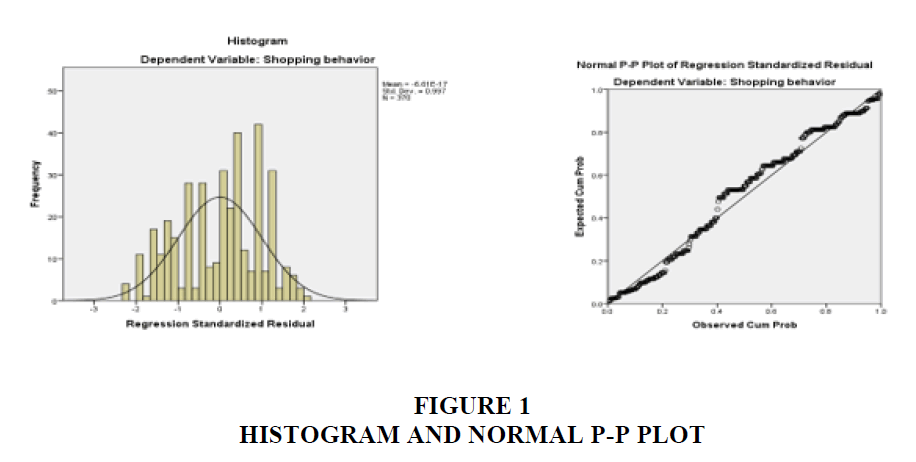
Figure 1 Histogram and Normal P-P Plot
Managerial Implications
The evolving retail landscape has compelled modern shopping center managers to reassess their current managerial roles. A shopping center manager's effectiveness lies in their meticulous approach to implementing the developers' ideas, managing tenants, and satisfying customers. Keeping this in mind, the researcher offers the following suggestions, since consumers continually seek entertainment and experiences during their shopping trips, shopping center managers should employ experiential marketing strategies and provide essential customer experiences to maintain and increase footfall. This approach also helps prevent mall fatigue among shoppers. Shopping center managers should integrate mall advertising and promotion as a vital part of their management strategy. With most shopping centers in Chennai featuring a mix of national and international brands, effective promotion will enhance consumer awareness of the mall's tenant mix. By ensuring advertising, promotions, and positions at every consumer touchpoint, shopping centers can become integral to a customer's daily life. Given that most mall shoppers are willing to spend 3 to 4 hours in a shopping center, mall managers need to devise detailed plans for various customer engagement programs to be conducted within their malls. Over-scheduling programs without proper planning may lead to overcrowding within the premises, complicating traffic management. The primary responsibility of the shopping center manager is to deploy excellent service staff to cater to a diverse range of customers, as service experiences serve as a hallmark of a mall's image. Customers will not return to a shopping center if they do not receive proper treatment. Ensuring the security of shoppers within a mall is a critical issue that must be addressed by shopping center managers. They should employ dedicated security personnel and bouncers to protect and prevent the harassment of female shoppers. Over the past two years, the city has witnessed three suicides within shopping centers.
Conclusion
The study on the evolving mall culture and shopping preferences in major cities in India highlights the significant impact of retail environments on consumer behavior. It reveals that factors such as retail development, competition, innovation, and consumer engagement play a crucial role in shaping shoppers' preferences and behaviors. The study also emphasizes the importance of a well-curated tenant mix, convenience, and mall environment in enhancing customer satisfaction and loyalty. These insights underscore the need for strategic management and innovative marketing approaches to create appealing and engaging shopping experiences. Statistical analyses validate the study's findings, demonstrating that mall culture and preferences significantly influence shopping behavior. High reliability scores and positive regression coefficients confirm the internal consistency and relevance of the identified factors. The research suggests that shopping center managers should focus on experiential marketing, effective promotions, and robust customer service to maintain and increase footfall. Ensuring a safe and enjoyable shopping environment is also critical for fostering customer loyalty and satisfaction, ultimately contributing to the sustained success of shopping centers in major cities in India.
References
Doreen Chze Lin Thang, Benjamin Lin Boon Tan (2003). Linking consumer perception to preference of retail stores: an empirical assessment of the multi-attributes of store image, Journal of Retailing and Consumer Services,10(4), 193-200.
Farrag, D. A., El Sayed, I. M., & Belk, R. W. (2010). Mall shopping motives and activities: A multimethod approach. Journal of International Consumer Marketing, 22(2), 95–115.
Indexed at, Google Scholar, Cross Ref
Khare, A., & Sarkar, S. (2020). Does Cultural Value Influence Consumers’ Attitudes toward Mall Events? A Study on Indian Mall Shoppers. Journal of International Consumer Marketing, 33(5), 526–542..
Indexed at, Google Scholar, Cross Ref
Kushwaha, T., Ubeja, S., & Chatterjee, A. S. (2017). Factors Influencing Selection of Shopping Malls: An Exploratory Study of Consumer Perception. Vision, 21(3), 274-283.
Indexed at, Google Scholar, Cross Ref
Ortegón-Cortázar, L. and Royo-Vela, M. (2017). Attraction factors of shopping centers: Effects of design and eco-natural environment on intention to visit, European Journal of Management and Business Economics, 26(2), 199-219.
Indexed at, Google Scholar, Cross Ref
Prashar, S., Singh, H., Parsad, C., & Vijay, T. S. (2017). Predicting Indian Shoppers’ Malls Loyalty Behaviour. Vikalpa, 42(4), 234-250.
Indexed at, Google Scholar, Cross Ref
Rasa Gudonaviciene, Sonata Alijosiene (2013). Influence of Shopping Centre Image Attributes on Customer Choices, Economics and Management, 18 (3), 545-542.
Indexed at, Google Scholar, Cross Ref
Shankar, V., Smith, A. K., & Rangaswamy, A. (2011). Customer satisfaction and loyalty in online and offline environments. International Journal of Research in Marketing, 20(2), 153–175.
Indexed at, Google Scholar, Cross Ref
Singh, D. P. (2015). Effect of Shopping Motivations on Indian Consumers’ Mall Patronage Intention. Asia-Pacific Journal of Management Research and Innovation, 11(1), 57-65.
Indexed at, Google Scholar, Cross Ref
Teller, C. (2008). Shopping streets versus shopping malls – determinants of agglomeration format attractiveness from the consumers’ point of view. The International Review of Retail, Distribution and Consumer Research, 18(4), 381–403.
Indexed at, Google Scholar, Cross Ref
Thanasi-Boçe, M., Kwiatek, P. and Labadze, L. (2021), "The importance of distance and attraction in patronizing a shopping mall", Journal of Place Management and Development, 14(2), 222-238.
Indexed at, Google Scholar, Cross Ref
Wagner, T., & Rudolph, T. (2010). Towards a hierarchical theory of shopping motivation. Journal of Retailing and Consumer Services, 17(5), 360–371.
Indexed at, Google Scholar, Cross Ref
Received: 04-Jun-2025, Manuscript No. AMSJ-25-15987; Editor assigned: 05-Jun-2025, PreQC No. AMSJ-25-15987(PQ); Reviewed: 10- Jun-2025, QC No. AMSJ-25-15987; Revised: 16-Jun-2025, Manuscript No. AMSJ-25-15987(R); Published: 28-Jul-2025