Research Article: 2026 Vol: 30 Issue: 1
Examining The Mediating Role Of E-Trust In The Relationship Between E-Utility And E-Loyalty In Online Shopping
Dnyaneshwaree Shrikant Jawale, Ph.D. Scholar, MET's Institute of Management, Maharashtra, India
Jyoti Singh, Associate Professor, MET's Institute of Management, Maharashtra, India
Nilesh R. Berad, Director, MET's Institute of Management, Maharashtra, India
Citation Information: Jawale, DS., Singh, J & Berad, NR. (2026) Examining the mediating role of e-trust in the relationship between e-utility and e-loyalty in online shopping. Academy of Marketing Studies Journal, 30(1), 1-12.
Abstract
Purpose: The research focuses on exploring the mediating role of E-trust between E-Utility and E-loyalty in the context of e-commerce. As the virtual commerce continues to soar high its growing trajectory, its importance and the understanding of trust acts a bridge between the perception of platforms utility by customers and their loyalty have become more important aspect. Hence, this research is an attempt to achieve a greater understanding of the process by which customer’s functional satisfaction with the virtual commerce world translates into a journey of enduring trust and eventual loyalty. Methodology: A Partial Least Squares Structural Equation Modeling (PLS-SEM) approach has been utilized here to explore the mediating role played by E-trust between E-Utility and E-Loyalty. The data has been gathered from existing online consumers, and the structural model has been estimated using the data to test the direct and indirect effects between the constructs. The statistical conclusion verifies the significance of each path coefficient and empirical verifies the mediation impact. Findings: The analysis results indicate that the relationship between E-Utility and E-Loyalty is partially mediated by E-Trust and has a moderate level of mediation strength. This further indicated that customer loyalty directly improves by virtue of the perceived usefulness and convenience of the platform but the relationship between two further improves by the reinforcing role of trust. Practical Implications: The research demonstrates that e-commerce companies need to address the functional and utilitarian aspect of a website’s value but also consider incorporating measures for building customer confidence. If the reliability level, protection for personal information, transparency policy, and prompt response are improved, it will significantly improve the relationship between confidence and loyalty and move the company towards higher customer retention and competitiveness. Originality: Through the empirical assessment of the mediation function of trust and the integration of E-Utility, E-Trust, and E-Loyalty into a single theoretical model, this research contributes to the body of literature. It stands out by illustrating the way that psychological belief in the websites of e-commerce acts as a key mediator between perceived functional value and loyalty and also provides both theoretical and practicable insights for understanding consumer behaviour in the online marketplace.
Keywords
E-Trust, E-Utility, E-Loyalty, Online Shopping, Mediation Analysis.
Introduction
The Internet revolution has profoundly affected contemporary society by enabling global connectivity and simplifying and speeding up tasks (Dwivedi et al., 2021). Reaching company activity on a worldwide scale is also made possible by this comfort. A vast Internet sales system for interconnected international commercial operations is being led by this revolution. Consumer purchasing and selling activities have been made possible by the advancement of Internet technology. Nowadays, every firm and its operations are based on the latest developments in Internet technology (Mota & Cilento, 2020). The internet's existence has led to the rise of new companies, or e-commerce as it is more commonly called. E-commerce is defined as an online business transaction conducted using the Internet and Internet-enabled devices (Jain et al., 2021). In terms of saving time and money while buying or selling, this event undoubtedly offers a lot of advantages to customers. Online shopping has become increasingly important in the sophisticated technical era to support global electronic commerce. Consumers are becoming less likely to visit physical stores and instead choose to use technology to their advantage by using the online capabilities offered by retail businesses. Customers can purchase goods online at any time of the day from any location, including the convenience of their houses. In terms of the time, travel, and effort needed to finish transactions, customers believe internet shopping to be more economical. Consumers can quickly compare the prices of similar products from several stores by conducting research online. About 1.92 billion people, according to the report, are using the internet functionality to make purchases (Statista, 2019a). It is anticipated that in 2019, e-commerce sales will surpass the $3 trillion milestone. Additionally, by 2019, there will be roughly 224 million online buyers in the United States (Statista, 2019b).
Numerous marketing application sectors have conducted substantial research on the phenomena of trust ((Cheng et al., 2024; Habbal et al., 2024). From a conventional setting to an online one and now to a mobile one, the idea of trust has been profoundly altered by the development of ICT (Ali et al., 2023). First, according to ((Kim et al., 2009; Saif et al., 2024), trust is a crucial marketing characteristic that influences customer behaviour. Second, the realisation of all online transactions is a major factor in the success of online trust (Capestro et al., 2024; Udayana et al., 2023). In technical environments like e-commerce and mobile banking, trust is a facilitator. Therefore, (Sahli, 2024) discovered that comprehending and cultivating customer trust is often necessary for the success of mobile payment services. E-trust, as it relates to online commerce, is the confidence that customers have in online vendors. Customers buying online have to rely completely on the data and images found on these websites to decide what to buy from the said websites. There is lack of communication among the sellers and the buyers. Consequently, the degree of customer confidence in e-commerce platforms is crucial (Tran & Strutton, 2020). E-commerce purchases carry several dangers, including sluggish return procedures, counterfeit goods, and products that do not match the description. There are also security threats, including the unauthorized or theft of customers' personal information such as credit card numbers, addresses, and client names. Such threats may make customers discontented and lose trust in online shopping services, hence they will be less likely to buy online in the future (Hadi et al., 2021). Ability, empathy, and honesty are the three components of e-trust (Kartono & Halilah, 2019). E-utility refers to the expected functional benefit that an e-business website provides to its users. It includes aspects such as “ease of use, efficiency, reliability, and convenience.” In the opinion of (Liu & Arnett, 2000), the success of a website in e-commerce is greatly reliant upon the ease of use, the speed of transaction, and the precision of product information. (Zeithaml et al., 2002) further opine that the level of quality provided by the website in services, particularly the ease of use and dependability of the site, directly impacts customer satisfaction and retention. E-commerce systems that offer a wide range of products, smooth navigation, and efficient search features improve user experience and eventually increase consumer loyalty, according to (Huang & Benyoucef, 2013). Furthermore, (Chen & Xie, 2008) contend that a website's perceived usefulness including how simple it is for users to locate and buy products plays a significant part in determining how customers behave and how long they stay on the platform. E-utility is therefore a major factor in determining how customers view and remain loyal to online marketplaces. The willingness of the customer to return to the website, whether or not they make a purchase online, is known as e-loyalty. According to this view, client loyalty is positive and may even be advantageous in everyday situations. (Ellitan & Suhartatik, 2023). Cognitive, emotive, conative and active application of the customer loyalty dimension to the website are the four components that make up the idea of e-loyalty.(Ellitan & Suhartatik, 2023; A. Hur et al., 2011;).
The primary goal of this study is to examine the mediating “role of E-Trust in the relationship between E-Utility and E-Loyalty in online shopping.” This paper aims to achieve an in-depth understanding of how the “perceived usefulness and functionality of an e-commerce platform influence customer trust, which in turn affects their loyalty towards the platform.” The primary purpose of this study is to evaluate experimentally the degree to which online customer’s E-Trust serves as a link between E-Utility and E-Loyalty. This study holds a lot of significance as it develops from its ability to provide light on the dynamics of online shopping behaviour of customers specifically how e-trust influences e-loyalty. This study emphasises the significance of trust in transforming functional utility into long term consumer loyalty by establishing “E-Trust as a partial mediator between E-Utility and E-Loyalty.” The results of this study will provide insightful information that e-commerce companies can use to improve customer happiness and retention by giving trust building tactics like safe platforms and open transparent communication Qatawneh et al., (2023).
Research questions give clarity about what the study seeks to answer. Hence, the research is guided by the following questions:
RQ1: How does E-Utility Influence E-Trust in online shopping?
RQ2: Does E-Trust mediate the relationship between E-Utility and E-Loyalty in online shopping?
This study strengthens to the expanding amount of research examining online customer’s willingness by concentration on the “mediating role of E-Trust between E-Utility and E-Loyalty,” a relationship that has received meagre attention in prior research. The majority of past articles has either investigated the direct relationship between website usefulness and customer loyalty or investigated trust as a standalone determinant of loyalty. However, empirical evidence that discerns the working mechanisms of E-Trust as a mediator in between perceived benefit and loyalty performance is still lacking. This paper bridges this knowledge gap through the application of a SEM strategy to reveal the size and direction of this mediation Martio & Moko, (2023). This paper departs from past research in a number of ways. It theoretically puts E-Utility, E-Trust, and E-Loyalty concepts together in one mediational model that gives a comprehensive explanation of how to maintain customers for electronic commerce. It utilizes the PLS-SEM method, which is ideal for performing predictive and causal analysis in behavioural research Patil et al., (2025). The study offers a contemporary perception of internet trust that integrates technical reliability, perceived security, and website transparency as core components of contemporary e-commerce websites. In addition, through investigation of the moderating effect of trust in a post-pandemic digital economy, the study contributes rich insights into contemporary online purchase behavior and offers fresh insights to researchers and practitioners. There are seven segments in this paper. The first section of this paper is the “Introduction” which provides the background of buying online behaviour and a detailed discussion of the topic is mentioned here, along with why is this study necessary, the emphasis of research, the research queries and the contributions it hopes to make the body of current knowledge. The contribution of this research along with how this study will fill that gap is also clearly stated in this section. The second section is the “review of literature” where in an overview of all the studies which are relevant to the said topic is provided along with the gap found in the literature and where more study is needed. The next section is the “theoretical framework” discusses the key concepts applied in this research and how hypotheses were developed based on the research questions. This section also contains the definitions and the application of the constructs and hypotheses that are to be examined. A graphical representation of the interplay between the variables is depicted in the conceptual framework Oktaviali et al., (2024). This section finally provides the hypotheses formed. The fourth section, "Research Methodologies," discusses how the study was conducted, such as the research design, instruments used to collect data, sample size, and the statistical methods employed, such as PLS-SEM. The fifth section, Data Analysis and Interpretation, presents statistical analysis output and employs tables and figures in order to facilitate readability of results Kurumbatu, (2024). The sixth part, Conclusion and Discussion, summarises up the main conclusions, explains about what they mean for online shoppers and stores, and points out how the study adds to what is already known. Finally, the seventh section, References, lists all the sources and scholarly works cited throughout the paper following standard academic referencing guidelines.
Literature Review
Hedonic and utilitarian factors do not directly affect loyalty, according to (Rezaldi et al., 2022), and price consciousness as a moderator also has little impact on Indonesian e-marketplace user loyalty. Additionally, the online experience did not mitigate the pragmatic relationship between trust and online purchasing. The most important predictor of e-trust in online buying, according to (Saoula et al., 2023), is reliability, which is followed by perceived simplicity of use and website design. The relationship among “website design, ease of use, dependability, and consumer e-retention” were also mediated by e-trust. The relationship between e-loyalty and e-satisfaction is not only mediated but also moderated by privacy. According to (Abdul & Othman, 2021), websites ought to consider these factors to assist consumers in decision-making. They found—such as ease of perception, risk, skill, empathy, and integrity—all the relationships that empower trust and that also moderate their relationship with the decisions for making purchases online. As per (Alnsour, 2022), perceived ease of use (PEOU) increases perceived control, improves the customer experience, and impacts the emotional aspects of the customer experience Kedaton et al., (2024). All of these results in an increase in e-commerce services customer loyalty. Convenience and usability are concurrent with customer loyalty (Bahari & Ngelambong, 2018), with the perceived ease of use of a digital platform increasing the likelihood of creating e-loyalty p. This means that via comfort experienced in using the platform, as well as its accessibility, the customer becomes loyal to it. The substantial influence of Electronic Customer Relationship Management (E-CRM) structures on Electronic Loyalty (E-Loyalty) in online shopping is highlighted by (Raut et al., 2025). Service Quality was the most important of the five E-CRM components that were studied; it was followed by "Technology, Trust, and Communication," all of which had a statistically significant positive correlation with customer loyalty. To develop consumer connections and e-loyalty, online businesses should concentrate on improving "communication, technology, trust, and service quality."
Theoretical Framework
Source: Kim, Myung & Lee, Choong-Ki & Jung, Timothy. (2020). Exploring Consumer Behavior in Virtual Reality Tourism Using an Extended Stimulus-Organism-Response Model. Journal of Travel Research. 59. 69-89. 10.1177/0047287518818915.
As shown in Figure 1, the Stimulus-Organism-Response (SOR) theory could be properly integrated into the information of the present research for understanding the association emerging link online shopping “e-unity, e-trust, and e-loyalty”. Based on this theory, e-utility is considered as the stimulus (S), which indicates the functional benefits or value given by the online platform to consumer behavior. The internal state or perception of consumers based on experience about the platform’s utility forms the e-trust. The trust then affects the Response (R) of the model and that is e-loyalty, the behavioural outcome where users show usage repetition or continued preferences to the platform. Thus, the interaction between e-utility (stimulus) and r-trust (organism) results in e-loyalty (response), which substantiates how consumers’ interpretations and interactions with online platforms lead to their loyalty actions Kamal et al., (2018).
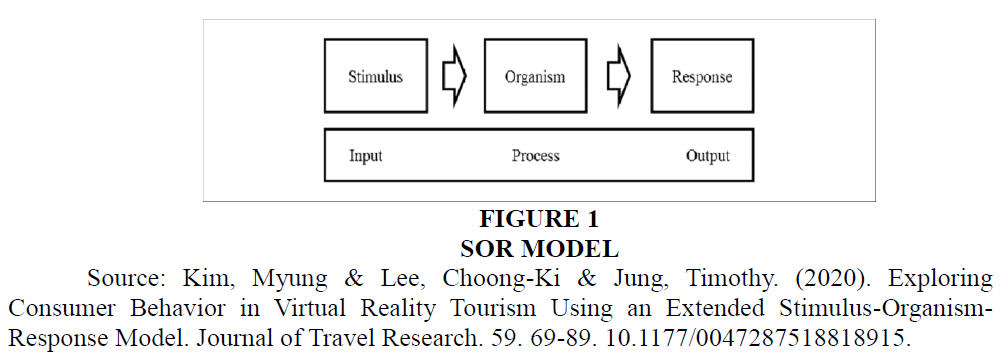
Figure 1 SOR Model
Source: Kim, Myung & Lee, Choong-Ki & Jung, Timothy. (2020). Exploring Consumer Behavior in Virtual Reality Tourism Using an Extended Stimulus-Organism-Response Model. Journal of Travel Research. 59. 69-89. 10.1177/0047287518818915.
Construct and Hypotheses
E-Utility Effects E-Trust
(Jogiyanto, 2019) defines ease as the degree to which a person feels that technology may be easily utilized and doesn't take a lot of work, but it must be simple to use and run. Another way to define ease is the convenience that internet marketing offers, such as the ability to place orders whenever and wherever customers are, day or night. The dimensions of perceived ease are separated into the following categories, as per (Sati, 2020): how easy a system is to use (business), how clear and understandable it is, how easy it is to learn, and how easy the system is overall (easiness). User experience is improved by effective online platforms, which raises e-trust. For example, research indicates that e-trust is significantly impacted by a well-designed user interface and fast service response times. (Raden et al., 2024).
According to (Saoula et al., 2023), the most important predictor of e-trust in online commerce scenarios is reliability. Consumers are more confident when making purchases on reputable websites since they believe them to be trustworthy. According to (Davis, 1989), perceived ease of use (PEOU) is the perception that utilizing the newest technology will be simple. Customers' beliefs that online buying will be easy to use are known as EOU in e-commerce. PEOU has a significant beneficial effect on PU, according to (Gefen et al., 2003), however, (Park et al., 2012) find the opposite effect, namely that PEOU does not affect PU. PEOU serves as both a result of PU and an antecedent of client loyalty in e-commerce (Pebriyanti et al., 2021; Suleman et al., 2019).
H2: E-Trust Influences E-Loyalty
The human-computer interaction (HCI) component of “Jesse James Garrett's user experience (UX) approach” enhances the bond between e-loyalty and e-trust. When clients achieve their goals, they can enjoy themselves, which can boost their satisfaction and confidence and make them want to use and recommend the same supplier in the future (Jeannot et al., 2022).
According to (Anser et al., 2023), a platform's trust has a significant impact on online shoppers' e-loyalty. Consumers who trust a web-based servce will be more dedicated to making purchases online, which helps the businesses bottom line. This is why e-trust and e-loyalty are closely related (Ashiq & Hussain, 2023). Previous studies, like those by (Al-Adwan & Al-Horani, 2019); (Alnaim, 2022); (Ashiq & Hussain, 2023); and (Kuska, 2024), demonstrate a positive relationship between these two constructs. The longevity of e-commerce will be determined by the company's attempts to establish trust, which will have strategic ramifications for online client loyalty Andrea et al., (2021).
Customers are more likely to be loyal to a platform or company in e-commerce if they have a high level of e-trust in them, according to research by (Melinda et al., 2023). When e-trust is established, e-loyalty to e-commerce platforms or businesses tends to grow (Alnaim, 2022). (Pham et al., 2023) found that e-trust is part of the construct of e-loyalty. According to (Gusfei & Pradana, 2022) the e-trust attribute found in e-commerce has an impact on the level of client loyalty. E-trust is important in determining e-loyalty in the sense that consumers' repeat purchases of a product on the website demonstrate e-loyalty to the website,(Giao et al., 2020). This research supports such findings. This theory was developed in light of the previously mentioned research:
Conceptual Framework
The conceptual framework of this study is predicated on the idea that e-utility or the perceived worth and usability of online shopping platforms has a substantial effect on e-trust, or the consumer’s confidence in the dependability and authenticity of the platform. Several past studies show that attributes including website design, reliability, and ease of use significantly boost e-trust (Saoula et al., 2023). E-utility includes features that make people trust a platform, like how easy it is to use, how quickly transactions happen, and how easy it is to find the information you need (Rezaldi et al., 2022; Selvi, 2024). A key indicator of e-loyalty, influenced by e-trust, is a customer's propensity to frequently utilise the platform and endorse it to others.
Past research has shown that trust is a key factor in loyalty and often mediates the relationship between service quality and loyalty (Nazmi et al., 2023; Rifki et al., 2024). By eliminating uncertainty and reinforcing positive experiences, trust services as the cornerstone for cultivating loyalty and minimizing the divide amongst utility and loyalty. This technique shows how building e-trust influences e-utility and e-loyalty, as shown in Figure 2. In a row, it shows how important trust is for getting people to buy things online and keep them.
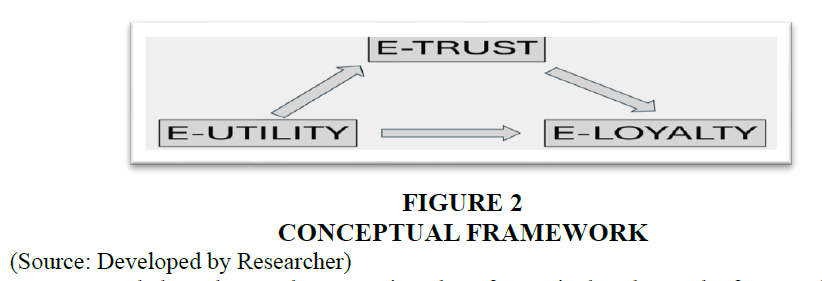
Figure 2 Conceptual Framework
(Source: Developed by Researcher)
Hypotheses
H1: E-Utility has a significant total effect on E-Loyalty
H2: E-Trust significantly mediates the relationship between E-Utility and E-Loyalty
H3: E-Utility has a significant direct effect on E-Loyalty
Research Methodology
This study employs a quantitative approach to test pre-formulated hypotheses and quantitatively assesses the connection between the variables using objective scientific data analysis. The primary data was collected and analysed to guarantee precise and reliable results using statistical tools. The quantitative method makes sure that this research provides a clear and measurable picture of the problem that is being studied. 485 users of online shopping were the respondents for this research. Respondents filled out a questionnaire that was shared via Google Forms. This approach was selected because of its effectiveness in gathering data from respondents systematically and efficiently (Bougie & Sekaran, 2019). SEM was used in the current study to analyse the collected data. It is used in social sciences as the concept of this model along with latent variables is assessed through its indicators, an analysis that combines two discipline methodologies psychometrics and an econometric perspective with an emphasis on prediction. In simple terms, SEM can use latent variables to conduct route analytic analysis (Ghozali, 2021).
Data Analysis and Interpretation
Description of Research Indicators
Interpretation: The descriptive data in Table 1 shows positive perceptions of e-utility in online shopping, with means ranging from 3.448 to 3.520. The standard deviations, range from 1.117 to 1.200. The mean highest-rated, “Online shopping makes it easier and quicker to search for and purchase goods” (mean = 3.520 and SD = 1.200) and the lowest-rated “Online shopping helps me improve my shopping decisions” (mean = 3.448, SD = 1.162).
| Table 1 Descriptive Statistics of E-Utility | |||
| Code | Statement | Mean | Std |
| EU1 | Online shopping makes it easier to satisfy my requirements and expectations. | 3.486 | 1.117 |
| EU2 | Online shopping increases my effectiveness in purchasing electronic products from the e-retailer. | 3.478 | 1.128 |
| EU3 | Online shopping helps me improve my shopping decisions. | 3.448 | 1.162 |
| EU4 | Online shopping makes it easier and quicker to search for and purchase goods. | 3.52 | 1.2 |
| EU5 | Online shopping simplifies the process of finding and buying items streamlining my overall shopping experience. | 3.495 | 1.178 |
Interpretation: The descriptive data as shown in Table 2 shows positive perceptions of e-trust in online shopping, with means ranging from 3.274 to 3.394. The standard deviations range from 1.076 to 1.444. The mean highest-rated, “The e-retailer has a good reputation in the e-commerce industry” (mean = 3.394 and SD = 1.444) and the lowest-rated “The e-retailer keeps its promises to customers” (mean = 3.274, SD = 1.076).
| Table 2 Descriptive Statistics of E-Trust | |||
| Code | Statement | Mean | Std deviation |
| ET1 | I believe that the e-retailer website/app is trustworthy. | 3.341 | 1.139 |
| ET2 | The e-retailer is sincere and honest. | 3.276 | 1.037 |
| ET3 | The e-retailer keeps its promises to customers. | 3.274 | 1.076 |
| ET4 | The e-retailer has a good reputation in the e-commerce industry. | 3.394 | 1.444 |
| ET5 | The e-retailer delivers genuine products and has good quality checks. | 3.331 | 1.104 |
Interpretation: The Table 3 descriptive data shows positive perceptions of e-loyalty in online shopping, with means ranging from 3.272 to 3.421. The standard deviations range from 1.098 to 1.122. The mean highest-rated, “I will share my positive experiences with the e-retailer and recommend it to friends and family” (mean = 3.421 and SD = 1.101), and the lowest-rated “I am committed to consistently buying from the e-retailer in the future” (mean = 3.272, SD = 1.111) Figure 3.
| Table 3 Descriptive Statistics of E-Loyalty | |||
| Code deviation | Statement | Mean | Std |
| EL1 | I will share my positive experiences with the e-retailer and recommend it to friends and family. | 3.421 | 1.101 |
| EL2 | I plan to make more frequent purchases from the e-retailer in the future. | 3.314 | 1.12 |
| EL3 | When making my next purchase the e-retailer will be my preferred choice. | 3.413 | 1.098 |
| EL4 | I am committed to consistently buying from the e-retailer in the future. | 3.272 | 1.111 |
| EL5 | I see myself maintaining a long-term shopping relationship with the e-retailer. | 3.291 | 1.122 |
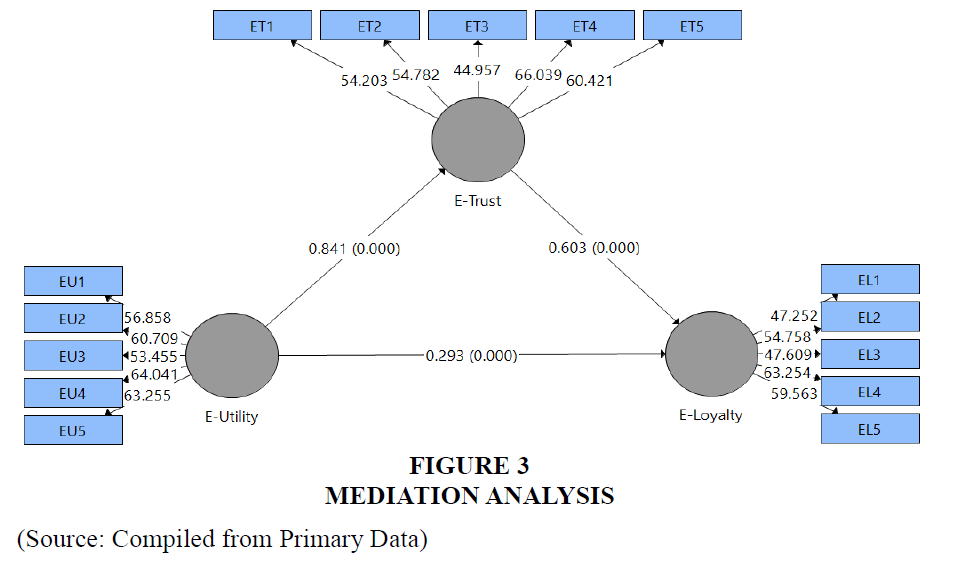
Figure 3 Mediation Analysis
(Source: Compiled from Primary Data)
As shown in Table 4, the constructs of E-Loyalty, E-Trust, and E-Utility all have very good reliability and validity according to the reported values. “Cronbach's Alpha values” (0.912 for E-Loyalty, 0.910 for E-Trust, 0.925 for E-Utility) assure high internal consistency, as they are all above the advised value of 0.7. Also, the “Composite Reliability (CR)” values for all the constructs (between 0.910 and 0.925) prove high reliability, so that the constructs are measured consistently. The “Average Variance Extracted (AVE)” values (E-Loyalty: 0.673, E-Trust: 0.670, E-Utility: 0.711) surpass the benchmark of 0.5, providing sufficient convergent validity and verifying that the corresponding constructs account for a substantial amount of the variation in the observed variables. All these findings support the constructs applicability for additional study in SEM or comparable approaches.
| Table 4 Reliability and Validity | |||
| Construct | Cronbach Alpha | Composite reliability | AVE |
| E-Loyalty | 0.912 | 0.911 | 0.673 |
| E-Trust | 0.91 | 0.91 | 0.67 |
| E-Utility | 0.925 | 0.925 | 0.711 |
The “Fornell-Larcker criterion confirms the discriminant validity” of the constructs of E-Loyalty, E-Trust, and E-Utility. The values on the diagonals are square roots of the AVE of each construct (E-Loyalty: 0.820, E-Trust: 0.819, E-Utility: 0.844), as presented in Table 5. In the corresponding rows and columns, they surpass the interrelated linkages.
| Table 5 Discriminant Validity (Fornell-Larcker Criterion) | |||
| Construct | E-Loyalty | E-Trust | E-Utility |
| E-Loyalty | 0.82 | ||
| E-Trust | 0.815 | 0.819 | |
| E-Utility | 0.81 | 0.795 | 0.844 |
As illustrated in Table 6, E-Utility substantially affects E-Loyalty both directly and indirectly with a combined effect of 0.800 (T-Stats = 39.07, P-value = 0.000). Research indicates that E-trust substantially mediates the connection amongst E-Utility and E-Loyalty, is evidenced by the indirect effect of 0.507 (T-Stats = 12.80, P-value = 0.000). The direct impact of E-Utility to E-Loyalty is still strong at 0.293 (T-Stats = 6.24, P-value = 0.000), indicating that there is a mediation effect. The variance accounted for (VAF) is 63.37%, implying that E-Trust has a moderate influence on the relationship between E-Utility and E-Loyalty. E-Utility directly influences E-Loyalty, but a significant portion of this effect is transmitted by E-Trust, underscoring the critical role of trust in fostering loyalty among the customers Table 7.
| Table 6 Mediation Analysis of E-Utility, E-Trust, and E-Loyalty | |||||
| Relationship Between | Type Of Effect | Std Path Coefficient | T-Stats | P-value | Remark |
| E-Utility à E-Loyalty | Total Effect | 0.8 | 39.07** | 0 | Total Effect Found Significant |
| E-Utility àE-Trust à E-Loyalty | Indirect Effect | 0.507 | 12.80** | 0 | Significant Mediation of E-Trust exists between E-Utility and E-Loyalty. |
| E-Utility à E-Loyalty | Direct Effect | 0.293 | 6.24** | 0 | Partial Mediation of E-Trust exists between E-Utility and E-Loyalty. |
| Strength Of Mediation Effect | Variance Accounted For (VAF) | 63.37% | Moderate Mediation Effect Found | ||
| Table 7 Summary of Hypothesis | |
| Hypothesis | Result |
| H1: E-Utility has a significant total effect on E-Loyalty | Supported |
| H2: E-Trust significantly mediates the relationship between E-Utility and E-Loyalty | Supported |
| H3: E-Utility has a significant direct effect on E-Loyalty | Supported |
Discussion
The findings of this study meet and complement existing research on online consumer behavior. The partial mediation of E-Trust meets with the findings of (Saoula et al., 2023), who found that reliability, user-friendliness, and web design were prime predictors of trust on e-commerce. This study aligns with the findings of (Bahari & Ngelambong, 2018) to indicate that usability and convenience result in loyalty through the development of user comfort and ease of access. The proposed trust-loyalty nexus in the present study is consistent with findings by (Anser et al., 2023; Ashiq & Hussain, 2023), demonstrating that trust significantly shapes online loyalty and intention to purchase again. The findings also support the Stimulus-Organism-Response (SOR) paradigm, according to which E-Utility (the stimulus) affects E-Trust (the organism), which affects E-Loyalty (the response). The findings also support (Abdul & Othman, 2021), who discovered that trust is built through empathy, ease in use, and honesty, and that they drive buying decisions online. The study demonstrates that E-Trust intervenes between the relationship only to some degree, demonstrating that while trust precedes it, all these factors including service quality, customer satisfaction, and website performance each play a unique role independently in influencing loyalty. Thus, the study enhances the theoretical and empirical model for explaining the transition from E-Utility to E-Loyalty via the intervening critical construct of E-Trust within online buying situations
Conclusion
The current study finds that E-Trust is a strong mediating variable between E-Utility and E-Loyalty during online buying, but the mediation is partial and of moderate magnitude. That is, the utility, convenience, and ease of an online bazaar all at once improve customer loyalty. Trust, however, reinforces this relationship by providing positive perceptions and long-term loyalty. Customers are more likely to have faith in an e-commerce website if the website is up and running smoothly and is easy to use. This makes them more likely to keep buying from the same website. The studies show that getting a website to work better is not enough to make customers come back. Shops need to create a secure, reliable, and quality service environment so that they can guarantee customers will come back. The study offers significant evidence regarding the behavioural processes that evoke online loyalty and signals the imperative role of trust as a facilitator between perceived usefulness and repeat participation at e-commerce sites.
References
Al-Adwan, A. S., & Al-Horani, M. A. (2019). Boosting customer e-loyalty: An extended scale of online service quality. Information, 10(12), 380.
Indexed at, Google Scholar, Cross Ref
Ali, A., Hameed, A., Moin, M. F., & Khan, N. A. (2023). Exploring factors affecting mobile-banking app adoption: a perspective from adaptive structuration theory. Aslib Journal of Information Management, 75(4), 773-795.
Indexed at, Google Scholar, Cross Ref
Alnaim, A. F., Sobaih, A. E. E., & Elshaer, I. A. (2022). Measuring the Mediating Roles of E-Trust and E-Satisfaction in the Relationship between E-Service Quality and E-Loyalty: A Structural Modeling Approach. Mathematics, 10(13), 2328.
Indexed at, Google Scholar, Cross Ref
Alnsour, I. R. (2022). Impact of fintech over consumer experience and loyalty intentions: an empirical study on Jordanian Islamic Banks. Cogent Business & Management, 9(1), 2141098.
Indexed at, Google Scholar, Cross Ref
Andrea, H. L. P., Kartonoc, R., & Sundjajad, A. M. (2021). The effect of perceived usefulness, perceived ease of use, perceived risk and technology readiness on intention to use e-banking in Jakarta. Turkish Journal of Computer and Mathematics Education, 12(10), 6829-6836.
Indexed at, Google Scholar, Cross Ref
Anser, M. K., Tabash, M. I., Nassani, A. A., Aldakhil, A. M., & Yousaf, Z. (2023). Toward the e-loyalty of digital library users: investigating the role of e-service quality and e-trust in digital economy. Library Hi Tech, 41(4), 1006-1021.
Indexed at, Google Scholar, Cross Ref
Bougie, R., & Sekaran, U. (2019). Research methods for business: A skill building approach. john wiley & sons.
Indexed at, Google Scholar, Cross Ref
Capestro, M., Rizzo, C., Kliestik, T., Peluso, A. M., & Pino, G. (2024). Enabling digital technologies adoption in industrial districts: The key role of trust and knowledge sharing. Technological Forecasting and Social Change, 198, 123003.
Indexed at, Google Scholar, Cross Ref
Chen, Y., & Xie, J. (2008). Online consumer review: Word-of-mouth as a new element of marketing communication mix. Management science, 54(3), 477-491.
Indexed at, Google Scholar, Cross Ref
Cheng, W., Tian, R., & Chiu, D. K. (2024). Travel vlogs influencing tourist decisions: information preferences and gender differences. Aslib Journal of Information Management, 76(1), 86-103.
Indexed at, Google Scholar, Cross Ref
Davis, F. D. (1989). Perceived usefulness, perceived ease of use, and user acceptance of information technology. MIS Quarterly, 13(3), 319. https://doi.org/10.2307/24900814
Indexed at, Google Scholar, Cross Ref
Dwivedi, Y. K., Ismagilova, E., Hughes, D. L., Carlson, J., Filieri, R., Jacobson, J., ... & Wang, Y. (2021). Setting the future of digital and social media marketing research: Perspectives and research propositions. International journal of information management, 59, 102168.
Indexed at, Google Scholar, Cross Ref
Ellitan, L., & Suhartatik, A. (2023). The role of e-trust and e-service quality in building e-loyalty and e-satisfaction. J-CEKI: Jurnal Cendekia Ilmiah, 2(3), 303-311.
Indexed at, Google Scholar, Cross Ref
Gefen, D., Karahanna, E., & Straub, D. W. (2003). Trust and TAM in online shopping: An integrated model. MIS quarterly, 51-90.
Giao, H. N. K., Vuong, B. N., & Quan, T. N. (2020). The influence of website quality on consumer’s e-loyalty through the mediating role of e-trust and e-satisfaction: An evidence from online shopping in Vietnam. Uncertain Supply Chain Management, 8 (2), 351–370.
Indexed at, Google Scholar, Cross Ref
Gusfei, A. D., & Pradana, M. (2022). The effect of e-service quality and e-trust on mobile payment application e-customer loyalty through e-customer satisfaction as intervening variable. Res Militaris, 12(2), 166-180.
Habbal, A., Ali, M. K., & Abuzaraida, M. A. (2024). Artificial Intelligence Trust, risk and security management (AI trism): Frameworks, applications, challenges and future research directions. Expert Systems with Applications, 240, 122442.
Indexed at, Google Scholar, Cross Ref
Huang, Z., & Benyoucef, M. (2013). From e-commerce to social commerce: A close look at design features. Electronic Commerce Research and Applications, 12(4), 246-259.
Indexed at, Google Scholar, Cross Ref
Hur, Y., Ko, Y. J., & Valacich, J. (2011). A structural model of the relationships between sport website quality, e-satisfaction, and e-loyalty. Journal of sport management, 25(5), 458-473.
Indexed at, Google Scholar, Cross Ref
Jain, V., Malviya, B. I. N. D. O. O., & Arya, S. A. T. Y. E. N. D. R. A. (2021). An overview of electronic commerce (e-Commerce). Journal of Contemporary Issues in Business and Government, 27(3), 666.
Indexed at, Google Scholar, Cross Ref
Jeannot, F., Jongmans, E., & Dampérat, M. (2022). Design visuel et expérience d’achat en ligne: quand l’expertise permet aux consommateurs de se (re) centrer sur l’attractivité du site d’e-commerce. Recherche et Applications en Marketing (French Edition), 37(1), 61-86.
Indexed at, Google Scholar, Cross Ref
Kamal, S. B. M., Abdullah, D., Nor, N. M., Ngelambong, A., & Bahari, K. A. (2018). Hotel booking websites and their impact on e-satisfaction and e-loyalty: analysis on utilitarian and hedonic features. International Journal of Academic Research in Business and Social Sciences, 8(15), 160-177.
Indexed at, Google Scholar, Cross Ref
Kartono, R. A., & Halilah, I. (2019, August). Pengaruh E-Trust Terhadap E-Loyalty (Studi Pada Seller Di Bukalapak). In Prosiding Industrial Research Workshop and National Seminar (Vol. 10, No. 1, pp. 1204-1213).
Indexed at, Google Scholar, Cross Ref
Kedaton, N. R. S., Sadat, A. M., & Sari, D. A. P. (2024). The Effect of E-Trust, Information Quality and User Interface Quality on E-Customer Loyalty Through E-Satisfaction as an Intervening Variable:(Study on Tokopedia Users in Jabodetabek). International Journal Of Education, Social Studies, And Management (IJESSM), 4(2), 720-733.
Indexed at, Google Scholar, Cross Ref
Kim, J., Jin, B., & Swinney, J. L. (2009). The role of etail quality, e-satisfaction and e-trust in online loyalty development process. Journal of retailing and Consumer services, 16(4), 239-247.
Indexed at, Google Scholar, Cross Ref
Kurumbatu, S. (2024). The Mediating Role of Trust in E-commerce Purchase Intention: Evidence from Lazada Users in Jakarta. Asian Journal of Social and Humanities, 2(12), 2941-2962.
Indexed at, Google Scholar, Cross Ref
Kuska, D. A. R., Wijayanto, H., & Santoso, A. (2024). Improving the e-satisfaction and e-loyalty based on e-trust and e-service quality on Shopee customer. Journal of Consumer Sciences, 9(1), 22-39.
Indexed at, Google Scholar, Cross Ref
Liu, C., & Arnett, K. P. (2000). Exploring the factors associated with Web site success in the context of electronic commerce. Information & management, 38(1), 23-33.
Indexed at, Google Scholar, Cross Ref
Martio, N. A., & Moko, W. (2023). Measuring the mediating role of e-trust in the relationship between e-service quality and e-loyalty on gen Z users of the shopee Apps. International Journal of Research in Business and Social Science, 12(8), 24-32.
Indexed at, Google Scholar, Cross Ref
Melinda, E., Usman, O., & Aditya, S. (2023). The effect of e-service quality and e-trust on e-loyalty with e-satisfaction as an intervening for mobile banking user. Jurnal dinamika manajemen dan bisnis, 6(1), 80-96.
Indexed at, Google Scholar, Cross Ref
Mota, F. P. B., & Cilento, I. (2020). Competence for internet use: Integrating knowledge, skills, and attitudes. Computers and Education Open, 1, 100015.
Indexed at, Google Scholar, Cross Ref
Oktaviali, M. R., Sidiq, F. M., Azzahra, K., & Romdonny, J. (2024). The Effect Of E-Service Quality and E-Trust On E-Loyalty With E-Satisfaction As The Intervening Variable. International Journal Of Humanities Education and Social Sciences, 3(6).
Othman, A. K. (2021). The mediating role of customer trust in affecting the relationship between online shopping factors and customer purchase decision. Journal of Information Technology Management, 13(3), 141-159.
Park, J. S., Hyun, J. H., Fairhurst, A., & Lee, K. H. (2012). Perceptions of presence as antecedents to e-tail shopping-An extended technology acceptance model. The Research Journal of the Costume Culture, 20(3), 451-462.
Patil, A., Viswanath Karad, M. I. T., Kaushik, P. M. K., & Viswanath Karad, M. I. T. (2025). IMPACT OF E-CRM ON E-LOYALTY IN ONLINE RETAILING. Academy of Marketing Studies Journal, 29(3).
Qatawneh, N., Alkhasawneh, R., Althonayan, A., & Altarawneh, A. (2023). Examining the Influence of Website Quality on Citizen’s E‐Loyalty in Domestic Tourism in Jordan: The Role of E‐Trust and E‐Satisfaction. Human Behavior and Emerging Technologies, 2023(1), 2614673.
Indexed at, Google Scholar, Cross Ref
Saif, S., Zameer, H., Wang, Y., & Ali, Q. (2024). The effect of retailer CSR and consumer environmental responsibility on green consumption behaviors: mediation of environmental concern and customer trust. Marketing Intelligence & Planning, 42(1), 149-167.
Saoula, O., Shamim, A., Mohd Suki, N., Ahmad, M. J., Abid, M. F., Patwary, A. K., & Abbasi, A. Z. (2023). Building e-trust and e-retention in online shopping: the role of website design, reliability and perceived ease of use. Spanish Journal of Marketing-ESIC, 27(2), 178-201.
Suleman, D. (2019). Perceived ease of use, trust and risk toward attitude and intention in shopping for online fashion products in Indonesia. Archives of Business Research, 7(4).
Tran, G. A., & Strutton, D. (2020). Comparing email and SNS users: Investigating e-servicescape, customer reviews, trust, loyalty and E-WOM. Journal of Retailing and Consumer Services, 53, 101782.
Udayana, A. A. G. B., Fatmawaty, A. S., Makbul, Y., Priowirjanto, E. S., Ani, L. S., Siswanto, E., ... & Andriani, S. (2023). Investigating the role of e-commerce application and digital marketing implementation on the financial and sustainability performance: An empirical study on Indonesian SMEs. International Journal of Data and Network Science, 8(24), 167-178.
Zeithaml, V. A., Parasuraman, A., & Malhotra, A. (2002). Service quality delivery through web sites: a critical review of extant knowledge. Journal of the academy of marketing science, 30(4), 362-375.
Received: 21-Oct-2025, Manuscript No. AMSJ-25-16332; Editor assigned: 22-Oct-2025, PreQC No. AMSJ-25-16332(PQ); Reviewed: 29- Oct-2025, QC No. AMSJ-25-16332; Revised: 05-Nov-2025, Manuscript No. AMSJ-25-16332(R); Published: 12-Nov-2025