Research Article: 2026 Vol: 30 Issue: 1
Investigating Sustainability Practices of Star-Rated Hotels and Customer Citizenship Behavior: Empirical Insights from Sub-Saharan Africa
Michael Boadi Nyamekye, University of Professional Studies, Accra
Juliana Aku Shika Andoh, University of Professional Studies, Accra
Andrews Ayiku, University of Professional Studies, Accra
Joel Okoe Quarcoe, University of Professional Studies, Accra
Akwasi Safo Kantanka, University of Professional Studies, Accra
Citation Information: Boadi Nyamekye, M., Shika Andoh, J.A., Ayiku, A., Okoe Quarcoe, J., & Kantanka, A.S. (2025) investigating sustainability practices of star-rated hotels and customer citizenship behavior: empirical insights from subsaharan africa. Academy of Marketing Studies Journal, 30(1), 1-15.
Abstract
This study examines whether sustainability practices implemented by four- and five-star hotels in Ghana encourage customers to engage in discretionary “citizenship”. Guided by social exchange theory (SET) and norm activation theory (NAT), a conceptual model was developed to examine the influence of the five sustainability practices on customer citizenship behavior (CCB). Survey data were collected from guests at star-rated hotels in Accra and analysed using partial least squares structural equation modeling. All five practices showed positive and significant relationships with CCB. The findings suggest that guests view visible sustainability initiatives as positive gestures worthy of reciprocity and that personal norms activated by awareness of environmental consequences motivate environmental actions. The study contributes to hospitality research by integrating reciprocal and moralânorm perspectives, demonstrating that comprehensive sustainability efforts are effective antecedents of CCB in a developing-country context.
Introduction
Sustainability practices have become a crucial concern for service industries, particularly hospitality, where operations heavily impact the environment and communities. As hotels consume vast amounts of energy, water, and land resources, they are increasingly expected to embed sustainable practices into their business models, not only to comply with regulatory demands but also to meet the rising expectations of environmentally conscious customers (Khalil et al., 2024; Nogueira, Gomes & Lopes, 2023). In this regard, Asih and Normasari (2025) argues that star-rated hotels are uniquely positioned to lead by example, as their visibility and reputation create opportunities to shape both industry standards and consumer behavior. Sustainable practices such as waste separation, energy reduction, water conservation, adoption of green products, and sustainable land management have therefore gained prominence as critical elements of hotel operations designed to safeguard natural resources while enhancing long-term business performance.
Alongside these operational practices, the role of customers has become equally important in realizing sustainability goals (Irfan & Bryła, 2025). Guests are no longer passive recipients of services; rather, they are active participants whose behaviors greatly influence the effectiveness of hotel sustainability initiatives. This shift underscores the relevance of customer citizenship behavior (CCB), which refers to voluntary and discretionary actions by customers that support service organizations beyond their contractual roles (Gong & Yi, 2021). In the hotel context, CCB may manifest when hotels willingly separate their waste or have in place different dustbins for guests to segregate their waste, installed water or energy-saving devices and use of eco-friendly products among other sustainable habits. In other words, CCB may occur when guests enthusiastically separate their waste, cooperate with water or energy-saving measures, promote the use of eco-friendly products, or even encourage fellow guests to adopt sustainable habits. By engaging in these behaviors, guests not only support hotel operations but also reinforce their own sense of contribution to environmental preservation and community well-being.
Globally, sustainability-driven behaviors such as these are gaining momentum as consumers become more aware of pressing environmental challenges, including climate change, pollution, and biodiversity loss (Mitrega et al., 2022; Tran et al., 2025). These issues have amplified calls for businesses to integrate sustainability principles, with hospitality being one of the most scrutinized sectors (Fauzi et al., 2024). Within this framework, hotel sustainability practices represent potential triggers for CCB, motivating customers to go beyond transactional exchanges and reciprocate through supportive, extra-role behaviors (Abdou et al., 2022; Li & Wei, 2021).
Notwithstanding the increasing attention to sustainability practices, empirical research linking specific hotel practices waste separation, energy reduction, water conservation, green products, and land management with CCB remains limited. Preceding work confirms that CCB contributes significantly to service quality and competitive advantage (Anaza, 2014; Jung & Yoo, 2017), yet little is known about how sustainability initiatives specifically green products, waste separation, energy reduction, water conservation, and land management shape such behaviors in the hotel sector (Hur, Kim & Kim, 2018; Hwang & Lee, 2019). Likewise, empirical evidence of how these sustainability practices influence CCB in hotels remains scarce in a developing country like Ghana where sustainable hospitality is still at a formative stage (Mensah & Ampofo, 2021). Given the country’s rising tourism sector and growing environmental concerns, probing how these hotels sustainability practices shape guest behaviours is both timely and strategically vital for advancing theory and guiding practice in emerging economies.
Addressing these gaps, the present study adopts Social Exchange Theory (SET) and Norm Activation Theory (NAT). SET postulates that customers are likely to reciprocate positive actions from service providers with supportive behaviors when they perceive value and fairness in the exchange (Blau, 1964). Therefore, when hotels demonstrate environmental responsibility, guests may respond with discretionary behaviors that support hotel operations. NAT, on the other hand, stresses the role of personal moral norms and awareness of consequences in motivating prosocial and pro-environmental actions (Schwartz, 1977). Applying NAT helps to explain why customers may feel morally obliged to engage in sustainability-supportive CCB such as waste sorting or energy conservation when they recognize the environmental consequences of inaction and feel personally responsible to contribute. By integrating these two theories, this study provides a richer theoretical foundation for understanding the interplay between sustainability practices and hotel guest citizenship behavior.
Accordingly, this research develops and tests a conceptual model to investigate the extent to which the sustainability practices of waste separation, energy reduction, water conservation, green products, and land management influence CCB in star-rated hotels. The study not only advances theoretical understanding by bridging SET and NAT but also offers practical insights for hotel managers seeking to leverage sustainability as a pathway to stimulate customer participation and achieve competitive advantage in an emerging country. The rest of the paper is organized as follows. First, the next section discusses the theoretical context and literature review, the research model and hypotheses for the study. The methodology for the study also follows, along with study results, analyses and discussions of findings. The paper concludes with some implications for theory and practice, as well as provides some avenues for future research.
Literature Review
Two influential theories, namely SET and NAT, are employed to anchor the study. SET provides a useful lens for understanding why hotel guests may engage in discretionary behaviors that support sustainability initiatives. The theory posits that social interactions are based on reciprocal exchanges, where individuals weigh the perceived benefits of their actions against the costs involved (Blau, 1964). In the hospitality context, when hotels demonstrate responsibility through practices such as waste separation, energy reduction, water conservation, green product adoption, and sustainable land management, guests may perceive added value in their service experience. This sense of value and fairness can stimulate a willingness to reciprocate through CCB for example, willingly helping other guests to adopt eco-friendly practices or tolerating inconveniences associated with sustainable operations (Gong & Yi, 2021). Hence, SET highlights how the mutual reinforcement of sustainable hotel practices and customer responses can create a cycle of value co-creation that benefits both the firm and its clientele (Van Tonder & De Beer, 2018).
NAT further strengthens the understanding of CCB by emphasizing the role of moral obligation and personal norms in shaping customer actions. According to NAT, individuals are more likely to engage in prosocial or pro-environmental behaviors when they are aware of the negative consequences of inaction and feel personally responsible for addressing those consequences (Schwartz, 1977). In the case of hotels, guests who recognize the environmental impact of unsustainable practices such as water waste, energy overuse, or poor land management may feel morally compelled to support sustainability initiatives. This moral activation can manifest in behaviors like separating waste correctly, conserving water during their stay, or encouraging peers to respect green product usage (Kiatkawsin & Han, 2017). By merging NAT with SET, the study captures both the rational-exchange perspective and the moral-normative dimension of CCB, offering a comprehensive framework to explain why guests engage in voluntary behaviors that advance hotel sustainability goals (Hwang & Lyu, 2020).
Sustainability Practices
The discourse on sustainability has evolved significantly over the past five decades, moving from a marginal concern to a central pillar of global development debates. Although early references to sustainability can be traced back to environmental activism in the mid-20th century, its prominence surged with the United Nations Conference on the Human Environment held in Stockholm in 1972, which underscored the urgent need for coordinated global action to mitigate escalating ecological challenges (Du Pisani, 2006). This conference provided the foundation for subsequent international dialogue on sustainability and ended in the influential Brundtland Report of the World Commission on Environment and Development [WCED] (1987), which defined sustainable development as the pursuit of present needs without compromising the ability of future generations to meet their own. The Brundtland definition, though widely cited, sparked debates about operational clarity and measurement, with scholars such as Hopwood, Mellor and O’Brien (2005) emphasizing the persistent ambiguity surrounding the concept.
Beyond definitional debates, sustainability has come to be understood as a multidimensional paradigm encompassing environmental integrity, social equity, and economic viability commonly referred to as the “triple bottom line” (Elkington, 1997). This viewpoint shifts the dialog from abstract principles to actionable practices, requiring businesses and communities alike to integrate long-term ecological responsibility with social and economic objectives (Hamsson, 2010). On this basis, sustainability is not merely about minimizing harm but also about fostering positive outcomes such as resource efficiency, community well-being, and intergenerational justice. It demands ethical responsibility, global support, and context-specific strategies that align with the unique challenges of different sectors, including hospitality. As such, sustainability practices whether through energy conservation, waste management, or eco-friendly innovation, are positioned as practical vehicles through which organizations can demonstrate accountability while creating enduring value for society and the environment.
Consumer citizenship behavior (CCB)
The concept of CCB has gained prominence in marketing and service research due to its critical role in strengthening service delivery and enhancing organizational performance. Rooted in the broader literature on organizational citizenship behaviour, CCB reflects the ways in which customers voluntarily contribute beyond their contractual obligations, thereby enriching the service experience for both the firm and other customers (Groth, 2005). Unlike core participation behaviors that are required for service delivery, CCB represents discretionary acts that are neither explicitly demanded nor directly rewarded, yet they create substantial value by improving service quality and reinforcing customer–firm relationships. This makes CCB a key construct in understanding customer engagement and co-creation within modern service environments (Balaji, 2014).
Scholars have identified several dimensions of CCB that illustrate its multifaceted nature. Gong and Yi (2021) outline key manifestations such as: recommending the firm’s services to friends and relatives; providing constructive feedback and suggestions for improvement; assisting other customers in navigating the service process; and displaying relationship affiliation by demonstrating loyalty and advocacy. Other expressions of CCB include participation in firm-sponsored events and research activities, tolerance and patience during service failures, and flexibility in adapting to unforeseen circumstances beyond the firm’s control. These behaviors not only ease the burden on service employees but also foster a collaborative service environment, where customers actively contribute to value co-creation (Jung & Yoo, 2017). From this perspective, CCB is not merely an outcome of customer satisfaction but a strategic asset that helps firms build resilience, innovate service processes, and gain competitive advantage in increasingly dynamic markets.
Hypotheses Development
The conceptual model (figure 1) posits that waste separation, energy reduction, water conservation, green products, and land management as hotel sustainable practices each positively and significantly influence customer citizenship behavior (CCB).
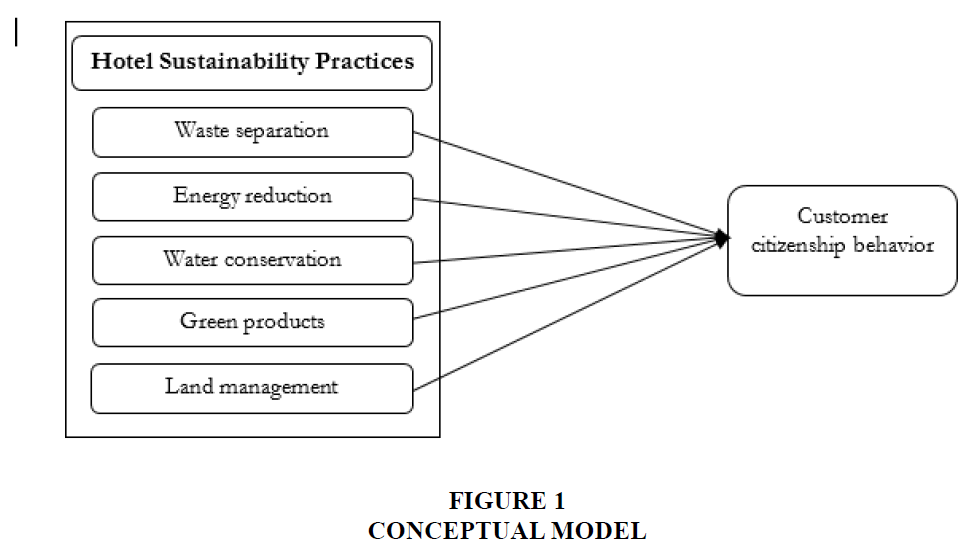
Figure 1 Conceptual Model
Waste separation has become a vital component of hotel sustainability management, with practices extending beyond internal operations to include guest participation. In many star-rated hotels, waste is sorted on-site using designated containers, while materials such as single-use plastics, disposables, and paper products are eliminated to prevent environmental harm and reinforce a culture of reuse (e.g., cloth napkins, cutlery, and glass bottles). Such measures not only reduce operational costs and pest risks but also signal a hotel’s commitment to environmental responsibility, which can, in turn, elicit voluntary customer support. Research shows that visible sustainability practices positively influence guests’ perceptions of corporate responsibility and motivate them to engage in CCB such as properly sorting their own waste, complying with hotel policies, and even encouraging peers to do the same (Han et al., 2010; Hur et al., 2018; Gong & Yi, 2021). By co-participating in waste management, guests contribute to both environmental protection and service efficiency, reinforcing the co-creation of value in the hospitality context. Based on this reasoning, it is posited that:
H1: Waste separation of hotel sustainable practices positively and significantly influences CCB.
Energy reduction represents one of the most pressing sustainability challenges for hotels, given their reliance on electricity and fossil fuels for heating, cooling, lighting, and guest services (Prud’homme & Raymond, 2013). Consequently, energy reduction initiatives such as the adoption of renewable sources (solar, wind), smart energy systems, motion sensors, energy-efficient lighting, and digital thermostats have become integral to responsible hotel management. Beyond reducing operational costs, these practices also serve as visible signals of environmental responsibility that can foster positive customer responses. Prior studies have shown that when guests perceive hotels as actively reducing energy use, they are more likely to reciprocate through discretionary behaviours, including conserving energy during their stay and promoting the hotel to others (Farrou et al., 2012; Kim et al., 2017). In this vein, it is hypothesized that:
H2. Saving reduction of hotel sustainable practices positively and significantly influences CCB.
Water conservation has emerged as one of the most critical pillars of sustainable hotel management, given the sector’s heavy reliance on water for housekeeping, landscaping, guest amenities, and food services (Bohdanowicz, 2005). Modern conservation practices extend beyond simply reducing consumption to include systemic initiatives such as installing low-flow showerheads, sensor-based faucets, dual-flush toilets, towel and linen reuse programs, and recycling greywater for non-potable purposes (Han et al., 2011). These visible efforts not only reduce operational costs and environmental footprints but also send a strong signal of corporate responsibility that resonates with environmentally conscious guests. Within this context, such practices are likely to generate reciprocal behaviours, as customers often respond to perceived organizational goodwill with voluntary actions that benefit the firm. Empirical evidence confirms that water-saving initiatives greatly improve customer attitudes, satisfaction, and willingness to support hotels through discretionary behaviours, such as offering positive word-of-mouth or signifying tolerance during minor inconveniences (Manaktola & Jauhari, 2007; Han et al., 2018). Thus, it is hypothesized that:
H3. Water conversation of hotel sustainable practices positively and significantly influences CCB.
The adoption of environmentally friendly products, commonly referred to as green products, is a vital sustainability practice that mitigates the negative environmental impact of hotel operations. Hotels increasingly buy cleaning and maintenance products that are biodegradable, non-toxic, and eco-certified, while minimizing the use of harsh chemicals, such as treating swimming pools through salt electrolysis instead of chemical chlorination (Bagur-Femenias et al., 2013). These practices signal the hotel’s commitment to environmental stewardship, which, can elicit reciprocal positive behaviors from guests. Specifically, guests who perceive that hotels are taking active measures to protect the environment may respond by engaging in CCB, like providing constructive suggestions, helping other customers, or showing patience and cooperation during service processes (Yi & Gong, 2006; Groth, 2005). Empirical studies support this relationship, indicating that eco-friendly practices influence guests’ willingness to voluntarily contribute to the service environment (Han et al., 2011; Kim et al., 2017). So, based on the empirical evidence, the following hypothesis is proposed:
H4: Green products of hotel sustainable practices positively and significantly influence CCB.
Land management in hotels involves the strategic use, preservation, and rehabilitation of natural spaces to lessen environmental degradation and promote ecological balance. This includes practices such as maintaining gardens and green spaces, controlling soil erosion, avoiding deforestation, and ensuring that hotel expansions do not encroach on sensitive ecosystems (Mensah, 2006). Effective land management also encompasses the careful planning of outdoor recreational areas to prevent overuse and degradation of natural resources while encouraging biodiversity conservation. From a social exchange perspective, guests recognize and appreciate hotels’ commitment to protecting natural landscapes, which may encourage them to engage in CCB voluntary actions such as providing feedback, recommending the hotel, assisting other guests, or promoting sustainable practices observed during their stay (Groth, 2005; Yi & Gong, 2006). Empirical studies suggest that guests who perceive a hotel’s proactive environmental stewardship are more likely to reciprocate through behaviors that benefit the organization beyond transactional interactions (Kim et al., 2017; Farrou et al., 2012). So, this study hypothesizes:
H4: Land management of hotel sustainable practices positively and significantly influence CCB.
Methodology
To empirically examine the hypothesized relationships underpinning this study, a quantitative research approach employing a structured questionnaire was adopted (Hair et al., 2010). Five hundred (500) guests were surveyed across three five-star and two four-star hotels in Accra. These hotels were chosen because Accra hosts Ghana’s highest concentration of top-tier properties, and these establishments are recognised for their advanced sustainability initiatives making them well suited for examining how guests respond to such practices. The study focused on four- and five-star hotels in Accra since these establishments are widely known for their luxury offerings and for indicating strong commitment to environmental sustainability (Abdou et al., 2020). Accra was selected as the study area due to its status as the capital city and its concentration of star-rated hotels, which surpasses that of the other fifteen regions in Ghana (Narteh et al., 2013).
Hotel star ratings, which range from one to five, reflect the overall quality of services and facilities provided, with higher ratings signifying superior service delivery (Hinson, Abdul-Hamid & Osabutey, 2017). For this study, only 4-and-5-star hotels were included due to their extensive implementation of sustainability practices. Data were collected using an intercept survey technique, whereby respondents were approached on-site while enjoying the hotel services (Walls, 2013). Only guests with prior experience interacting with the hotels were included. To select participants, all eligible hotels were approached for consent, and individuals present in the lobby who voluntarily agreed to participate were conveniently selected to complete the questionnaire. This approach ensured that respondents had direct experience with the services and sustainability initiatives of the hotels, thereby enhancing the reliability and relevance of the data collected.
Results
Sample Characteristics
Among the 500 respondents, 53.8 % were male and 46 % female. The sample was predominantly aged 48–57 (75.8 %), with 22 % aged 28–37 and 2.2 % aged 38–47. Most guests held a university degree (64 %) or postgraduate qualification (31.4 %); 4.6 % had an HND. Leisure/holiday was the most common visit purpose (34.6 %), followed by business/work (22.4 %) and conferences (8 %); 30.4 % selected “other.” Length of stay was typically two–three nights (42.4 %), with single-night stays at 18.4 %; 16.4 % stayed four–seven nights and another 16.4 % more than two weeks, while 6.4 % stayed eight–14 nights Table 1.
| Table 1 Profile of Respondents | |||
| Details | Frequency | Percent | |
| Gender | Male | 269 | 53.8 |
| Female | 230 | 46.0 | |
| Missing | 1 | .2 | |
| Age | 28-37 | 110 | 22.0 |
| 38-47 | 11 | 2.2 | |
| 48-57 | 379 | 75.8 | |
| Education | HND | 23 | 4.6 |
| University Degree | 320 | 64.0 | |
| Postgraduate | 157 | 31.4 | |
| Purpose of visit | Leisure/holiday | 173 | 34.6 |
| Business/work | 112 | 22.4 | |
| Conference | 40 | 8.0 | |
| Special event (wedding, concert, etc.) | 23 | 4.6 | |
| Other | 152 | 30.4 | |
| Length of stay | 1 night | 92 | 18.4 |
| 2–3 nights | 212 | 42.4 | |
| 4–7 nights | 82 | 16.4 | |
| 8–14 nights | 32 | 6.4 | |
| More than 2 weeks | 82 | 16.4 | |
| Total | 500 | 100.0 | |
Measurement Model Assessment
The statistical software for analysing the measurement and structural model was Smart PLS-SEM 3. We first examined our indicator, and as shown in figure 2, except for LM1, all our items loaded well on their construct. All items had a loading greater than the recommended 0.7 (xxx), suggesting that the indicators demonstrated good convergent validity and were reliable measures of their underlying constructs.
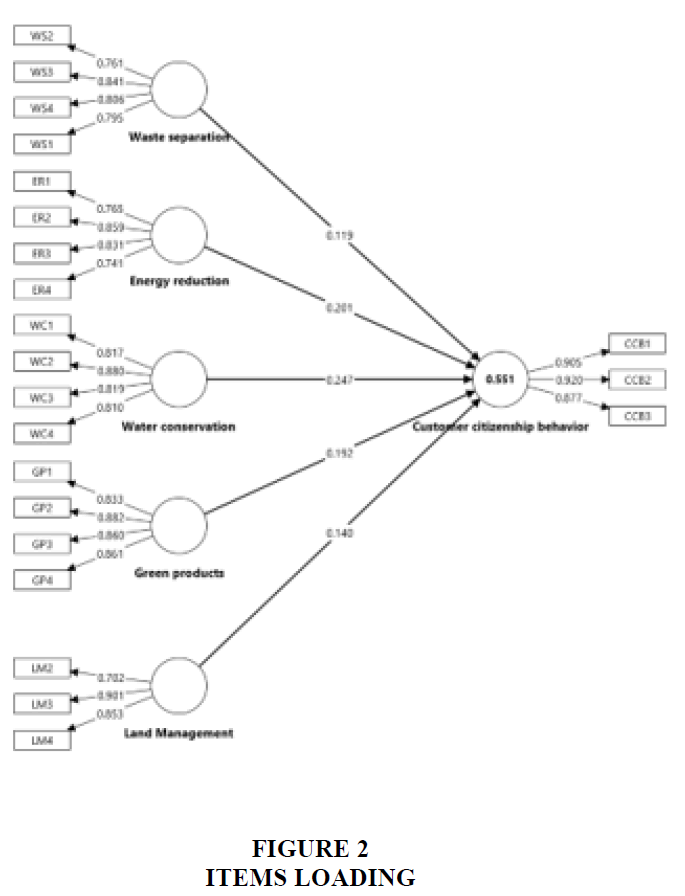
Figure 2 Items Loading
Construct reliability and validity were also assessed. As shown in Table 2, Cronbach’s alpha values ranged from 0.732 to 0.884, above the 0.70 threshold (Nunnally & Bernstein, 1994). Composite reliability (ρa and ρc) values ranged between 0.732 and 0.928, also above the 0.70 cutoff (Hair et al., 2019), confirming internal consistency reliability. Convergent validity was established, with Average Variance Extracted (AVE) values ranging from 0.557 to 0.812, surpassing the recommended 0.50 criterion (Fornell & Larcker, 1981). CCB demonstrated the strongest reliability and validity (α = 0.884; ρc = 0.928; AVE = 0.812), while Land Management, though relatively lower (α = 0.732; AVE = 0.557), remained acceptable. Discriminant validity was confirmed using the Heterotrait–Monotrait (HTMT) ratios, all of which were below the conservative threshold of 0.85 (Henseler et al., 2015), supporting construct distinctiveness Table 2.
| Table 2 Reliability and Validity Assessment | |||||||||||
| 1 | 2 | 3 | 4 | 5 | 6 | α | rho_a | rho_c | AVE | ||
| 1 | Customer citizenship behavior | 0.884 | 0.887 | 0.928 | 0.812 | ||||||
| 2 | Energy reduction | 0.722 | 0.812 | 0.816 | 0.877 | 0.641 | |||||
| 3 | Green products | 0.716 | 0.722 | 0.881 | 0.882 | 0.918 | 0.738 | ||||
| 4 | Land Management | 0.662 | 0.689 | 0.671 | 0.732 | 0.817 | 0.828 | 0.557 | |||
| 5 | Waste separation | 0.614 | 0.6 | 0.614 | 0.65 | 0.814 | 0.821 | 0.877 | 0.642 | ||
| 6 | Water conservation | 0.763 | 0.77 | 0.834 | 0.743 | 0.635 | 0.851 | 0.853 | 0.9 | 0.692 | |
Hypotheses Testing
The hypotheses were examined using PLS-SEM with 5,000 bootstrap resamples. As shown in figure 3, all five hypothesized relationships were statistically significant. Energy reduction (β = 0.205, t = 4.067, p < 0.001), green products (β = 0.191, t = 3.376, p = 0.001), land management (β = 0.127, t = 2.853, p = 0.004), waste separation (β = 0.122, t = 2.832, p = 0.005), and water conservation (β = 0.250, t = 4.464, p < 0.001) all exhibited positive effects on CCB. Accordingly, hypotheses H1 through H5 are supported, confirming that sustainability practices significantly predict CCB.
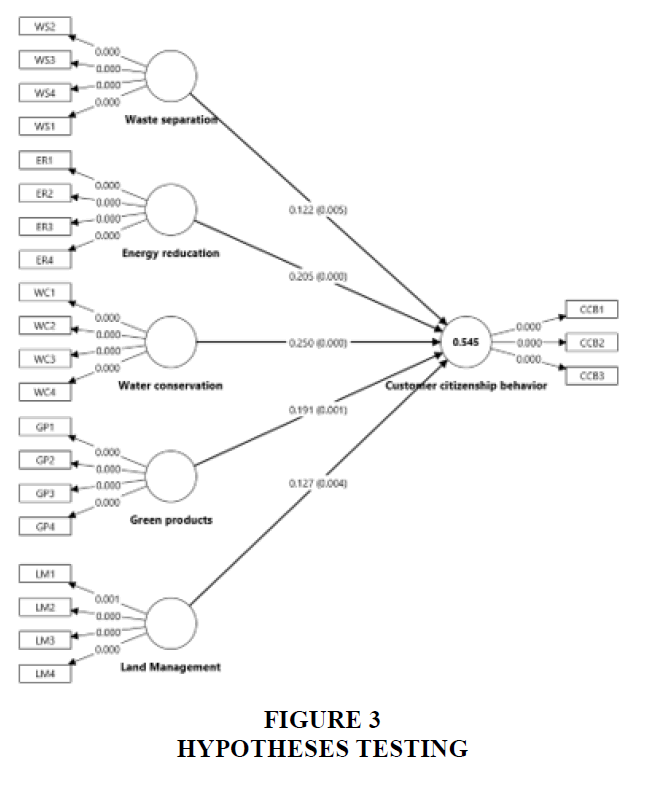
Figure 3 Hypotheses Testing
Discussion
The structural model showed that all five sustainability practices examined in this study had positive and significant effects on customer citizenship behaviour (CCB). Among these practices, water conservation produced the strongest effect (β=0.250), followed by energy reduction (β=0.205), green products (β=0.191), land management (β=0.127) and waste separation (β=0.122). These results support the central proposition of SET that individuals reciprocate favourable actions from service providers with discretionary behaviours that benefit the organisation. SET views social interactions as reciprocal exchanges in which voluntary actions are motivated by anticipated returns; Blau’s seminal articulation notes that exchange behaviour refers to voluntary actions of individuals that are motivated by the returns they are expected to bring (Ahmad et al., 2023). By investing in visible sustainability initiatives such as waste separation bins, smart-energy systems, water-saving devices, eco-friendly products and landscaped green spaces, hotels signal fairness and value to guests, prompting them to reciprocate through extra-role behaviours like helping other guests, providing feedback and tolerating minor inconveniences.
The findings also corroborate NAT, which asserts that personal norms drive prosocial behaviours when individuals are aware of the consequences of inaction and recognize their responsibility to act (Ai & Rosenthal, 2024). Water conservation had the largest effect on CCB, suggesting that when hotels visibly install low-flow fixtures, sensor-activated taps or linen reuse programmes, guests become aware of the environmental cost of wasting water and feel personally responsible to conserve it. NAT posits that personal norms are activated through four steps: awareness of consequences, awareness of actions to alleviate those consequences, belief in one’s ability to act and ascription of personal responsibility (Ai & Rosenthal, 2024). These steps may be occurring in the hotel context; for example, signage about water scarcity and instructions on towel reuse educate guests on environmental consequences and empower them to adopt pro-environmental behaviours.
The significant relationship between energy reduction and CCB underscores the importance of visible energy-saving initiatives. Previous studies in Sub-Saharan Africa reported that using renewable energy, installing automatic sensors and providing energy-saving tips significantly influence customer citizenship behaviour. Our results align with these findings: when hotels personalise the guest experience through smart energy systems and renewable energy sources, guests respond with supportive behaviours, confirming that visible efforts in energy management reinforce perceptions of corporate responsibility.
Waste separation also showed a positive effect on CCB. This supports earlier research indicating that clearly labelled containers and colour-coded bins for recyclables encourage customers to sort their waste, thereby influencing their citizenship behaviour. Waste separation in Ghanaian hotels may thus not only reduce environmental harm but also foster value co-creation by engaging guests in sustainability initiatives.
The adoption of green products was another positive predictor of CCB. Using biodegradable cleaning agents, eco-certified amenities and chemical-free pool treatments signals a hotel’s environmental stewardship, which guests reciprocate by recommending the hotel, providing constructive suggestions or exhibiting patience during service interactions. These finding echoes previous works showing that environmentally responsible practices elicit voluntary support from customers (Abdou et al., 2022).
Land management had the weakest, yet still significant, effect on CCB. Practices such as maintaining gardens, controlling soil erosion and preserving natural spaces contribute to guests’ perception of environmental responsibility. The relatively modest effect may be due to the less tangible nature of land management compared with energy or water measures; however, it still enhances guests’ appreciation of the hotel’s environmental commitment and encourages discretionary behaviours.
Collectively, the results confirm that sustainability practices are important antecedents of CCB in the hotel sector. They demonstrate that both rational reciprocities as emphasised by SET and moral obligation as articulated by NAT underpin guests’ willingness to go beyond transactional interactions. Guests perceive environmentally responsible practices as positive initiating actions and respond with extra-role behaviours that support hotel operations, thereby fostering a virtuous cycle of value co-creation.
Theoretical Contributions
This research advances the hospitality and sustainability literature in several ways. First, it integrates SET and NAT to provide a richer understanding of why sustainability practices influence customer citizenship behaviour. Previous studies often rely on either reciprocal exchange or moral norms to explain extra-role behaviours; combining these frameworks acknowledges that customers evaluate both tangible benefits and moral imperatives. The study thus answers call for research that bridges rational and moral perspectives when explaining pro-environmental behaviours.
Second, by empirically testing five distinct sustainability practices in star-rated hotels, the research offers a comprehensive assessment of how different operational initiatives shape CCB. Earlier work in the region focused on a narrower set of practices; for example, one study in Sub-Saharan Africa found that energy and waste management significantly influenced CCB, while water conservation practices had a negative effect. Our findings reveal that water conservation, when implemented with clear communication and guest participation, can be the most powerful driver of CCB. This suggests that contextual differences and implementation strategies may explain divergent outcomes across studies.
Finally, the study contributes to the emerging literature on sustainability practices in developing countries. Many existing investigations are based on Western or East Asian contexts. By focusing on star-rated hotels in Ghana, the research extends theoretical insights into a developing country setting and highlights the importance of context in shaping guests’ responses. The positive effects observed across all five practices suggest that when sustainability initiatives are visibly implemented and communicated, guests in developing economies respond similarly to those in more developed regions.
Practical Contributions
The findings offer actionable insights for hotel managers and policymakers in Ghana and similar emerging markets. First, they emphasise that investing in sustainability practices yields dual benefits: it reduces environmental impact and elicits voluntary guest behaviours that support service delivery. Hotel operators should prioritise visible initiatives such as installing energy-efficient lighting, renewable energy systems, sensor-activated faucets and dual-flush toilets, as these not only save resources but also encourage guests to reciprocate with advocacy, tolerance and helping behaviours. Research has shown that customers are more likely to offer voluntary assistance, provide feedback and speak positively about environmentally responsible hotels (Abdou et al., 2022).
Second, effective waste management systems including clearly labelled bins and training for staff and guests on recycling should be implemented. Studies have found that separating waste influences customer citizenship behaviour, indicating that guests appreciate and support efforts to minimise environmental harm. Third, hotels should invest in water-saving technologies and communicate water scarcity issues to guests. Signage explaining the environmental consequences of water waste and instructions on linen reuse can activate personal norms and foster a sense of responsibility, thereby encouraging guests to conserve water (Ahmad et al., 2023). Fourth, adopting eco-friendly products across cleaning, amenities and food service reinforces a green image and attracts environmentally conscious customers. Promoting such products to guests helps them understand the benefits and enhances green satisfaction, which in turn motivates CCB.
Finally, preserving natural landscapes and integrating green spaces into hotel design, although less visible, can still contribute to positive customer responses. Land management efforts should be communicated through storytelling, guided tours or signage that educates guests about local ecosystems and the hotel’s conservation efforts. Doing so can strengthen guests’ moral commitment to environmental stewardship and encourage them to support the hotel’s sustainability initiatives.
Limitations and Future Research
While this study offers valuable insights, it has several limitations that suggest avenues for future research. Data were collected from star-rated hotels in Accra, which may limit the generalisability of the findings to other regions or hotel categories. Longitudinal studies across different seasons or in other developing countries would enhance external validity. Additionally, although the study focuses on guests’ perceptions of sustainability practices, future research could incorporate managers’ perspectives or objective measures of environmental performance to understand the alignment between implementation and perception. Finally, exploring mediating variables such as green satisfaction, perceived value or customer engagement, and moderating factors like demographic characteristics or environmental awareness, could reveal deeper mechanisms through which sustainability practices translate into customer citizenship behaviour.
References
Abdou, A.H., Shehata, H.S., Mahmoud, H.M.E., Albakhit, A. I., & Almakhayitah, M. Y. (2022). The effect of environmentally sustainable practices on customer citizenship behavior in eco-friendly hotels: does the green perceived value matter?. Sustainability, 14(12), 7167.
Indexed at, Google Scholar, Cross Ref
Ahmad, R., Nawaz, M. R., Ishaq, M. I., Khan, M. M., & Ashraf, H. A. (2023). Social exchange theory: Systematic review and future directions. Frontiers in Psychology, 13, 1015921.
Anaza, N. A. (2014). Personality antecedents of customer citizenship behaviors in online shopping situations. Psychology & Marketing, 31(4), 251-263.
Indexed at, Google Scholar, Cross Ref
Asih, A. M. S., & Normasari, N. M. E. (2025). Exploring Sustainable Pathways: A Systematic Literature Review of Three Pillars of Sustainability Applications. Sustainable Futures, 100970.
Bagur‐Femenias, L., Llach, J., & del Mar Alonso‐Almeida, M. (2013). Is the adoption of environmental practices a strategical decision for small service companies? An empirical approach. Management Decision, 51(1), 41-62.
Balaji, M.S. (2014), Managing customer citizenship behavior: a relationship perspective, Journal of Strategic Marketing, Vol. 22 No. 3, pp. 222-239.
Blau, P. M. (1964). Justice in social exchange. Sociological inquiry, 34(2).
Bohdanowicz, P. (2005). European hoteliers’ environmental attitudes: Greening the business. Cornell Hotel and Restaurant Administration Quarterly, 46(2), 188–204.
Du Pisani, J.A. (2006), Sustainable development – historical roots of the concept, Environmental Sciences, Vol. 3 No. 2, pp. 83-96.
Elkington, J. (1997), Cannibals with Forks: The Triple Bottom Line of 21st Century Business, Capstone, Oxford.
Farrou, I., Kolokotroni, M., & Santamouris, M. (2012). A method for energy classification of hotels: A case-study of Greece. Energy and Buildings, 55, 553-562.
Fauzi, M. A., Hanafiah, M.H., & Kunjuraman, V. (2024). Tourists' intention to visit green hotels: building on the theory of planned behaviour and the value-belief-norm theory. Journal of Tourism Futures, 10(2), 255-276.
Fornell, C., & Larcker, D. F. (1981). Evaluating structural equation models with unobservable variables and measurement error. Journal of Marketing Research, 18(1), 39–50.
Indexed at, Google Scholar, Cross Ref
Gong, T., & Yi, Y. (2021). A review of customer citizenship behaviors in the service context. The Service Industries Journal, 41(3-4), 169-199.
Groth, M. (2005). Customers as good soldiers: Examining citizenship behaviors in service contexts. Journal of Management, 31(1), 15–37.
Hair, J. F., Hult, G. T. M., Ringle, C. M., & Sarstedt, M. (2019). A primer on partial least squares structural equation modeling (PLS-SEM) (2nd ed.). Sage.
Hamsson, P. (2010), Sustainable development: managing the environment, society and economy over time, Journal of Environmental Policy and Planning, Vol. 12 No. 3, pp. 201-218.
Han, H., Hsu, L., & Sheu, C. (2011). Application of the theory of planned behavior to green hotel choice: Testing the effect of environmental consciousness. Tourism Management, 32(4), 101–110.
Han, H., Yu, J. and Kim, W. (2018), Environmental corporate social responsibility and the strategy to boost the airline’s image and customer loyalty intentions, Journal of Travel & Tourism Marketing, Vol. 35 No. 7, pp. 848-862.
Henseler, J., Ringle, C. M., & Sarstedt, M. (2015). A new criterion for assessing discriminant validity in variance-based structural equation modeling. Journal of the Academy of Marketing Science, 43(1), 115–135.
Hopwood, B., Mellor, M. and O’Brien, G. (2005), Sustainable development: mapping different approaches, Sustainable Development, Vol. 13 No. 1, pp. 38-52.
Hur, W.M., Kim, H., & Kim, H.K. (2018). Does customer engagement in corporate social responsibility initiatives lead to customer citizenship behaviour? The mediating roles of customer‐company identification and affective commitment. Corporate Social Responsibility and Environmental Management, 25(6), 1258-1269.
Hwang, J., & Lee, J. (2019). A strategy for enhancing senior tourists’ well-being perception: Focusing on the experience economy. Journal of Travel & Tourism Marketing, 36(3), 314-329.
Hwang, J., & Lyu, S. O. (2020). Relationships among green image, consumer attitudes, desire, and customer citizenship behavior in the airline industry. International Journal of Sustainable Transportation, 14(6), 437-447.
Indexed at, Google Scholar, Cross Ref
Irfan, A., & Bryła, P. (2025). Green marketing strategies for sustainable food and consumer behavior: A systematic literature review and future research agenda. Journal of Cleaner Production, 486, 144597.
Jung, J. H., & Yoo, J. J. (2017). Customer-to-customer interactions on customer citizenship behavior. Service Business, 11(1), 117-139.
Khalil, N., Che Abdullah, S. N., Haron, S. N., & Hamid, M. Y. (2024). A review of green practices and initiatives from stakeholder’s perspectives towards sustainable hotel operations and performance impact. Journal of Facilities Management, 22(4), 653-682.
Kiatkawsin, K., & Han, H. (2017). Young travelers' intention to behave pro-environmentally: Merging the value-belief-norm theory and the expectancy theory. Tourism management, 59, 76-88.
Kim, J., Kim, M., & Lee, C. (2017). Hotel sustainability practices and their effect on customer loyalty: The mediating role of customer citizenship behavior. Sustainability, 9(6), 1–15.
Kim, S.H., Lee, K. and Fairhurst, A. (2017), The review of ‘green’ research in hospitality, 2000–2014: current trends and future research directions, International Journal of Contemporary Hospitality Management, Vol. 29 No. 1, pp. 226-247.
Li, S., & Wei, M. (2021). Hotel servicescape and customer citizenship behaviors: mediating role of customer engagement and moderating role of gender. International Journal of Contemporary Hospitality Management, 33(2), 587-603.
Manaktola, K., & Jauhari, V. (2007). Exploring consumer attitude and behavior towards green practices in the lodging industry in India. International Journal of Contemporary Hospitality Management, 19(5), 364–377.
Mensah, I. (2006), Environmental management practices among hotels in the Greater Accra Region, International Journal of Hospitality Management, Vol. 25 No. 3, pp. 414-431.
Indexed at, Google Scholar, Cross Ref
Mensah, I., & Ampofo, E. T. (2021). Effects of managers’ environmental attitudes on waste management practices in small hotels in Accra. International Hospitality Review, 35(1), 109-126.
Mitrega, M., Klézl, V., & Spáčil, V. (2022). Systematic review on customer citizenship behavior: Clarifying the domain and future research agenda. Journal of Business Research, 140, 25-39.
Nogueira, E., Gomes, S., & Lopes, J. M. (2023). Triple bottom line, sustainability, and economic development: What binds them together? A bibliometric approach. Sustainability, 15(8), 6706.
Nunnally, J. C., & Bernstein, I. H. (1994). Psychometric theory (3rd ed.). McGraw-Hill.
Prud’homme, B. and Raymond, L. (2013), Sustainable development practices in the hospitality industry: an empirical study of their impact on customer satisfaction and intentions, International Journal of Hospitality Management, Vol. 34, pp. 116-126.
Indexed at, Google Scholar, Cross Ref
Schwartz, S. H. (1977). Normative influences on altruism. In Advances in experimental social psychology (Vol. 10, pp. 221-279). Academic Press.
Tran, D. V., Nguyen, D. M., & Nguyen, T. (2025). Fostering green customer citizenship behavioral intentions through green hotel practices: the roles of pride, moral elevation, and hotel star ratings. Journal of Sustainable Tourism, 33(1), 122-142.
Van Tonder, E., & De Beer, L. T. (2018). New perspectives on the role of customer satisfaction and commitment in promoting customer citizenship behaviours. South African Journal of Economic and Management Sciences, 21(1), 1-11.
WCED (World Commission on Environment and Development) (1987), Our Common Future, Oxford University Press, Oxford.
Yi, Y., & Gong, T. (2006). Customer value co-creation behavior: Scale development and validation. Journal of Business Research, 59(11), 1163–1173.
Indexed at, Google Scholar, Cross Ref
Received: 29-Aug-2025, Manuscript No. AMSJ-25-16167; Editor assigned: 30-Aug-2025, PreQC No. AMSJ-25-16167(PQ); Reviewed: 10-Sep-2025, QC No. AMSJ-25-16152; Revised: 26-Sep-2025, Manuscript No. AMSJ-25-16072(R); Published: 06-Nov-2025