Research Article: 2026 Vol: 30 Issue: 2
Investigation of antecedents to behavioural intention of gold loan customers in India
Bhavna Kaura Ohri, GNA University, Phagwara, Punjab, India
Monika Hanspal, GNA University, Phagwara, Punjab, India
Citation Information: Ohri., B.K & Hanspal., M. (2026) Investigation of antecedents to behavioral intention of gold loan customers in india. Academy of Marketing Studies Journal, 30(2), 1-11.
Abstract
This paper aims to examine the variables involved in improving the behavioral intention of customers through perceived service quality (PSQ), with a focus on gold loans. The authors collected data from 600 usable responses from Northern India. The data was analysed by structural equation modelling using analysis of moment structures (AMOS). The results indicate that 5 dimensions, along with 2 new sub-dimensions of PSQ, contribute to the raised levels of customer satisfaction (CS), working as a mediating variable, which in turn triggers Behavioral Intention (BI) positively in gold loan customers. This study provides valuable insights for banking institutions to improve collateralised loan services. The identified drivers propose that achieving widespread recognition of these factors necessitates implementing many secured loans especially gold loans to enhance BI. The contribution lies in providing a holistic study of PSQ drivers and the mediating role of CS in enhancing overall BI. This study is a new endeavour in gold loan studies, involving all major financial institutions like public sector banks, private sector banks and NBFC’s, since it combines new dimensions of PSQ, CS and BI into a unified research model and tests it through empirical data. This study explores topics in research that have not been studied before by examining the interconnections between these variables with the context to gold loan.
Keywords
Gold Loan, Perceived Service Quality, Customer Satisfaction, Behavioral Intention.
Introduction
Loan is defined as state of being lent with certain specifics like interest rate, principal amount and date of repayment. The Indian civilization has a long history with gold. It is not only valued as a valuable asset but is also closely linked to the feelings of its customers (Sharma, 2013). One of the greatest investment choices that appreciates over time and acts as a buffer against inflation is gold, which is becoming more and more popular. Additionally, gold has been seen as a medium that can be readily pledged during times of difficulty. There has been a gigantic rise in the demand for Gold Loans since pandemic. The eruption of corona virus disease 2019 (Covid 19) has prompted major disruptions of global value chains and recession in India. The phase of crisis imbalance supply and demand of various products and hence its prices increases. The fall in GDP, increase in prices of goods, factories and offices were temporarily closed, medical emergency, lay off from jobs, no money to eat all these has led to increase in a credit demand especially from the financial institutions and banks. Further the lenders charged the high rate of interest and they have the high risk of non-repayment of the amount as the borrower has no source of income at that time. Risk-averse banks have turned away from substantial infrastructure and industrial loans in favour of retail loans as a result of decreased corporate profitability and deleveraging (Sharma, 2018). India is considered to be the world’s fourth largest importer of gold (Mukherjee, 2020) and a pivotal distributor of gold. Gold is an inherent part of the Indian family. As they consider this yellow metal as a prestige to show and as a mythology to save for marriages, new born babies, house warming, festivals and various ceremonies of Indian people. The consumers are investing more in gold as its value increases with the time (Raghavan & Ahmed, 2011). One of the main reason why gold loans are preferred as it is easy to processed moreover where family and friends are not preferred, and there is a disdain for moneylenders (Kanungo & Chakrabarti, 2021). When compared to March 31, 2022 and March 31, 2023, respectively, gold (including gold deposits and gold held in India) made up 72.31 percent of total assets (RBI report 2022-23). Moreover the Fintech has played an important role in making the gold loan so popular that the country’s gold loan market saw 102% rise in loan disbursal between 2019 and 2020. Recent industry projections indicate that the organised gold loan market in India is expected to reach approximately ₹15 trillion by FY2026, with banks continuing to strengthen their market share relative to NBFCs (ICRA Limited, 2025). Banks held a 76 percent market share for the fiscal year 2022, dominating the gold lending market. NBFCs, on the other hand, saw a modest drop in market share from the prior year.
The risks associated with loan defaults—such as penal charges, frequent reminders, deterioration of credit scores, and possible legal action—encourage disciplined repayment behavior, collectively shaping the growth and attractiveness of gold loans in India. the market for gold loans in India was valued at INR 2,921.42 billion in 2019 and is projected to increase to INR 6,275.40 billion by 2025, at a compound annual growth rate (CAGR) of 12.75%. The perspective of consumers and lenders about gold loans has drastically changed throughout time. NBFC's were the only entities actively engaged in the gold loan industry until recently, but the organized gold loan market has since expanded significantly thanks to tech-driven services like online gold loan services. The gold loan industry experienced growth during the Covid 19 period because it serves as a shelter for both borrowers and lenders (banks and consumers).The increase in gold loans has given the current study a great chance to measure and analyze the expectations and perceptions of borrowers and lenders of public banks, private banks as well as NBFCs. Customers' expectations and perceptions will be examined in this study in order to determine their level of satisfaction and future behavioral intentions. Customers' expectations are defined as the gap between what they perceive to be perfect services and what they actually receive. "We do not anticipate a decline in gold prices in the near term to the point where recovery losses begin to be incurred. So that is what we continue to concentrate on. (Jan. 19, 2023 ET) — Rajesh Sharma, MD, Capri Global Capital. It shows more severity in term of economic activities. Service quality has drawn a lot of attention from practitioners, managers, and researchers in the last several years because of its significant influence on consumer satisfaction, loyalty, corporate success, reduced costs, and behaviour intention. (Hallowell, 1996) , (Chang & Chen, 1998) , (Seth et al., 2005), (Shrestha, 2021) , (Yum & Yoo, 2023) , (Studies & Islamia, 2025) etc.
Thus, this research work attempts to study the role of perceived service quality, customer satisfaction on behavioral intention of the gold loan customers. This can be illustrated with the help of Figure 1.
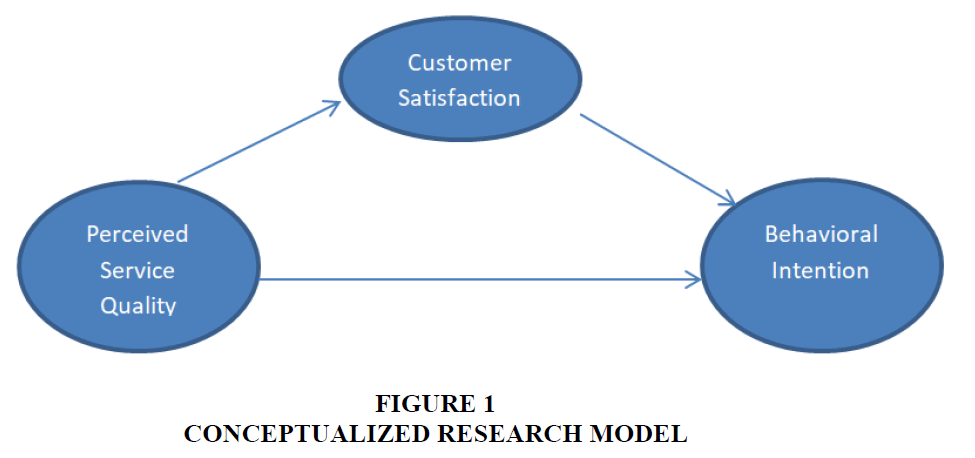
Figure 1 Conceptualized Research Model
Review of Literature
A literature review can be defined as a critical and evaluative piece of writing pertaining to the area under research. A robust literature review helps us to evaluate the relationship of the construct under study and its relationship with other constructs in the environment and how they can be articulated in the concerned field of study leading to identification of research lacunae in the topic under study
Gold Loan
Gold loans have recently gained more significance for both bankers and borrowers. Many studies have been done to look into various aspects of the gold loan. Recent studies emphasize the related aspects of gold lending services and their increasing importance within the financial system. (Alsmadi et al; 2023) highlighted a novel franchise-based gold loan model that makes use of reliable local jewelers and financial technology to improve customer satisfaction, increase credit accessibility, and encourage financial inclusion, especially for marginalized groups. According to (Andrlić et al; 2023), women's emotional and cultural attachment to gold has a substantial impact on the acceptance of gold loans. This suggests that marketing techniques should match financial value with cultural and symbolic meanings. Customers' decisions to use gold loan products are heavily influenced by perceived value rather than rental or interest costs, according to (Li and Umair's 2023) value-perception analysis. (Baur et al; 2022) highlighted the macroeconomic importance of gold prices by pointing out that rising gold prices immediately boost demand for gold loans by allowing for greater borrowing against the same collateral, which benefits gold finance companies more than jewelers. According to (Gohil et al; 2022), at the consumer perception level, banks are the preferred source of borrowing, and borrowers typically view gold loans as better than personal loans because of their convenience, quickness, and straightforward repayment plans. (Lakshmi & Devarakonda 2022); (Minhaj & Khan, 2025) however, drew attention to procedural limitations in private sector banks, pointing out complicated paperwork, fewer loan-to-value approvals, and the on going impact of gold price fluctuations on the demand for gold loans. When taken as a whole, these studies show that cultural attitudes, value considerations, pricing dynamics, institutional procedures, and fintech-enabled service innovations all influence the expansion of gold loans.
Perceived Service Quality, Customer Satisfaction, Behavioral Intention and Theory Framework
The researcher conducted a comprehensive review of prior studies pertinent to the measurement of Service Quality and Customer Satisfaction within the Banking Industry. Generally, the SERVQUAL model (with five dimensions: tangibles, reliability, empathy, assurance, and responsiveness) is the comprehensive model for globally evaluating SQ in service sector (Pakurár et al., 2019). The first subscale contains five dimensions—Tangibility, Reliability, Empathy, Assurance and Responsiveness (Chen et al., 2023). The second subscale of my research work consists of two dimensions— Financial aspect (Pakurár et al., 2019) and Fintech (Chen et al., 2023). The fundamental SERVQUAL dimensions—in particular, tangibles, responsiveness, assurance, empathy, and reliability—have a major impact on perceived and expected service quality in both conventional and Islamic banks, according to studies conducted in South Asia and the Middle East (Akintan, 2020). In developing banking markets like Nepal, Bangladesh, Vietnam, and India, customer satisfaction and loyalty are strongly influenced by service quality, which frequently acts through mediating mechanisms like trust, reputation, and customer satisfaction itself (Joshi, 2021), (Phi & Pham Huong, 2023). Technology-enabled and fintech-driven aspects of service quality—ease of use, security, interface design, privacy, and accessibility—have become more prominent during and after the COVID-19 pandemic, greatly influencing customer satisfaction and decreasing reliance on physical branches (Al-Khawaja et al., 2023), (Vetrivel et al., 2020). Empathy, assurance, and human interaction are still essential in technologically intensive environments, especially in housing and retail lending services, according to loan-specific studies conducted in India (Khan et al., 2024). Additionally, customer retention and competitive advantage are increased when service quality is strategically aligned with marketing strategies, CRM, pricing, and demographic expectations (Bupu et al., 2023). Together, these studies confirm that multifaceted service quality delivery is a vital foundation for long-term banking profitability and customer loyalty. As per theoretical support the Technology Acceptance Model (TAM) (Davis, 1989) and UTAUT/UTAUT2 (Venkatesh et al., 2003; 2012), technology attributes such as perceived usefulness, ease of use, system reliability, and facilitating conditions significantly shape user perceptions and behavioral intentions. FinTech is quickly changing the banking industry by improving client satisfaction, efficiency, and service quality while making traditional banks more competitive (Agrawal et al., 2024). Because of their dependability, responsiveness, and ease of use, ICT-enabled platforms—especially mobile banking—significantly increase consumer satisfaction (Almansour & Elkrghli, 2023). As per Price Fairness Theory (Xia et al., 2004), customers assess service quality by comparing what they give (costs) with what they receive (benefits). In financial services, pricing variables—interest rates, processing fees, penalties, transparency of charges, and repayment flexibility—are not peripheral but central to perceived service value.
Previous researches on gold loans has mostly concentrated on consumer awareness and regional comparisons, paying little attention to customer satisfaction, perceived service quality, and behavioral intention across all major players of financial institutions NBFCs, public banks, and private banks (Palavesakrishanan S, 2019), (Arunasree, 2021), (Kayasth & Ayre, 2021). The literature ignores modern fintech-driven service features including digital transactions, automation, safety, competitive pricing, and flexible loan terms in accordance of SERVQUAL dimensions. There is a glaring conceptual and geographical research gap, as evidenced by the lack of an integrated demand-supply approach and the untapped empirical data from the North India region. Based on the above literature review, the following are hypotheses developed to perform the present study:
H1: PSQ has a direct positive impact on CS.
H2: CS has a direct positive impact on BI.
H3: PSQ has a direct positive impact on BI.
Research Methodology
Purpose: The purpose of the research study is to study the role of perceived service quality, customer satisfaction on behavioral intention of the gold loan customers in North India.
Research design: For the purpose of this study the exploratory, descriptive and casual research research design is used as exploratory study was conducted to gain comprehensive knowledge about the extended variables of Service Quality, the data was then analysed using descriptive research. Studying the causes and effects of PSQ, CS, and BI makes it a casual research as well.
Data collection: In the present study primary data has been collected from top two financial institutions included public sector, private sector and NBFC’s. The gold loan customers of North India has been contacted for data collection. The primary data collection has been done though administering a structured questionnaire which involved identification of reliable and valid scale to measure the constructs in the hypothesized model.
Sampling and procedure: In this case the sampling frame is gold loan customers of public sector banks, private sector banks and NBFCs. For the purpose of this research the researcher distributed 700 questionnaires, Out of which 60 questionnaires were not fully filled hence, discarded, 40 were wrongly filled, so the final analysis was carried out with 600 valid responses from gold loan customers. The respondents for the study were selected using non-probability judgmental sampling.
A detailed description of the scales adopted for measurement is provided in the section under constructs of the study. For the purpose of this research structural equation modelling (SEM) has been utilized. In order to ensure the validity, the items in the study were used from the measures developed by previous studies. A five-point Likert scale was used to measure all variables.
Constructs under study
Perceived Service Quality: The 22-item questionnaire, developed by (Parasuraman et al., 1988); Patel et al., (2024) is used based on five generic quality dimensions: tangibles, assurance, responsiveness, empathy, and reliability. A new sub scale is studied in this research the FinTech and Financial aspect in banking sector as these dimensions exert a profound influence in banking services. There are two 22 items of SERVQUAL and 11 items of new subscale.
Customer satisfaction: The construct of customer satisfaction is measured using a six-item scale adapted from Oliver’s (1980; 1997) overall customer satisfaction scale.
Behavioral Intention: Behavioral intention was measured using a six-item scale adapted from Zeithaml, Berry, & Parasuraman’s (1996) Behavioral Intentions Scale.
Data analysis and Interpretation
In the research study first exploratory factor analysis was initially applied to assess the two new dimensions in PSQ and further structural equation model (SEM) has been carried out in order to evaluate the relationship between PSQ, CS and BI. But prior, to conducting SEM confirmatory factor analysis (CFA) has been performed to validate the constructs.
Exploratory Factor Analysis (EFA): A total of twenty-two statements derived from the literature review and the (Parasuraman et al., 1988) (SERVQUAL) model were included in the questionnaire. In addition, 11 newly developed statements related to FinTech and the financial aspect were incorporated to capture emerging dimensions of service quality. The analysis used the Principal Component Analysis (PCA) method for factor extraction along with Promax rotation, as the dimensions of perceived service quality were assumed to be correlated in the context of the present study. The adequacy of the sample size in the data set is analysed with the help of KMO test and Bartlett test is applied to test the existence of significant correlation between the different pairs of statements. Based on exploratory factor analysis, the Bartlett's test of sphericity yields a p-value of.000 and a KMO score of 0.836. The Principal Component Analysis (PCA) extracted seven components with eigenvalues greater than one, which together accounted for 64.18 percent of the total variance in the dataset. The results representing the factor loadings between all the statements and the seven factors selected for the further analysis is shown below in Table 1.
| Table 1 Rotated Component Matrix Showing Factor Loadings of Service Quality Items | |||||||
| Rotated Component Matrixa | |||||||
| Component | |||||||
| 1 | 2 | 3 | 4 | 5 | 6 | 7 | |
| FINPS1 | 0.854 | ||||||
| FINPS5 | 0.791 | ||||||
| FINPS4 | 0.767 | ||||||
| FINPS3 | 0.765 | ||||||
| FINPS6 | 0.757 | ||||||
| FINPS2 | 0.692 | ||||||
| EPS1 | 0.841 | ||||||
| EPS4 | 0.828 | ||||||
| EPS3 | 0.767 | ||||||
| EPS5 | 0.767 | ||||||
| EPS2 | 0.762 | ||||||
| FPS1 | 0.827 | ||||||
| FPS4 | 0.794 | ||||||
| FPS2 | 0.79 | ||||||
| FPS3 | 0.778 | ||||||
| FPS5 | 0.763 | ||||||
| RPS4 | 0.79 | ||||||
| RPS3 | 0.787 | ||||||
| RPS1 | 0.772 | ||||||
| RPS2 | 0.763 | ||||||
| RPS5 | 0.722 | ||||||
| APS1 | 0.855 | ||||||
| APS4 | 0.789 | ||||||
| APS3 | 0.771 | ||||||
| APS2 | 0.743 | ||||||
| TPS1 | 0.807 | ||||||
| TPS3 | 0.79 | ||||||
| TPS4 | 0.777 | ||||||
| TPS2 | 0.721 | ||||||
| RESP1 | 0.868 | ||||||
| RESP2 | 0.802 | ||||||
| RESP3 | 0.751 | ||||||
| RESP4 | 0.705 | ||||||
Rotation Method: Varimax with Kaiser Normalization.
a. Rotation converged in 6 iterations.
The five generic quality dimensions: tangibles, assurance, responsiveness, empathy, and reliability and Scale items related with the technological efficiency and trustworthiness of banking services, this component has been named as ‘FinTech Service Quality’ all these indicators related with the financial benefits and lending value offered by banks, this component has been named as ‘Financial Aspect’.
Confirmatory Factor Analysis (CFA): In the study the primary data is collected from the gold loan customers with respect to evaluate the relationship between PSQ, CS and BI. In order to analyse the validity of the factors w.r.t. convergent as well as discriminant validity, the confirmatory factor analysis is applied. The convergent validity can be tested with the help of composite reliability statistic as well as averages variance extracted measure. The composite reliability statistic of each factor is expected to be greater than 0.7 and average variance extracted should be greater than 0.5. For discriminant validity, the average variance extracted of each factor should be greater than its average shared variance as well as maximum shared variance (Hair et al 1992). Table 1 represents the convergent and discriminant validity by way of composite reliability (CR), average variance extracted (AVE), maximum shared variance (MSV) and average shared variance (ASV) Table 2.
| Table 2 Construct Reliability, Convergent and Discriminant Validity Assessment (Fornell–Larcker Criterion) | |||||||||||||
| CR | AVE | MSV | MaxR(H) | Customer_Satisfaction | Assurance | Tangibility | Reliability | Empathy | Responsiveness | Fintech | Financial_aspect | Behavioural_Intention | |
| Customer_Satisfaction | 0.92 | 0.66 | 0.54 | 0.92 | 0.811 | ||||||||
| Assurance | 0.83 | 0.54 | 0.06 | 0.844 | 0.138 | 0.737 | |||||||
| Tangibility | 0.8 | 0.51 | 0.16 | 0.814 | 0.039 | 0.098 | 0.711 | ||||||
| Reliability | 0.84 | 0.52 | 0.16 | 0.87 | 0.059 | 0.216 | 0.397 | 0.724 | |||||
| Empathy | 0.87 | 0.57 | 0.13 | 0.876 | 0.114 | 0.237 | 0.291 | 0.353 | 0.756 | ||||
| Responsiveness | 0.81 | 0.52 | 0.06 | 0.854 | 0.01 | 0.239 | 0.044 | 0.036 | 0.148 | 0.719 | |||
| Fintech | 0.87 | 0.53 | 0.17 | 0.879 | 0.352 | 0.185 | 0.057 | 0 | 0.027 | 0.066 | 0.728 | ||
| Financial_aspect | 0.86 | 0.54 | 0.2 | 0.861 | 0.316 | 0.064 | 0.006 | -0.03 | 0.053 | 0 | 0.201 | 0.736 | |
| Behavioural_Intention | 0.91 | 0.62 | 0.54 | 0.91 | 0.733 | 0.209 | 0.192 | 0.171 | 0.145 | 0.105 | 0.409 | 0.448 | 0.788 |
Additionally, we assessed the fit indices of the model, including p-value, chi-square minimum/degrees of freedom (CMIN/DF), goodness of fit index (GFI), comparative fit index (CFI) and root mean square error of approximation (RMSEA). We determined that all these fit indices were below the threshold level, normed Chi-square of 1.705 (1549.614/909) is displayed by the measurement model, along with GFI = 0.90, AGFI = 0.883, NFI = 0.90, CFI = 0.952, RMR = 0.046, and RMSEA = 0.034. The normative Chi-square is within the 3.0 conservative cut off. GFI, NFI, and CFI are acceptable with .90 cut off. Both RMR and RMSEA fall below the .08 threshold with GFI and AGFI of.90 and.883, respectively, being far above it. The GFI and AGFI were more than sufficient for the investigation, given the complexity of the current model.
The results of CFA analysis on the measurement model is shown in Figure 2 as well. The results of CFA analysis on the measurement model found that all the statements are significantly represents their respective constructs.

Figure 2 CFA of PSQ, CS and BI
Structural Equation Model (SEM)
SEM displays the structural model’s path coefficients as well as their significance levels. As shown in Figure 3 every path’s coefficient is statistically significant and points in the anticipated direction. First, there is a positive and substantial link between PSQ and CS (β =2.548, p<0.05) suggesting that H1 is supported. H2 is substantiated by the large and positive association between CS and BI (β = .335, p<0.05). H3 is supported by the large and positive association between PSQ and BI (β = 2.83, p<0.05). Consequently, we conclude that our study supports all the hypotheses.

Figure 3 Structural Model: BI Model Results
All path coefficients reported are standardized estimates (β). Perceived Service Quality (PSQ) significantly influences Customer Satisfaction (CS) (β = 0.600), and CS significantly affects Behavioral Intention (BI) (β = 0.334). The standardized indirect effect of PSQ on BI through CS is β = 0.200, and the bootstrap confidence interval (0.044 to 0.313) confirms its significance. The direct effect of PSQ on BI also remains significant (β = 0.665, p < 0.001). Therefore, Customer Satisfaction partially mediates the relationship, indicating that service quality influences behavioral intention both directly and through customer satisfaction.
Findings
The findings highlight the central role of Perceived Service Quality and Customer satisfaction in shaping behavioral intention among gold loan customers. Consistent with earlier studies, FinTech emerges as a construct characterised by security, efficiency, user-friendliness, and overall digital satisfaction, reinforcing its growing importance in financial service delivery (Sudirjo et al., 2024), (Chhaidar et al., 2023), (Tam & Thuy, 2023). The results further confirm that improved service quality enhances behavioral intention both directly and indirectly through customer satisfaction, supporting the foundational SERVQUAL framework (Parasuraman et al., 1988) and recent empirical evidence (Yesmin et al., 2023). Customer satisfaction plays a partial mediating role, indicating that while satisfied customers are more likely to remain loyal and recommend services, service quality itself also independently drives behavioral responses. This aligns with prior research emphasizing satisfaction as a mediator between perceived service quality to behavioral intentions (Ravichandran, 2010),(Jibran et al., 2025).
Discussion and Conclusion
The gold loan is the best financial inclusion in the loan category. Consumers are happy with the financial organizations' services. Since the lender has a good, highly liquid asset to utilize as collateral and the consumer can easily secure a loan with the fewest formalities and return them, both parties benefit. A recent development in the lending sector has assisted people in meeting their financial demands by providing them with gold. One of the best ways for borrowers to obtain rapid, short-term funding is through gold loans. Since consumers are requesting FinTech solutions and are more focused on the financial aspects of the loan, this study examined the influence of perceived service quality with extended dimensions of SEVQUAL. Additionally, it examined how customer satisfaction functions as a mediator between behavioral intention and perceived service quality. Therefore, it is determined that this research study must assist future scholars, policymakers, and financial institutions in creating appropriate frameworks to enhance their respective businesses and expectations. By creating a seamless continuum between savings, collateral, and credit, India can achieve full-spectrum asset monetization.
References
Agrawal, S. S., Rose, N., & Prabhu Sahai, K. (2024). The fintech revolution: AI’s role in disrupting traditional banking and financial services. Decision Making: Applications in Management and Engineering, 7(1), 243–256
Akintan, M. D., & S. J. (2020). Assessing service quality dimensions on customers patronage of Islamic banking in South Western Nigeria. International Journal of Research in Commerce and Management Studies, 2(1).
Al-Khawaja, H. A., Yamin, I., & Alshehadeh, A. R. (2023). The COVID-19 pandemic’s effects on fintech in the banking sector. Review of Economics and Finance, 21(1), 316–322.
Almansour, B. Y., & Elkrghli, S. (2023). Factors influencing customer satisfaction on e-banking services: A study of Libya. 3(1).
Indexed at, Google Scholar, Cross Ref
Alsmadi, A. A., Al-Hazimeh, A. M. D., Al-Afeef, M. A., Al-Smadi, A. W., Rifai, F., & Al-Okaily, M. (2023). Banking services transformation and financial technology role. Information Sciences Letters, 12(1), 315–324.
Indexed at, Google Scholar, Cross Ref
Andrlić, B., Hak, M., & Pathy, G. S. (2023). The changes in the perceptions of women towards the symbolic value of gold: Marketing and financial implications. Journal of Risk and Financial Management, 16(4).
Indexed at, Google Scholar, Cross Ref
Baur, D. G., Gopalakrishnan, B., & Mohapatra, S. (2022). Financial market evidence of gold’s unique role in India. SSRN Electronic Journal.
Indexed at, Google Scholar, Cross Ref
Bupu, R., Sodikin, M., & Sanchita, S. (2023). Towards customer satisfaction: The role of customer relationship management, service quality, and customer perceptions. 4810, 41–56.
Indexed at, Google Scholar, Cross Ref
Chang, T. Z., & Chen, S. J. (1998). Market orientation, service quality and business profitability: A conceptual model and empirical evidence. Journal of Services Marketing, 12(4), 246–264.
Indexed at, Google Scholar, Cross Ref
Chen, L., Jia, J., & Wu, C. (2023). Factors influencing the behavioral intention to use contactless financial services in the banking industry: An application and extension of the UTAUT model. Frontiers in Psychology, 14, Article 1096709.
Indexed at, Google Scholar, Cross Ref
Gohil, S., Shah, N., & Kumar, S. (2022). International Journal of Research Publication and Reviews. International Journal of Research Publication and Reviews, 4(1), 1806–1812.
Indexed at, Google Scholar, Cross Ref
Hair, J. F., Anderson, R. E., Tatham, R. L., & Black, W. C. (1992). Multivariate data analysis. Macmillan.
Indexed at, Google Scholar, Cross Ref
Hallowell, R. (1996). The relationships of customer satisfaction, customer loyalty, and profitability: An empirical study. International Journal of Service Industry Management, 7(4), 27–42.
Indexed at, Google Scholar, Cross Ref
Joshi, C. (2021). Perceived service quality and customer satisfaction in Nepalese banking. 5(1), 1–22.
Kanungo, S., & Chakrabarti, A. (2021). Gold governance and goldsmithery: Economic sociology of an informal manufacturing sector in India. Contributions to Indian Sociology, 55(2), 172–199.
Indexed at, Google Scholar, Cross Ref
Khan, F., Cyriac, S., Thomas, A., Somasekharan, T. M., & Manoj, P. K. (2024). Empathy of bank employees and its influence on service quality of banks: Evidence from the knowledge economy of Kerala in Digital India. International Journal of Religion, 5(2), 289–300.
Indexed at, Google Scholar, Cross Ref
Lakshmi, N., & Devarakonda, N. (2022). Future gold price prediction using ensemble learning techniques and isolation forest algorithm. In Computational intelligence and data analytics: Proceedings of ICCIDA 2022 (pp. 405–419). Springer Nature Singapore.
Li, Y., & Umair, M. (2023). The protective nature of gold during times of oil price volatility: An analysis of the COVID-19 pandemic. The Extractive Industries and Society, 15, Article 101284.
Indexed at, Google Scholar, Cross Ref
Minhaj, S. M., & Khan, M. A. (2025). Performance of online banking and direct effect of service quality on consumer retention and credibility with mediation of consumer satisfaction. International Journal of Business Information Systems, 49(4), 473–490.
Indexed at, Google Scholar, Cross Ref
Mukherjee, P. (2020). Domestic gold refining industry: Challenges and the way forward. Commodity Insights Yearbook 2020, 36–40.
Oliver, R. L. (1980). A cognitive model of the antecedents and consequences of satisfaction decisions. Journal of Marketing Research, 17(4), 460–469.
Indexed at, Google Scholar, Cross Ref
Oliver, R. L. (1997). Satisfaction: A behavioral perspective on the consumer. McGraw-Hill.
Indexed at, Google Scholar, Cross Ref
Pakurár, M., Haddad, H., Nagy, J., Popp, J., & Oláh, J. (2019). The service quality dimensions that affect customer satisfaction in the Jordanian banking sector. Sustainability, 11(4), Article 1113.
Indexed at, Google Scholar, Cross Ref
Parasuraman, A., Zeithaml, V. A., & Berry, L. L. (1988). SERVQUAL: A multi-item scale for measuring consumer perceptions of service quality. Journal of Retailing, 64(1), 12–40.
Patel, R., Mishra, A. K., Chishti, M. Z., & Modi, T. M. (2024). Relationship between internet banking service quality, e-customer satisfaction, and loyalty: A comparative study of India and Pakistan. Journal of Central Banking Theory and Practice, 13(2), 213–228.
Indexed at, Google Scholar, Cross Ref
Phi, H. D., & Pham Huong, D. (2023). Effect of service quality on customer loyalty: The mediation of customer satisfaction and corporate reputation in the banking industry. Eurasian Journal of Business and Management, 11(1), 1–16.
Indexed at, Google Scholar, Cross Ref
Raghavan, A. S., & Ahmed, N. N. (2011). Passion for ornamental gold jewellery in India. International Journal of Enterprise Innovation Management Studies, 2, 125–135.
Seth, N., Deshmukh, S. G., & Vrat, P. (2005). Service quality models: A review. International Journal of Quality and Reliability Management, 22(9).
Indexed at, Google Scholar, Cross Ref
Sharma, M. (2013). Study of gold loan market as an alternative source of credit for low-income households.
Sharma, S. (2018). Determinants of gold prices in India. International Journal of Research and Analytical Reviews, 5(4), 909–921.
Shrestha, P. M. (2021). Impact of service quality on customer satisfaction and loyalty. 2019, 71–80.
Indexed at, Google Scholar, Cross Ref
Vetrivel, S. C., Rajini, J., & Krishnamoorthy, V. (2020). Influence of internet banking service quality on customer satisfaction: An Indian experience. Journal of Critical Reviews, 7(2), 546–551.
Indexed at, Google Scholar, Cross Ref
Yum, K., & Yoo, B. (2023). The impact of service quality on customer loyalty through customer satisfaction in mobile social media.
Indexed at, Google Scholar, Cross Ref
Zeithaml, V. A., Berry, L. L., & Parasuraman, A. (1996). The behavioral consequences of service quality. Journal of Marketing, 60(2), 31–46.
Indexed at, Google Scholar, Cross Ref
Received: 02-Jan-2026, Manuscript No. AMSJ-26-16821; Editor assigned: 04-Jan-2026, PreQC No. AMSJ-26-16821(PQ); Reviewed: 10- Jan-2026, QC No. AMSJ-26-16821; Revised: 11-Feb-2026, Manuscript No. AMSJ-26-16821(R); Published: 23-Feb-2026