Research Article: 2026 Vol: 30 Issue: 2
Strategic Drivers of School Branding: Developing a Model Based on School Leaders’ Insights
Anurag Singh Chauhan, MDI Gurgaon
Citation Information: Chauhan., A. S. (2026) Strategic drivers of school branding: developing a model based on school leaders’ insights. Academy of Marketing Studies Journal, 30(2), 1-16.
Abstract
Branding serves as a critical process for effectively communicating the attributes, features, and benefits of products and services to prospective consumers. In the context of K-12 schools, particularly in developing countries, branding is inherently unique, encompassing both tangible and intangible dimensions. The factors influencing school branding and the criteria parents use to make school-choice decisions are multifaceted. This study examines the hierarchical relationships and interdependencies among these factors from the perspective of school leaders. Through a series of Focus Group Discussions (FGDs), this research identifies key parameters that contribute to school branding, drawing on existing literature to substantiate these findings. Using Total Interpretive Structural Modelling (TISM), a hierarchical model is developed to illustrate the linkages and cross-linkages between these factors. The resulting model provides a framework for school leaders to prioritize and strategically focus on key areas to enhance their school's brand identity. This study contributes to the literature by offering a nuanced understanding of the branding process in educational institutions and by emphasizing the role of school leadership in navigating complex branding decisions.
Keywords
Branding, K-12 Schools, Total Interpretive Structural Modelling (TISM), School-Choice Criteria.
Introduction
Branding, though a concept that has existed for millennia, has evolved significantly over time. Historically, early forms of branding can be traced back to potters who inscribed their initials on their creations (Hieronymus & Dirim, 2003), and farmers who marked their cattle to distinguish them from others (Keller, 2009). The American Marketing Association (AMA) defines a brand as “a name, term, symbol, or design, or a combination of them, which is intended to signify the goods or services of one seller or group of sellers and to differentiate them from those of competitors” (Keller, 2009). A brand plays a critical role in creating awareness, reputation, and a unique niche within the marketplace (Keller, 2009). It serves as a mental shortcut for customers, evoking particular attributes, features, and benefits associated with a product or service. Brands, therefore, act as key differentiators, distinguishing not only local products but also competing offerings (Aaker, 2012). In this sense, a brand can be perceived as a bouquet of values, encapsulating a promise of a unique and differentiated experience (De Chernatony, 2006). This promise involves a bundle of attributes that may be tangible or intangible, real or perceived, and rational or emotional (Ambler & Styles, 1992). Thus, a brand integrates both product-related tangible values and intangible qualities (Aaker, 2012).
Brands are more than just functional identifiers; they represent symbols with personalities that resonate with consumers, going beyond the mere utility of the product or service (Alt & Griggs, 1988; Arnold, 1992; Goodyear, 1993). A brand is a dynamic symbol, encompassing a range of ideas and attributes (Gardner & Levy, 1955). The stronger and clearer the message these symbols communicate, the greater the trust they generate in consumers (Dawar & Parker, 1992). The effectiveness of the branding process is significantly enhanced when the information conveyed through these symbols is accurate and aligned with the actual attributes of the product or service (Leischnig et al., 2012).
For customers, determining the true quality of a product or service is a complex, risky, and uncertain process (Jacoby et al., 1978). The risks associated with purchasing can vary, including financial, time, social, and even physical risks (Swait & Ardem, 2003). Given the challenges posed by limited information and the high stakes involved, customers often rely on brand signals as indicators of quality (Rao & Monroe, 1988). This is particularly true in the context of educational services, where parents face significant challenges in assessing the quality of schools for their children. The information required to accurately judge a school’s quality is not readily available, and parents are often forced to rely on brand signals, which may include both tangible and intangible cues. Tangible signals encompass aspects such as the school's infrastructure, academic performance, and transportation, while intangible signals include factors like teacher quality, the school's reputation, and word-of-mouth endorsements (Schneider & Buckley, 2002).
Education, unlike typical consumer products, offers both tangible and intangible services. While schooling is fundamentally a service, where the ownership of the product does not change hands (Lovelock & Wirtz, 2001), the antecedents of the school brand are both tangible (e.g., physical infrastructure) and intangible (e.g., the quality of education). The true efficacy of a school's educational service can only be fully realized after the completion of the schooling process (Chen, 2008). Thus, school branding is not merely a standalone attribute; it is the cumulative result of various aspects, including the school's infrastructure, academic performance, teaching quality, culture, and systems (Jobber & O'Reilly, 2011; King, 1991).
Historically, parents have sought stable careers and reliable income for their children through quality education, often pushing them towards well-established schools with strong reputations (Napompech, 2011). In the same way that brand identity is shaped by a combination of features, communication, and experiences (Jobber, 2011; King, 1991), a school’s brand identity emerges from a mixture of tangible assets such as infrastructure and academic outcomes, as well as intangible elements like teacher quality and cultural ethos.
With globalization, rising middle-class incomes, and increased disposable income, Indian parents, in particular, are increasingly inclined to send their children to private schools rather than government-run institutions (Prasad, 2013). Government schools, which are regulated and funded by state and central governments, face challenges related to a lack of resources, rigid administrative guidelines, and inconsistent academic performance. Conversely, private schools, often managed by educational trusts, enjoy greater flexibility in terms of curriculum design, pedagogy, and marketing strategies, which allows them to create stronger and more appealing brand identities. In private schools, the ability to innovate teaching practices, strengthen curriculum, and enhance the overall learning experience has contributed to their growing brand acceptance among parents. These features serve as key differentiators between competing private schools.
Recent studies have highlighted the importance of school branding in shaping parental preferences. For instance, a study conducted in Malaysia found that 84% of parents preferred sending their children to branded schools over non-branded alternatives (Dahari & Ya, 2011). Similarly, other research has shown that parents are more likely to choose well-established brands for K-12 education, viewing them as offering higher quality than newer or unbranded institutions (Malik et al., 2015). Effective school branding thus serves as a crucial tool in positioning a school as a preferred choice for prospective parents and in distinguishing it from competing schools (De Chernatony & Riley, 1998).
Every school operates within a unique environment, influenced by factors such as the surrounding community, the demographics of the student and parent populations, and specific local expectations (Ho, 2014). As such, it is essential for schools to tailor their branding strategies to reflect their distinct characteristics and context. However, the branding efforts within the educational sector are often constrained by limited budgets and a lack of expertise in strategic marketing.
Academic performance remains a critical determinant of a school’s brand strength. Poor academic outcomes can lead to negative word of mouth and, ultimately, a decline in brand equity and student enrollment (Chen & Lin, 2013). On the other hand, a focus on enhancing teaching quality, promoting holistic student development, offering extracurricular activities, and improving the school environment can significantly bolster a school’s brand image within the community (Oei, 2015). Identifying a school’s brand identity and implementing strategic marketing activities to foster a positive brand image are essential to establishing a strong, sustainable school brand (Urde & Koch, 2014). In this process, internal stakeholders, such as successful students, renowned faculty, and administrative staff, act as brand ambassadors, helping reinforce the school’s brand through positive word of mouth, high rankings, accreditations, and strong academic performance.
Problem Definition
A strong school brand plays a pivotal role in attracting not only high-quality students but also top-tier teachers, both of which are essential to the overall success of educational institutions (De Chernatony, 2010). In developed countries, where the majority of schools are state-run, the branding of schools is largely influenced by academic outcomes, as other variables such as infrastructure, curriculum, and extracurricular offerings tend to be standardized across institutions (Keller, 2009). In contrast, the school branding landscape in India and other developing countries is more complex. The top-ranking schools in India, as identified by surveys such as Education World and Outlook, are predominantly private institutions, where the quality of education is shaped by factors such as infrastructure, faculty, and student selection—areas where government-run schools have limited flexibility (Prasad, 2013; Malik et al., 2015).
In India, private school administrators have significant autonomy over school operations, enabling them to leverage their brand to attract and retain the best teaching talent (Dahari & Ya, 2011). However, the existing literature on the antecedents of school branding in developing countries—especially in India—remains sparse. This paper seeks to address this gap by identifying the key factors that contribute to school branding and exploring their interrelationships. Understanding these factors is crucial for school leaders in developing countries seeking to improve their institutional positioning and attract high-quality students and faculty (Joseph et al., 2012).
Research Methodology
To identify the factors contributing to school branding and their interconnections, Focus Group Discussions (FGDs) were conducted. FGDs are an effective qualitative research method, enabling in-depth exploration of perspectives from key stakeholders involved in the school branding process (Krueger & Casey, 2014; Lee et al., 2014). The participants of the FGDs were school principals with extensive experience in both teaching (over 10 years) and administration (over 5 years). A total of 33 responses were collected through a structured questionnaire designed based on the Total Interpretive Structural Modelling (TISM) methodology. This approach was used to assess the influence of various factors on one another and identify potential cause-and-effect relationships (Sage et al., 1977).
Four FGDs were conducted across diverse geographical locations—Delhi, Muzaffarnagar, Kolkata, and Coimbatore—each comprising 10 participants. The discussions were moderated by a seasoned expert in education management, who used a combination of open-ended questioning and facilitation. The aim was to guide participants toward a comprehensive understanding of the factors that influence school branding. Each FGD lasted between 45 and 60 minutes. At the outset, the moderator posed open-ended questions to set the context, followed by self-administered questioning among participants, with periodic moderation to maintain focus on the goals of the discussion.
The key questions posed during the FGDs were:
1. Is branding important for K-12 schools in the current educational environment?
2. What elements of the school ecosystem contribute to or impact the overall school brand?
These discussions, coupled with the insights drawn from the structured questionnaire, allowed for a nuanced understanding of the key drivers of school branding, particularly in the context of private schools in India.
Focus Group Discussions
The majority of participants concurred that branding is indeed an essential function for K-12 schools. They argued that branding should be a central focus for schools, with the understanding that it plays a crucial role in shaping the perceptions of parents and the broader community (Kotler & Fox, 1995). Several participants emphasized that a school must strategically engage in activities that contribute to a positive brand image, aligning this image with the institution's vision and mission. The following perspectives were shared:
• "A school brand is earned over time through consistent and high-quality performance."
• "Parents consider a school’s brand image before making decisions about their child's education."
• "A strong school brand not only attracts quality students but also skilled educators."
• "Branding is an outcome of doing the right things, in the right way, over time."
However, a minority of participants argued that branding is not entirely controllable and should not be the primary focus of the school. They suggested that branding develops organically as the school strengthens its focus on core academic and extracurricular activities. While these activities may indeed influence the school’s brand, some participants contended that branding is a natural by-product of operational excellence. Nevertheless, others maintained that proactive, intentional efforts to shape the brand image are essential.
Elements of the School Ecosystem Impacting the School Brand
Discussions in all four FGDs revealed a comprehensive set of factors contributing to the development of a school's brand. These elements were viewed as interconnected components of the school ecosystem that, when aligned with the institution’s goals, strengthen its brand identity (Urde & Koch, 2014). The factors that emerged out were:
• Academic Performance: A significant majority of participants agreed that the academic performance of students—both in board exams and competitive entrance tests (e.g., IIT-JEE, medical and law exams)—is a primary determinant of school branding (Chen & Lin, 2013). As one participant noted:
º "Academic success reflects the quality of education, as well as the leadership and teaching staff."
º "While other elements can enhance the brand, academic performance remains the cornerstone."
• Physical Infrastructure: Physical infrastructure was identified as a foundational element in shaping the school’s brand. This includes the size and condition of school facilities, laboratories, sports infrastructure, and overall campus design. Participants emphasized:
º "Quality infrastructure is now seen as a prerequisite for providing quality education."
º "The first impression of a school, formed through its infrastructure, significantly influences its brand."
• Extracurricular and Co-curricular Activities: The integration of extracurricular and co-curricular activities was highlighted as a key driver of brand differentiation. These activities contribute to a well-rounded education, which is increasingly valued by parents. As one participant explained:
º "Extracurricular activities are integral to holistic child development and contribute significantly to a positive brand image."
º "Parents today seek schools that foster a balance between academic rigor and personal development through activities outside the classroom."
• Information Technology (IT) Infrastructure: The role of technology in school branding was another major theme. Participants noted that robust IT infrastructure, including smart classrooms, online communication tools, and real-time progress tracking for parents, was a critical factor in building the school brand. One participant remarked:
º "Given the ubiquitous access to the internet, parents expect real-time updates on their child’s progress."
º "Schools with strong IT infrastructure meet parental expectations, providing convenience and transparency."
• Teacher and Staff Quality: Teacher quality was universally acknowledged as one of the most important factors in shaping the school’s reputation. Participants argued that the effectiveness of teaching staff directly influences both student performance and overall school branding. One comment that captured this sentiment was:
º "The quality of teachers directly impacts the quality of education, which in turn shapes the school brand."
º "A school’s brand is significantly influenced by the quality of its teachers and leadership."
• Marketing and Promotion: Finally, the role of marketing and promotion in school branding was discussed. Participants highlighted that schools must engage in proactive promotional activities—such as hosting academic events, participating in cultural initiatives, and utilizing media platforms—to amplify their brand image (Jobber & O’Reilly, 2011). As one participant emphasized:
º "Effective marketing strategies are crucial in communicating the school’s strengths to all stakeholders."
"It’s not just about doing the right things; schools must also actively communicate their successes to parents, the community, and the media."
Total Interpretive Structural Modelling (TISM) for School Branding Analysis
Interpretive Structural Modelling (ISM) is a structured methodology for mapping complex relationships between multiple elements by transforming abstract mental models into well-defined, visible representations (Warfield, 1974; Sage, 1977). This method operates through a hierarchical framework that establishes relationships among components, thereby simplifying understanding of complex systems (Warfield, 1976). While ISM is a powerful tool for structuring interrelationships, its capacity for interpretation remains limited, as it primarily addresses the relationships and directional connections among elements through paired comparisons. In contrast, Total Interpretive Structural Modelling (TISM) extends ISM by incorporating the interpretation of these relationships, allowing for a deeper and more comprehensive analysis (Sushil, 2005, 2012).
TISM enhances ISM’s utility by providing interpretive clarity at each relational level, making the model more transparent and reducing ambiguity arising from multiple interpretations of relationships among elements. Unlike traditional ISM, which leaves certain connections open for subjective interpretation, TISM incorporates logical reasoning for both nodes and links within the model, thereby enhancing its transparency and applicability in real-world settings (Sushil, 2012). This approach ensures that all identified relationships are not only mapped but are also interpreted with precision, creating a more reliable and relevant model.
The application of TISM has proven effective for analyzing complex systems, particularly when interdependencies among factors are intricate and multifaceted (Rizvi et al., 2019). Given the qualitative nature of educational research and the need to establish a comprehensive framework that integrates multiple viewpoints, TISM provides a robust tool for evaluating and mapping these interlinkages. By addressing the limitations of traditional ISM, TISM ensures that relationships within the model are systematically interpreted, leading to a more accurate representation of the factors influencing school branding.
TISM Development Process
The development of a TISM model follows a systematic, step-by-step approach to ensure that the relationships between key elements are clearly defined, interpreted, and validated. This process involves the following steps:
Step 1: Identifying the Key Elements
The first step in developing a TISM model involves identifying the key elements that influence the overall school brand. In the context of this study, the elements were derived through Focus Group Discussions (FGDs) with educational stakeholders. These discussions helped identify the critical factors that contribute to the branding of K-12 schools, ensuring that the model reflects the perspectives of those directly involved in educational management and branding (Sushil, 2012).
Step 2: Defining Contextual Relationships Between Elements
Defining the contextual relationships between the identified factors is crucial for structuring the model. This step explores how each factor influences or enhances the others. For instance, a relationship might be identified where "Extra-curricular activities enhance academic performance." Such contextual relationships help establish the foundations of the structural model by clarifying the interactions between various components (Rizvi et al., 2019).
Step 3: Interpreting Relationships
The primary distinction between ISM and TISM lies in the interpretation of relationships. While ISM focuses solely on mapping the interactions, TISM requires a deeper exploration of how and why one factor influences another. This step seeks to answer the key question: In what ways does Factor X influence/enhance Factor Y? This interpretive process adds depth to the structural model, enabling a clearer understanding of the underlying mechanisms driving the relationships between school branding factors (Sushil, 2005).
Step 4: Interpretive Logic of Pair-wise Comparison
To establish a solid interpretive framework, TISM incorporates pair-wise comparisons of the elements. This step involves creating an interpretive knowledge base by analyzing how each factor impacts the others. The responses to these comparisons are recorded as "Yes" (Y) or "No" (N), establishing directional relationships. If the response is "Yes," the relationship is further explored to provide clarity on how one element influences another (Sushil, 2012).
Step 5: Reachability Matrix and Transitivity Check
Once the pair-wise comparisons are made, a reachability matrix is constructed, where "1" indicates a positive relationship ("Yes") and "0" indicates no relationship ("No"). This matrix is then examined for transitivity—if Factor X influences Factor Y, and Factor Y influences Factor Z, then it is assumed that Factor X also influences Factor Z. Any newly established transitive links are updated in the reachability matrix and interpreted accordingly. This process ensures that the model captures all potential relationships and their logical implications, enhancing the model's accuracy and real-world relevance (Sushil, 2012) Table 1 & Table 2.
| Table 1 Reachability Matrix | |||||||
| C1 | C2 | C3 | C4 | C5 | C6 | C7 | |
| C1 | 1 | 1 | 0 | 1 | 0 | 0 | 0 |
| C2 | 1 | 1 | 0 | 1 | 0 | 0 | 0 |
| C3 | 0 | 0 | 1 | 0 | 0 | 1 | 1 |
| C4 | 0 | 0 | 0 | 1 | 0 | 0 | 0 |
| C5 | 0 | 0 | 0 | 0 | 1 | 1 | 0 |
| C6 | 0 | 0 | 0 | 0 | 1 | 1 | 0 |
| C7 | 0 | 0 | 1 | 0 | 0 | 0 | 1 |
| Table 2 Post-Iterative Matrix | |||||||
| C1 | C2 | C3 | C4 | C5 | C6 | C7 | |
| C1 | 1 | 1 | 0 | 1 | 0 | 0 | 0 |
| C2 | 1 | 1 | 0 | 1 | 0 | 0 | 0 |
| C3 | 0 | 0 | 1 | 0 | 0 | 1 | 1 |
| C4 | 0 | 0 | 0 | 1 | 0 | 0 | 0 |
| C5 | 1 | 0 | 0 | 0 | 1 | 1 | 0 |
| C6 | 1 | 0 | 0 | 1 | 1 | 1 | 0 |
| C7 | 0 | 0 | 1 | 0 | 0 | 1 | 1 |
Step 6: Level Partitioning in the Reachability Matrix
Level partitioning in Total Interpretive Structural Modelling (TISM) follows a similar approach as that in Interpretive Structural Modelling (ISM) and plays a critical role in organizing the elements hierarchically (Warfield, 1974; Saxena et al., 2006). This step identifies the hierarchical placement of elements based on their direct and indirect relationships with other factors. Elements placed at the top level of the reachability matrix are characterized by their direct influence on other elements, along with those factors that lie within the same level of influence. The resulting level partition provides a clear structure that helps in understanding the relative importance and positioning of each factor within the broader system.
Step 7: Developing the Diagraph
The diagraph, a directed graph that visually represents the relationships between the elements, is developed by graphically arranging all the factors according to their interconnections as established in the reachability matrix. At this stage, the interpretive knowledge base is consulted to revise and refine the transitive relationships between the elements. Only those transitive relationships that are deemed significant and impactful in shaping the overall model are retained, ensuring that the diagraph accurately reflects the most critical interdependencies. This refinement process is crucial for eliminating irrelevant connections and focusing on key dynamics (Sushil, 2005; Sushil, 2012).
Step 8: Constructing the Interaction Matrix
Once the diagraph is established, it is converted into an interaction matrix, where binary values (1’s) are used to indicate significant direct or transitive relationships between elements. This matrix serves as a comprehensive representation of the interdependencies within the system, making it easier to visualize the direct and indirect influences among the elements. Interpretations drawn from the interpretive knowledge base further inform the construction of the interaction matrix, ensuring that all key interactions are captured accurately and logically (Rizvi et al., 2019) Table 3 to Table 6.
| Table 3 Partitioning Matrix (Iteration 1) | ||||
| Reachability | Antecedent | Intersection | Level | |
| C1 | 1, 2 | 1, 2, 3, 4, 5, 6 | 1, 2 | I |
| C2 | 1, 2 | 1, 2, 3, 4, 5, 6 | 1, 2 | I |
| C3 | 1, 2, 3, 4, 5, 6 | 3, 4 | ||
| C4 | 1, 2, 3, 4, 5, 6 | 3, 4 | ||
| C5 | 1, 2, 5, 6 | 3, 4, 5, 6 | ||
| C6 | 1, 2, 5, 6 | 3, 4, 5, 6 | ||
| Table 4 Partitioning Matrix (Iteration 2) | ||||
| Reachability | Antecedent | Intersection | Level | |
| C3 | 3, 4, 5, 6 | 3, 4 | ||
| C4 | 3, 4, 5, 6 | 3, 4 | ||
| C5 | 5, 6 | 3, 4, 5, 6 | 5, 6 | II |
| C6 | 5, 6 | 3, 4, 5, 6 | 5, 6 | II |
| Table 5 Partitioning Matrix (Iteration 3) | ||||
| Reachability | Antecedent | Intersection | Level | |
| C3 | 3, 4 | 3, 4 | 3, 4 | III |
| C5 | 3, 4 | 3, 4 | 3, 4 | III |
| Table 6 Interaction Matrix | ||||||
| Teacher and Staff Quality | Physical Infrastructure | Extra and Co-curricular Activities | Academic Performance | Marketing and Promotion | IT Infrastructure | |
| Teacher and Staff Quality | X | 1 | 0 | 0 | 0 | 0 |
| Physical Infrastructure | 1 | X | 0 | 0 | 0 | 0 |
| Extra and Co-curricular Activities | 0 | 0 | X | 0 | 1 | 1 |
| Academic Performance | 1* | 0 | 0 | X | 1 | 0 |
| Marketing and Promotion | 1* | 0 | 0 | 1 | X | 0 |
| IT Infrastructure | 0 | 0 | 1 | 0 | 1* | X |
| DirectLink | ||||||
| Significant Transitive Link | ||||||
Step 9: Total Interpretive Structural Modelling (TISM)
In the final step, the connective and interpretive information derived from the diagraph and the interaction matrix are synthesized to produce the Total Interpretive Structural Model (TISM). This model represents the hierarchical structure of the identified elements, with interpretive links that delineate the directional relationships between the factors. The TISM framework, by integrating both the structural and interpretive aspects, provides a comprehensive view of the system's dynamics, offering valuable insights for both theoretical analysis and practical decision-making in school branding (Sushil, 2012). The TISM approach ensures that all relationships are clearly defined, reducing ambiguity and enhancing the overall relevance of the model in real-world applications Table 7, Figure 1.
| Table 7 Interaction Matrix (Interpretive Matrix) | |||||
| Academic Performance | Teacher and Staff Quality | Physical Infrastructure | Marketing and Promotion | Extra and Co-curricular Activities | |
| Academic Performance | X | Academically strong school attracts better teachers | 0 | 0 | 0 |
| Teacher and Staff Quality | Better teachers lead to better results | X | 0 | 0 | |
| Physical Infrastructure | 1 | 0 | X | Tangible Infrastructure enhances Marketing efforts | Infrastructure boosts EC activities |
| Marketing and Promotion | Marketing and promotion push schools to put impetus on Academic results | 0 | 0 | X | Marketing efforts pushes schools to introduce more Extra and Co-curricular activities |
| Extra and Co-curricular Activities | Holistic development and positive impact on Academics | 0 | 0 | Extra and Co-curricular activities enhance the marketing pitch | X |
| IT Infrastructure | 1 | 0 | Directly Relevant | Online platforms boost EC | |
| Direct Link | |||||
| Significant Transitive Link | |||||
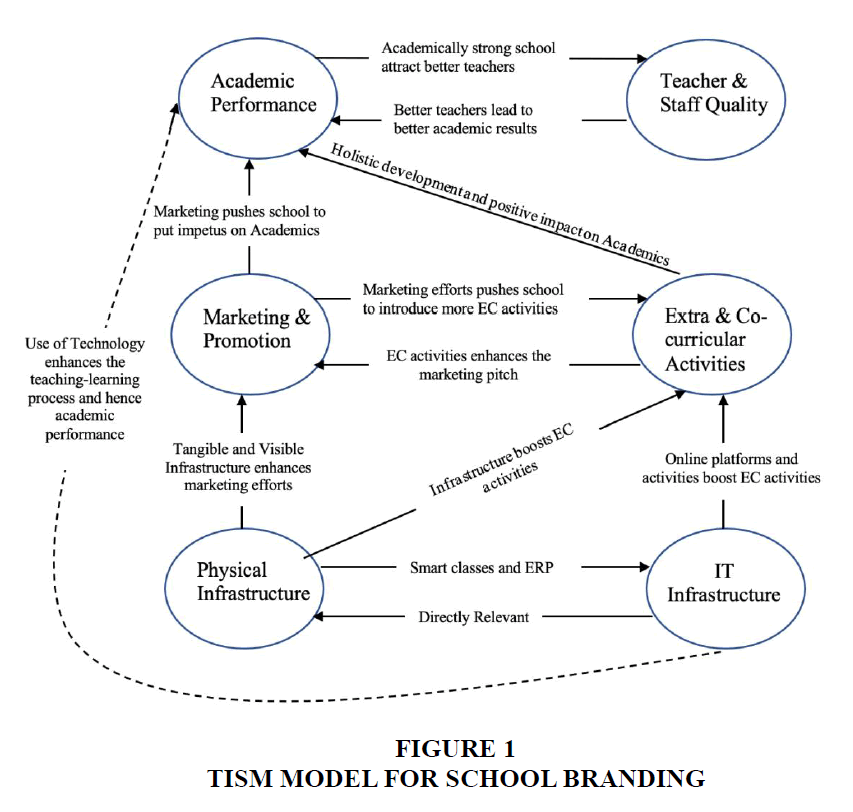
Figure 1 TISM Model for School Branding
Findings and Conclusions
This study investigates the critical factors influencing the branding of K-12 schools in India, with a particular focus on the interplay between academic, infrastructural, and organizational elements. Drawing upon Focus Group Discussions (FGDs) with experienced school principals and administrators, each possessing over a decade of leadership expertise, six key drivers of school branding emerged. These drivers include academic performance, teacher and staff quality, marketing and promotion, extracurricular (EC) and co-curricular activities, physical infrastructure, and IT infrastructure.
The findings suggest that school leaders must strategically prioritize these factors to enhance their institution’s brand perception. Among these factors, academic performance and teacher quality were identified as the most influential elements in shaping a school’s brand image. The results of competitive exams, such as the Indian Institutes of Technology Joint Entrance Examination (IIT-JEE) and the National Eligibility cum Entrance Test (NEET), are viewed as definitive markers of a school’s academic excellence. In a competitive educational environment like India, these results significantly contribute to the public’s perception of a school’s standing. Academic performance, therefore, plays a crucial role in elevating the overall school brand, as successful outcomes are often directly correlated with perceived institutional quality (Cheng & Leung, 2023).
Similarly, the quality of teachers and staff was identified as a key determinant of school branding. This finding is consistent with literature that highlights the central role of teachers in shaping both educational outcomes and the broader school environment (Kane et al., 2023). The quality of teaching staff influences not only student performance but also parental perceptions, which are often shaped by interactions with educators. A dedicated and skilled faculty enhances the learning experience, leading to improved academic results and, consequently, a stronger school brand (Ladd, 2022). As emphasized by Davis and Robinson (2021), effective teachers are indispensable to the successful branding of educational institutions.
Extracurricular (EC) and Co-Curricular Activities were found to have a significant transitive impact on academic performance—an important and often overlooked relationship in traditional branding models. This study shows that engagement in EC activities contributes to students’ holistic development, fostering skills that complement academic learning and positively affect their academic performance (Brown & Smith, 2023). Schools that offer a diverse array of EC and co-curricular activities integrated into the academic curriculum are viewed more favorably by parents, further enhancing their school’s brand. The findings challenge the prevailing view that academic excellence alone drives a school’s reputation, underscoring the importance of a balanced educational experience in shaping brand perception.
Marketing and Promotional Strategies were also identified as essential for establishing and communicating the school’s brand. In an increasingly competitive educational market, effective marketing strategies enable schools to showcase their strengths, such as academic performance, extracurricular offerings, and state-of-the-art infrastructure. These marketing efforts provide prospective parents with the relevant information necessary to make informed decisions. The study reveals that schools that effectively communicate their academic and non-academic strengths are more likely to establish a positive reputation in the community (Miller & Wilkins, 2022). Additionally, marketing efforts often drive schools to focus more on improving their extracurricular offerings, which enhances the overall brand image.
The Infrastructure of a school, both physical and technological, was found to be a foundational component of its brand. Physical infrastructure, including classrooms, sports facilities, and specialized labs, forms the tangible aspect of a school’s brand, influencing initial perceptions among parents (Bhatnagar, 2023). Furthermore, IT infrastructure, such as smart classrooms and Enterprise Resource Planning (ERP) systems, enhances the perceived modernity and efficiency of the school, contributing to a positive brand image. Schools that integrate technology into both teaching and administrative processes are seen as more progressive, thus reinforcing their position in a competitive market (Singh & Kumar, 2022).
Implications for School Branding in India
Based on the findings, the research provides several important insights for school leaders seeking to enhance their institution’s brand. First, it is evident that academic performance and teacher quality are central to a school’s brand image. Schools must prioritize investments in teacher professional development, curriculum design, and academic support systems to ensure continued success and competitiveness. As academic results are strongly linked to the reputation of the institution, school leaders should focus on optimizing these outcomes, especially in highly competitive entrance exams (Singh & Sharma, 2023).
Second, the findings underscore the importance of a holistic educational approach. Schools should expand their focus beyond traditional academic excellence to incorporate a broad range of extracurricular activities that contribute to students’ personal development. As parents increasingly seek well-rounded educational experiences for their children, offering an array of co-curricular and extracurricular activities can significantly enhance the school’s brand perception (Brown & Smith, 2023).
Furthermore, schools must recognize the integral role of marketing and promotional strategies in shaping their brand. Proactive marketing efforts that highlight the school’s academic and extracurricular achievements, along with transparent communication of school infrastructure and achievements, can greatly enhance the institution’s public image (Patel, 2024).
Finally, infrastructure investment is crucial. Both physical and technological infrastructure should be seen as essential for modernizing educational practices and enhancing the overall student experience. Schools that invest in state-of-the-art facilities and technology will not only improve the quality of education but also enhance their brand reputation by positioning themselves as forward-thinking and innovative institutions (Singh & Kumar, 2022).
Conclusion
This study contributes to understanding school branding in the Indian K-12 education context by systematically identifying the key factors that shape a school’s brand and elucidating their interrelationships through a TISM-based framework. The research demonstrates that a school’s brand is not determined by a single attribute but rather emerges from the combined effect of academic performance, teacher and staff quality, extracurricular engagement, marketing strategies, and physical and technological infrastructure. Academic performance and teacher quality are revealed as the most influential drivers, reinforcing existing literature that positions human capital and learning outcomes at the core of institutional reputation. However, this study also highlights the significant yet often underappreciated role of extracurricular activities in shaping academic performance and, by extension, school branding. Similarly, marketing and promotional efforts, while sometimes viewed as secondary, play an essential role in communicating a school’s achievements and value proposition to the wider community. Infrastructure, both physical and IT-related, serves as a tangible signal of quality and innovation, influencing initial perceptions and sustaining the brand’s competitive positioning.
By integrating these interconnected dimensions, school leaders can adopt a more strategic and systematic approach to brand management. The findings suggest that successful branding requires a deliberate alignment of academic rigor, human capital development, extracurricular programming, and infrastructure investment, supported by effective communication and marketing. Such an approach enables schools to meet the evolving expectations of parents, attract and retain high-quality students and teachers, and establish a sustainable competitive advantage in the increasingly crowded educational marketplace. Moreover, the TISM framework developed in this study provides a practical tool for school administrators to assess the relative importance of branding elements, understand their interdependencies, and prioritize initiatives with the greatest impact on brand perception. Ultimately, schools that embrace a holistic, data-informed, and strategically coordinated approach to branding are better positioned to enhance institutional reputation, foster long-term educational excellence, and achieve sustainable growth in a dynamic and competitive educational landscape.
Limitations and Future Scope of Work
This study, while offering valuable insights into the factors influencing school branding in India, has a few limitations. Primarily, it relies on Focus Group Discussions (FGDs) with school principals and administrators, which may not fully capture the perspectives of other stakeholders, such as parents, students, or policymakers. Future research could broaden the stakeholder sample to provide a more comprehensive view. Additionally, the study’s focus on India limits its applicability to other regions, and comparative studies across different countries or educational systems could offer further insights.
The research does not quantitatively assess how each factor directly influences school branding or its financial outcomes. Future studies could incorporate survey-based data to quantify the impact of key branding factors. Moreover, the role of digital marketing and social media in school branding, especially in the context of the digital age, remains underexplored and warrants further investigation. The rise of online education and blended learning also presents new challenges for school branding, making it an area for future research.
Appendix
| Appendix 1 Interpretive Logic-Knowledge Base Questionnaire | ||||
| S. No. | Element Nos. | Element Statement | Y/N | Brief Explanation |
| 1 | C1-C2 | Academic Performance will influence or improve Teacher and Staff Quality | ||
| 2 | C2-C1 | Teacher and Staff Quality will influence or improve Academic Performance | ||
| 3 | C1-C3 | Academic Performance will influence or improve Physical Infrastructure | ||
| 4 | C3-C1 | Physical Infrastructure will influence or improve Academic Performance | ||
| 5 | C1-C4 | Academic Performance will influence or improve IT Infrastructure | ||
| 6 | C4-C1 | IT Infrastructure will influence or improve Academic Performance | ||
| 7 | C1-C5 | Academic Performance will influence or improve Marketing and Promotion | ||
| 8 | C5-C1 | Marketing and Promotion will influence or improve Academic Performance | ||
| 9 | C1-C6 | Academic Performance will influence or improve Extra and Co-curricular Activities | ||
| 10 | C6-C1 | Extra and Co-curricular Activities will influence or improve Academic Performance | ||
| 13 | C2-C3 | Teacher and Staff Quality will influence or improve Physical Infrastructure | ||
| 14 | C3-C2 | Physical Infrastructure will influence or improve Teacher and Staff Quality | ||
| 15 | C2-C4 | Teacher and Staff Quality will influence or improve IT Infrastructure | ||
| 16 | C4-C2 | IT Infrastructure will influence or improve Teacher and Staff Quality | ||
| 17 | C2-C5 | Teacher and Staff Quality will influence or improve Marketing and Promotion | ||
| 18 | C5-C2 | Marketing and Promotion will influence or improve Teacher and Staff Quality | ||
| 19 | C2-C6 | Teacher and Staff Quality will influence or improve Extra and Co-curricular Activities | ||
| 20 | C6-C2 | Extra and Co-curricular Activities will influence or improve Teacher and Staff Quality | ||
| 23 | C3-C4 | Physical Infrastructure will influence or improve IT Infrastructure | ||
| 24 | C4-C3 | IT Infrastructure will influence or improve Physical Infrastructure | ||
| 25 | C3-C5 | Physical Infrastructure will influence or improve Marketing and Promotion | ||
| 26 | C5-C3 | Marketing and Promotion will influence or improve Physical Infrastructure | ||
| 27 | C3-C6 | Physical Infrastructure will influence or improve Extra and Co-curricular Activities | ||
| 28 | C6-C3 | Extra and Co-curricular Activities will influence or improve Physical Infrastructure | ||
| 31 | C4-C5 | IT Infrastructure will influence or improve Marketing and Promotion | ||
| 32 | C5-C4 | Marketing and Promotion will influence or improve IT Infrastructure | ||
| 33 | C4-C6 | IT Infrastructure will influence or improve Extra and Co-curricular Activities | ||
| 34 | C6-C4 | Extra and Co-curricular Activities will influence or improve IT Infrastructure | ||
| 37 | C5-C6 | Marketing and Promotion will influence or improve Extra and Co-curricular Activities | ||
| 38 | C6-C5 | Extra and Co-curricular Activities will influence or improve Marketing and Promotion | ||
References
Aaker, D. A. (2012). Building strong brands. Simon and schuster.
De Chernatony, L. (2006). From brand vision to brand evaluation. Routledge.
De Chernatony, L. (2010). Creating powerful brands. Routledge.
De Chernatony, L., & Dall'Olmo Riley, F. (1998). Defining a" brand": Beyond the literature with experts' interpretations. Journal of Marketing management, 14(5), 417-443.
Indexed at, Google Scholar, Cross Ref
Jacoby, J., & Chestnut, R. W. (1978). Brand loyalty: Measurement and management. (No Title).
Indexed at, Google Scholar, Cross Ref
Joseph, M., Mullen, M. R., & Spake, D. (2012). A framework for school branding: Creating a brand identity for educational institutions. International Journal of Educational Management, 26(6), 718-734.
Kotler, P., & Fox, K. F. (1995). Strategic marketing for educational institutions. Prentice Hall.
Krueger, R. A. (2014). Focus groups: A practical guide for applied research. Sage publications.
Indexed at, Google Scholar, Cross Ref
Lee, A., Ho, M., Cheung, C. K. M., & Keung, V. M. W. (2014). Factors influencing adolescent girls’ decision in initiation for human papillomavirus vaccination: a cross-sectional study in Hong Kong. BMC public health, 14(1), 925.
Indexed at, Google Scholar, Cross Ref
Lovelock, C. H., & Wirtz, J. (2001). Services marketing: people, technology, strategy. (No Title).
Rao, A. R., & Monroe, K. B. (1988). The moderating effect of prior knowledge on cue utilization in product evaluations. Journal of consumer research, 15(2), 253.
Indexed at, Google Scholar, Cross Ref
Sage, A. P. (1977). Methodology for large-scale systems.
Indexed at, Google Scholar, Cross Ref
Sushil. (2012). Interpreting the interpretive structural model. Global Journal of Flexible Systems Management, 13(2), 87-106.
Indexed at, Google Scholar, Cross Ref
Urde, M., & Koch, C. (2014). Market and brand-oriented schools of positioning. Journal of Product & Brand Management, 23(7), 478-490.
Indexed at, Google Scholar, Cross Ref
Received: 20-Jan-2026, Manuscript No. AMSJ-26-16867; Editor assigned: 21-Jan-2026, PreQC No. AMSJ-26-16867(PQ); Reviewed: 28- Jan-2026, QC No. AMSJ-26-16867; Revised: 04-Feb-2026, Manuscript No. AMSJ-26-16867(R); Published: 11-Feb-2026