Review Article: 2026 Vol: 30 Issue: 2
The Anatomy of Failed Shields: Key Factors in Bank Risk Breakdowns
Ruby Sharma, Chandigarh Business School of Administration, Landran, Mohali
Pallavi Pahuja, Chandigarh Business School of Administration, Landran, Mohali
Aaruni Batta, Chandigarh Business School of Administration, Landran, Mohali
Radhika Giri, Chandigarh Business School of Administration, Landran, Mohali
Rajesh Jhamb, Govt. Polytechnic College for Women, Chandigarh
Citation Information:Sharma, R., Pahuja, P., Batta, A., Giri R., & Jhamb, R. (2026) The anatomy of failed shields: key factors in bank risk breakdowns. Academy of Marketing Studies Journal, 30(2), 1-12.
Abstract
This study investigates the factors influencing risk management practices within the commercial banking sector, encompassing both public and private institutions. Primary data were collected via a structured questionnaire administered to 540 bankers. The research instrument assessed five critical dimensions of the risk management process: (i) Understanding Risk and Risk Management; (ii) Risk Identification; (iii) Risk Assessment and Analysis; (iv) Risk Monitoring; and (v) overall Risk Management Practices. Structural Equation Modeling (SEM) was employed to test the hypothesized relationships. The findings reveal that all examined risk-related factors understanding risk, risk monitoring, risk identification, and risk assessment & analysis exert a statistically significant positive effect on the risk management practices of banks. The SEM analysis further identifies Understanding Risk and Risk Management (URRM) and Risk Monitoring (RM) as the most significant determinants. The proposed model demonstrates a good fit, explaining approximately 65% of the variance in the observed risk management practices. This indicates that the integrated aspects of the risk management process substantially shape how banks implement their risk management frameworks. The study concludes that enhancing foundational risk comprehension and strengthening continuous monitoring mechanisms are paramount for advancing risk management efficacy in the banking industry.
Keywords
Risk Management Practices, Structural Equation Modeling (SEM), Risk Identification, Risk Assessment, Risk Monitoring, Financial Risk.
Introduction
A man without money is like a bird without wings, the Rumanian proverb insists the importance of the money. A bank is an organization, an institution, which primarily deals with circulation and supply of money. Hence, banks can be regarded as pillars of progress in any economy. Banking industry carries out a pivotal role in the development of the financial system of any country.
Crouhy et al., (2014) defined risk management as risk management is really about how firms actively select the type and level of risk that it is appropriate for them to assume.
Most business decisions are about sacrificing current resources for future uncertain returns. In this sense, risk management and risk-taking aren’t opposites, but two sides of the same coin.
According to Edward (2006) risk management defined as the identification, assessment, and prioritization of risks followed by coordinated and economical application of resources to minimize, monitor, and control the probability and impact of unfortunate events or to maximize the realization of opportunities. Anwarul et al., 2013 pointed out that risk management is a basis for prudent banking practice as banking is a risky business. For banks to be profitable and successful, implementing effective risk management practices is a must. Risk is inherent in all industry, but it is more crucial for the banking business, which is why risk management in the banking business is more important. Implementing an effective risk management procedure is crucial for banking business.
The success and survival of commercial banks are mainly dependent on the effectiveness of their risk management practices. Risk management is a continuous process that depends directly on changes in the environment of banks both internal and external. These changes require continuous attention for identification of risk and risk control. These changes in the environment require continuous attention for identification of risk and risk control (Al-Tamimi & Al-Mazrooei, 2007; Khalid & Amjad, 2012). Risk management refers to the exercise or practice of forecasting the potential risks thus analyzing and evaluating those risks and taking some corrective measures to reduce or minimize those risks (Md. Abdul Mannan Khan, 2018). Risk management in banking is theoretically defined as - the logical development and execution of a plan to deal with potential losses. Usually, the focus of the risk management practices in the banking industry is to manage an institution's exposure to losses or risk and to protect the value of its assets. Risk management is the application of proactive strategy to plan, lead, organize, and control the wide variety of risks that are rushed into the fabric of an organization’s daily and long-term functioning (Jotaniya & Negi, 2018).
The financial crisis of 2007–2009 highlighted the importance of risk management within financial institutions. Risk management means identification, measurement, monitoring and controlling risks in an organization. Risk management framework is important for banks. The risk management strategy must be integrated with its overall corporate strategies (Froot & Stein, 1994). Risk analysis and risk management has got much importance in the Indian economy during the liberalization period. In conjunction with the underlying frameworks, basic risk management process that is generally accepted is the practice of identifying, analyzing, measuring, and defining the desired risk level through risk control and risk transfer.
Risk management is one of the core banking activities in all kinds of financial institution which involves basically two types of risk existing in the market, the systematic risk and unsystematic risk. Systematic risk refers to the risk that is positive correlated with market and the can be minimized by using different risk management practice. On the other hand, the unsystematic risk is associated with the value of the asset. Unsystematic risk cannot explain by general market moments and can be avoidable through diversification (Nazir et al., 2012). Risk management defines the need of identification of core risks, method to develop consistent and accurate risk 16 measurement, give the importance of risk reduction, avoidance and transfer through proper risk return calculation and best monitoring procedures of risk position for the organization. Risk management is an inseparable part of business on financial markets. The core of an efficient and effective risk management lies in determining an optimal level of risks that are to be tolerated whereas risks above this level are suitable to be controlled (Svata, 2011).
Practicing effective risk management system was a prescription given by several scholars to minimize banking problems and failures. Moreover, effective risk management is accepted as a major cornerstone of bank management by academicians, practitioners and regulators. (Hussain & Al-Ajmi, 2012; Al-Tamimi & Al-Mazrooei, 2007; Gestel, 2009; Saunders, 2008; Suresh, 2010; Hull, 2012; Harrison, 2002). Risk management underscores the fact that the survival of an organization depends heavily on its capabilities to anticipate and prepare for the change rather than just waiting for the change and react to it. The objective of risk management is not to prohibit or prevent risk taking activity, but to ensure that the risks are consciously taken with full knowledge, clear purpose and understanding so that it can be measured and mitigated (Kanchu, 2013).
Review of Literature
Ahmad N. H. & Ahmad S. N. (2004) highlighted that the rapid and dynamic changes in the global financial landscape posed various risks to banking institutions. Operating side by side with conventional banks, Islamic banks were equally vulnerable to risks. The researchers pointed out that the future of Islamic financial institutions would depend to a large extent on how well they manage risks. This ability could be enhanced if the factors affecting these risks were systematically identified. The paper examined the factors affecting credit risk, being the main risk faced by banking institutions and systematically identified the key factors influencing credit risk formation in Islamic banking operating in Malaysia. A comparison of these factors between Islamic and conventional banking operations was highlighted. Several policy implications were addressed to promote risk management culture in Islamic banking industry.
Prapawadee Na Ranong Wariya Phuenngam (2009) conducted a study in order to gain a better understanding of risk management procedures and to examine the critical success factors for effective risk management procedures. To explore the importance of critical success factors in a practical context, researchers used the quantitative method of a self-completion questionnaire in order to collect data from a selection of financial institutions in Thailand. The study found a set of seven critical success factors which could be used as a guideline on how to increase the effectiveness of risk management procedures. These factors were (1) Commitment and support from top management, (2) Communication, (3) Culture, (4) Information Technology (IT), (5) Organization structure, (6) Training and (7) Trust. The study concluded that these seven factors could increase the effectiveness of risk management procedures from the perspective of the financial industry in Thailand.
Awojobi & Omotola (2011) conducted a study on the Nigerian banking industry, focusing on factors affecting risk management efficiency in banks. For empirical investigation, researcher employed Panel regression analysis taking a stratum of time series data and cross-sectional variants of macro and bank-specific factors for period covering 2003 to 2009. Result for panel regression indicated that risk management efficiency in Nigerian banks was not just affected by bank-specific factors but also by macroeconomic variables and described the pro-cyclicality of bank performance in the Nigerian banking sector.
Ruozi R. & Ferrari P. (2013) highlighted that liquidity risk was difficult to measure and depended on so many factors. The study mentioned that, at the international level, a wide consensus had emerged over many years on the importance of liquidity risk monitoring and the need to mitigate the associated risk in order to preserve the stability of individual banks and the soundness of the entire banking system. The research mentioned that the crisis had highlighted the need for more efficient liquidity management by banks by involving all governing bodies and corporate management in monitoring and managing liquidity in both normal and stress conditions, integrating better treasury with other functions affecting the liquidity position, and increasing the importance of liquidity risk as a part of risk management. The crisis had also highlighted the weaknesses of self-regulation based on internal models and the need to integrate domestic and international regulations. The study concluded that proper policy for examining the liquidity risk as a function of the impact area, the time horizon, the origin and the economic scenario where it occurred was required. After analyzing these four aspects, models for risk measurement, by identifying indicators to monitor, setting appropriate operating limits and related organizational issues needs to be defined.
Najat & Elsadig (2014) conducted a study which showed empirical investigating factors that determined risk management practices and its relationship with financial performance among Iraqi private banks. This study was conducted in order to obtain a comprehensive understanding of the factors behind the implementation of framework on risk management practices found in Iraqi private banks. This study involved 30 Iraqi private banks employees who were working in the selected private banks in Iraq. The interview survey was carried out on the employees consisted of open-ended questions and analyzed through the theme analysis procedure. Interesting results were obtained that linked to organizational factors, top management support and training (48%) technology capabilities (30%) risk related factor (15%) and financial performance (5%).
Waemustafa & Sukri (2015) analyzed the macroeconomic and bank specific factors of risk in Islamic and Conventional banks. Multivariate regression analysis was applied on the sample of 15 conventional banks and 13 Islamic Banks in Malaysia over the period of 2000-2010. The finding showed that the banks specific determinants of credit risk were uniquely influenced the credit risk formation of Islamic and Conventional banks. The study found that financing in risky sectors and regulatory contracts significantly affected the credit risk of Islamic banks. For Conventional banks, loan loss provision, debt-to-total asset ratio, regulatory capital, size, earning management and liquidity were significant factors influencing credit risk. Inflation was the only significant macroeconomic factor to credit risk for both Islamic and Conventional banks.
Haryono Y. Ariffin N. M. & Hamat M. (2016) conducted a study using dynamic panel data methods to examine the factors affecting credit risk in Indonesian Islamic banks. The panel data was collected from 11 full-fledged Islamic banks and 22 Islamic business units (windows) in conventional banks from 2004-2012, taking into account both macroeconomic variables and bank-specific variables. The results showed that the GDP growth rate and the unemployment rate with a one-year lag had a strong effect on the level of the non-performing financing. Moreover, bank-specific variables such as diversification and financing structure had a positive effect on the problem financing although its direction was not as expected. It was hoped that the findings could draw attention to factors affecting credit risk in Islamic banks so that credit risk can be properly managed.
Abedalfattah Zuhair Al-abedallat (2016) studied that various banks suffered from many types of banking risks which had significantly affected banks' profits. The credit risk was considered to be the major risks to commercial banks. Also, the study aimed to identify various factors that were affecting credit risk. The study findings showed that there was significant statistical impact of the factors (the efficiency of workers in the banking credit, the instructions of the Central Bank, and the credit policy of the bank) on the credit risks in the Jordanian commercial banks. The study recommended that the central bank should increase their oversight on the credit granted by the commercial banks. Also, the commercial banks should establish a department of risk management and make diversification in the credit facilities so as to reduce the credit risk.
Objectives of the Study
H1: There is a significant relationship between Understanding Risk (UR) and Risk Management Practices (RMP) of commercial banks.
H2: There is a significant relationship between Risk Identification (RI) and Risk Management Practices (RMP) of commercial banks.
H3: There is a significant relationship between Risk Assessment and Analysis (RAA) and Risk Management Practices (RMP) of commercial banks.
H4: There is a significant relationship between Risk Monitoring and Analysis (RMA) and Risk Management Practices (RMP) of commercial banks.
Research Methodology
With the help of structured questionnaire, primary data was collected for this study. Primary data of 540 bank managers representing public and private sector banks were collected. The data collected helped in the quantitative analysis. A total of 600 questionnaires were distributed amongst the respondents and out of which 540 duly filled and complete in all aspects responses were received.
As this research has a quantitative base so questionnaire used in this research is with closed questions. The research instrument used to collect data was based on questionnaire developed by Al-Tamimi & Al-Mazrooei (2007) with minor modifications as per the requirement of the research. The questionnaire was based on five aspects (i) Understanding risk and risk management; (ii) Risk identification; (iii) Risk assessment and analysis; (iv) Risk monitoring; and (v) Risk management practices.
Secondary data was also collected from blogs, journals, relevant articles, and bank websites. Some pre conducted surveys were also referred in the process to get detailed insights. Judgment sampling method a type of non-probability sampling technique was adopted to collect primary data. In this method the researcher has complete confidence about representation of sampling units
Analysis and Interpretation
In the social sciences, Structural Equation Modeling (SEM) is regarded as one of the most significant statistical advancements (Hair et al., 2011). This study examined the association among Risk Management Practices (RMPs) and the aspects of risk management such as URRM, RI, RAA and RM. Mainly the results of Confirmatory Factor Analysis (CFA) and Structural Equation Modeling (SEM) were reported.
Evaluation of Measurement Model
In order to evaluate reliability, convergent validity and discriminant validity, CFA was carried out. Table 1 presented below shows that the reliability of all scales is above 0.7 (Hair et al., 2007), which indicates that all scales have higher internal consistency levels.
| Table 1 Internal Consistency | ||
| Sr. no. | Constructs | Internal consistency |
| 1 | Understanding risk and risk management | 0.834 |
| 2 | Risk identification | 0.798 |
| 3 | Risk assessment and analysis | 0.854 |
| 4 | Risk monitoring | 0.866 |
| 5 | Risk management practices | 0.831 |
The findings supported Hair et al., (2010) recommendations for a good model fit. Validity includes convergent validity and discriminant validity of the constructs, to be evaluated after testing the reliability. To assure the uni-dimensionality of the multiple-item components and to eliminate indicators that are not reliable, convergent validity establishes if each construct maybe expressed by its own indicators (Gefen et al., 2000). The factor loadings of each question, the Average Variance Extracted (AVE), and Cronbach's alpha coefficient were examined for convergent validity. AVE is equivalent to a construct's communality and is simply defined as the grand mean value of the squared loadings of a set of measurement items? (Hair et al., 2014).
The Table 2 below demonstrates high factor loadings that are greater than the minimum threshold of 0.5 (Hair et al., 2010) and range between 0.723 and 0.876, demonstrating convergence of the indicators with appropriate underlying factors. Table 2 further demonstrates that, as predicted by Nunnally (1978), both the Cronbach alpha coefficients and the composite reliability values were above 0.7. Additionally, all of the AVE values for the various constructs were higher than 0.50.
| Table 2 Confirmatory Factor Analysis of the Model | ||||
| Construct | Indicator | Factor loadings | Cronbach’s alpha | Average Variance Extracted (AVE) |
| Understanding risk and risk management | UR1 | 0.735 | 0.834 |
0.595
|
| UR2 | 0.745 | |||
| UR3 | 0.723 | |||
| UR4 | 0.727 | |||
| UR5 | 0.758 | |||
| UR6 | 0.766 | |||
| UR7 | 0.745 | |||
| Risk identification | RI1 | 0.876 | 0.798 | 0.576 |
| RI2 | 0.792 | |||
| RI3 | 0.843 | |||
| RI4 | 0.785 | |||
| RI5 | 0.865 | |||
| Risk assessment and analysis | RA1 | 0.786 | 0.854 | 0.624 |
| RA2 | 0.754 | |||
| RA3 | 0.785 | |||
| RA4 | 0.786 | |||
| RA5 | 0.765 | |||
| RA6 | 0.745 | |||
| RA7 | 0.734 | |||
| Risk monitoring | RM1 | 0.766 | 0.866 | 0.651 |
| RM2 | 0.812 | |||
| RM3 | 0.745 | |||
| RM4 | 0.714 | |||
| RM5 | 0.772 | |||
| RM6 | 0.795 | |||
| Risk management practices | RMP1 | 0.844 | 0.831 | 0.596 |
| RMP2 | 0.821 | |||
| RMP3 | 0.795 | |||
| RMP4 | 0.765 | |||
| RMP5 | 0.801 | |||
| RMP6 | 0.825 | |||
| RMP7 | 0.855 | |||
| RMP8 | 0.796 | |||
| RMP9 | 0.844 | |||
| RMP10 | 0.834 | |||
Discriminant Validity
The degree to which the measurements of several concepts are statistically distinct is measured by discriminant validity (Gefen et al., 2000). The Table 3 that is presented below displays the discriminant validity results. The diagonal in the table shows that the estimated correlation between the components was lower than the square root of the AVE between each pair of factors, demonstrating discriminant validity (Hair et al., 2010). The remaining values in the table represent correlations among the constructs, but the bold diagonal numbers in the table represent the square root of the AVE shared between the constructs and their measurements. As a result, the model's discriminant validity was established.
| Table 3 Discriminant Validity in the SEM Model Showing RMP | |||||
| Construct | UR | RI | RA | RM | RMP |
| UR | 0.771 | ||||
| RI | 0.384 | 0.758 | |||
| RA | 0.582 | 0.494 | 0.789 | ||
| RM | 0.501 | 0.486 | 0.545 | 0.806 | |
| RMP | 0.354 | 0.524 | 0.436 | 0.536 | 0.772 |
Following the suggestions of Anderson & Gerbing (1988), several goodness-of-fit indices-including the Goodness-of-Fit Indices (GFI), the Normed Fit Index (NFI), the Comparative Fit Index (CFI), the Root Mean Square Error of Approximation (RMSEA), the Root Mean Square (RMR), and the X2 re-estimate test (CMIN/DF)-were assessed to verify the quality of the model.
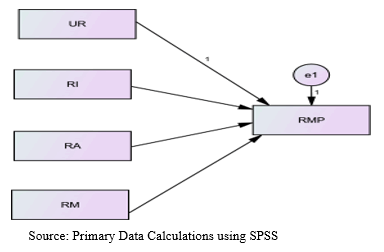
Figure 1 Structural Equation Model
Model Fit Parameters of AMOS
The Chi-square value, or CMIN, is used to determine if a difference between the observed variables and the predicted findings is statistically significant. In other words, CMIN reveals if the sample data and hypothetical model reflect the analysis well. If the CMIN/DF number is less than 3, the fit is good (Kline, 1998). A reasonable match is indicated if the value is less than 5, (Marsh & Hocevar, 1985).
According to Jöreskog & Sörbom (1984; Tanaka & Huba, 1985), the GFI, or goodness of fit index, is used to determine the smallest discrepancy function required to obtain a perfect fit under maximum probability circumstances. Root mean square residual is the term. RMR number should be as low as possible. A RMR of 0 indicates an ideal fit. GFI stands for "Goodness of Fit Index" and accepts values between 0 and 1, with 1 denoting a perfect match. The Degree of Freedom (DF) for testing the model is indicated by AGFI, or Adjusted Goodness of Fit Index. A value of 1 represents an ideal fit. AGFI values do not terminate at 0 like GFI values do. PGFI: Parsimony Goodness of Fit Index determines the degree of freedom for the model and is a version of GFI (Mulaik et al., 1989).
Baseline comparisons refers to the default, saturated, and independence models that Amos automatically fits for each analysis. The normed fit index, commonly known as Delta 1 (Bollen, 1898), consists of values scaling between the independence model (which fits poorly) and the saturated model (which fits perfectly). A score of 1 indicates a perfect match, whereas models with values under 0.9 may often be significantly improved (Bentler & Bonett, 1980). RFI stands for Relative Fit Index, which is derived from NFI. Values near to 1 denote a perfect match, whereas 1 denotes a very excellent fit. IFI stands for Incremental Fit Index and values near to 1 denote a very excellent match. The Tucker-Lewis coefficient (TLI), also known as the Bentler-Bonett Non-Normed Fit Index (NNFI), goes from 0 to 1, with a value closer to 1 signifying a perfect fit and a value closer to 0 a poor fit. CFI: Comparative Fit Index has a value range of 0 to 1, with values close to 1 indicating a very excellent match and 1 indicating the ideal fit (Hu & Bentler, 1999).
The difference between the observed covariance matrix per degree of freedom and the projected covariance matrix is measured by RMSEA, or root mean square error of approximation (Chen, 2007). Root mean square error of approximation, with valuesmore than 0.1 being regarded as poor, borderline values between 0.08 and 0.1, acceptable values between 0.05 and 0.08 and excellent values below 0.05 (Table 4) (MacCallum et al., 1996).
| Table 4 Model Fitness of Confirmatory Factor Analysis in SEM | |||||
| Model fit summary | |||||
| CMIN | |||||
| Model | NPAR | CMIN | DF | P | CMIN/DF |
| Default model | 12 | 8.562 | 3 | 0 | 2.854 |
| Saturated model | 15 | 0 | 0 | ||
| Independence model | 5 | 42.479 | 10 | 0 | 4.24 |
| RMR, GFI | |||||
| Model | RMR | GFI | AGFI | PGFI | |
| Default model | 0.075 | 0.97 | 0.949 | 0.17 | |
| Saturated model | 0 | 1 | |||
| Independence model | 0.116 | 0.481 | 0.222 | 0.321 | |
| Baseline comparisons | |||||
| Model | NFI | RFI | IFI | TLI | CFI |
| Delta1 | rho1 | Delta2 | rho2 | ||
| Default model | 0.909 | 0.823 | 0.772 | 0.953 | 0.907 |
| Saturated model | 1 | 1 | 1 | ||
| Independence model | 0 | 0 | 0 | 0 | 0 |
| RMSEA | |||||
| Model | RMSEA | LO90 | HI90 | PCLOSE | |
| Default model | 0.049 | 0.363 | 0.457 | 0 | |
| Independence model | 0.467 | 0.441 | 0.493 | 0 | |
Fit-indices have received a number of recommendations proposed by various researchers. A model is said to have a strong model-data fit if the p value is more than 0.05 and the ratio of χ2 degree of freedom is less than 3. RMSEA (Root Mean Square Approximation Error) is less than .05. The Root Mean Square Residual (RMR) should be below .05 and the Goodness-of-Fit Index (GFI) and Comparative Fit Index (CFI) should be above .90. The AGFI or adjusted goodness-of-fit index, to be more than .90 and the Normed Fit Index (NFI) number approaches one, the better the fit (Byrne, 1998; Chin & Todd, 1995; Hu & Bentler, 1995). The quality of fit was acceptable representation of the sample data, GFI (Goodness of Fit Index); AGFI (Adjusted Goodness of Fit Index) is larger than the 0.80. Table shows results of goodness-of-fit analysis of measurement models between endogenous and exogenous variables. The quality-of-fit indices CMIN/df ratio (0.05), Goodness of-Fit Index (GFI) of >0.90, and Root Mean Square Error of Approximation (RMSEA) of values less than 0.08 together shows that all CFAs of constructs provided a pretty excellent fit. The goodness-of-fit of the measurement models is summarized in the table. All of the constructs in the model were reliable for running the structural equation model, according to the confirmatory factor analysis of the study variables. These findings show that the scales were accurate and the model fitted the data very well.
Estimates of Structural Model
Structural equation modeling was used to examine the theoretical interdependence between four factors with risk management practices as a dependent variable. With the help of this analysis, all relevant paths can be tested, and measurements errors and feedback are included right into the model. As the components are shown to be significant at the p>0.05 level, the fit indices demonstrate a model's strong fit (Table 5 and Figure 2).
| Table 5 Examining the Linkage and Estimation for Confirmatory Factor Analysis in SEM | |||||||
| Regression weights: (Group number 1-Default model) | |||||||
| Estimate | Standardized errors |
Critical ratio |
P (<0.001) |
Regression weights |
|||
| RMP | <--- | UR | 1 | 0.667 | |||
| RMP | <--- | RI | 0.417 | 0.044 | 9.561 | *** | 0.281 |
| RMP | <--- | RM | 0.413 | 0.039 | 10.722 | *** | 0.315 |
| RMP | <--- | RA | 0.236 | 0.041 | 5.78 | *** | 0.17 |
| Squared multiple correlations: (Group number 1-Default model) | |||||||
| Estimate | |||||||
| RMP | 0.652 | ||||||
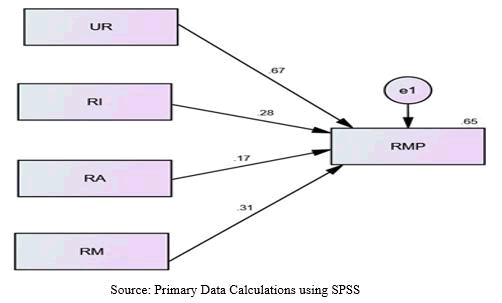
Figure 2 Measurement Model
To test the parameters, structural model of Understanding Risk (UR), Risk Identification (RI), Risk Assessment and analysis (RA), Risk Monitoring (RM) And Risk Management Practices (RMP) was constructed. The aim of building the structural model was to establish if UR, RI, RA and RM has significant impact on RMP. The results indicate that the direct impact of UR, RI, RM and RA on risk management practices remained significant (β=0.667, p<0.05), (β=0.281, p<0.05), (β=0.315, p<0.05) and (β=0.170, p<0.05), respectively. R-square value indicates that risk factors, accounts for 65% variance in risk management practices. As per the recommendations of Hair et al., (2011), R2<0.25 is considered to be as very weak. The values between 0.25 and 0.50 were regarded as weak, values between 0.50 and 0.75 were considered as moderate and value greater than 0.75 was considered to be as substantial. On the other hand, as per the suggestions of Chin (1998), value of R2 greater than 0.67 was considered as substantial and value between 0.33 and 0.67 was shown to be moderate, whereas the value less than 0.19 was considered to be as weak. Therefore, it can be concluded that R2 in the present model of the study is moderate to substantial.
In commercial banks, the test indicates that there existed a strong significant relationship between the dependent variable (RMP) and explanatory variables (URRM, RI, RAA and RMO). Both a positive and significant correlation is found between all the aspects of risk management and risk management practices.
Research Hypothesis Results
Results of hypothesis 1: Hypothesis 1 is accepted which means that there is a statistically significant relationship between Understanding Risk (UR) and Risk Management Practices (RMP).
Results of hypothesis 2: Hypothesis 2 is accepted which means that there is a statistically significant relationship between Risk Identification (RI) and Risk Management Practices (RMP).
Results of hypothesis 3: Hypothesis 3 is accepted which means that there is a statistically significant relationship between Risk Assessment and Analysis (RAA) and Risk Management Practices (RMP).
Results of hypothesis 4: Hypothesis 4 is accepted which means that there is a statistically significant relationship between Risk Monitoring (RM) and Risk Management Practices (RMP).
Discussion
The findings of the factors affecting risk management practices indicated that all the risk related factors wise understanding risk, risk monitoring, risk identification and risk analysis & assessment have a statistically significant effect on the risk management practice of the commercial banks. The results of the Structural Equation Modeling (SEM) analysis conducted on the overall commercial banking data indicate that Understanding Risk and Risk Management (URRM) and Risk Monitoring (RM) are the most significant contributors to the risk management practices of banks.
The study's overall risk management model is found to be a good fit, explaining approximately 65% of the variation in the risk management practices observed in the commercial banks. This implies that the different aspects of the risk management process, as captured by the model, have a substantial influence on how banks approach and implement risk management practices. Overall, the adopted risk management model is found a good fit which explained approximately 65% of the variation in the risk management practices due to the different aspects of the risk management process.
Conclusion
The results of the study highlight that risk management practices within commercial banks are shaped by a range of factors. Among risk related factors, the understanding of risk and risk management stand out as the most influential variable. This is closely followed by the practices employed to monitor risks (risk monitoring practices) and the methods used for identifying potential risks. The developed risk management model, encompassed various risk related factors, accounts for around 65% of the observed variations in how risk management is practiced within commercial banks.
References
- Aggarwal, P., & McGill, A. L. (2007). Is that car smiling at me? Schema congruity as a basis for evaluating anthropomorphized products. Journal of Consumer Research, 34(4), 468–479.
- Al Tamimi, H. A. H., & Al?Mazrooei, F. M. (2007). Banks’ risk management: A comparison study of UAE national and foreign banks. The Journal of Risk Finance, 8(4), 394–409.
- Sharma, R., & Pahuja, P. (2020). A study on service quality of banks in Tricity. International Journal of Advanced Science and Technology, 29, 1067–1077.
- Mahmoud, N., & Ahmed, E. M. (2014). Factors affecting risk management practices and financial performance of Iraqi private banks. Middle-East Journal of Scientific Research, 22(7), 971–977.
- Pahuja, P., Sharma, R., & Batta, A. (2025). Humanizing AI: The role of employer branding in attracting and retaining top talent. 339-346.
- Al Tamimi, H. (2008). Implementing Basel II: An investigation of the UAE banks’ Basel II preparations. Journal of Financial Regulation and Compliance, 16(2), 173–187.
- Pahuja, P., Sharma, R., & Batta, A. (2024). Employer branding: Pioneering HR innovations. 212–219.
- Arun kumar, & Kotreshwar, G. (2005). Risk management in commercial banks (A case study of public and private sector banks).
- Sharma, R., Pahuja, P., Singh, G., & Sharma, A. (2024). Heading toward the solution of employability issues through interdisciplinary management education. 57–73.
- Sharma, R. (2011). E-Banking: Problems and prospects. International Journal of Management & Business Studies, 5(10), 1–10.
- Arora, S. (2011). Risk management system: A comparative study of Indian public and private sector banks with special reference to Indore division (Unpublished doctoral dissertation).
- Sharma, R., Batta, A., & Pahuja, P. (2025). From brand to bond: Unlocking the connect between employer branding and employee retention in private banks. World Journal of Management and Economics, 18(1).
- Ahmad, N. H., & Ahmad, S. N. (2004). Key factors influencing credit risk of Islamic bank: A Malaysian case. The Journal of Muamalat and Islamic Finance Research, 1(1), 65–80.
- Sharma, R., & Goyal, M. (2023). Understanding the risk landscape in banks—a micro-macro perspective on RMP. MAIMS Journal of Management, 18(2), 41–50.
- Ruozi, R., & Ferrari, P. (2013). Liquidity risk management in banks: Economic and regulatory issues. s
- Sharma, R., Jhamb, R., & Batra, G. S. (2024). Navigating uncertainty: A comprehensive analysis of risk management practices in private sector banks. IPE Journal of Management, 14(1), 24–39.
- Phuenngam, W. (2009). Critical success factors for effective risk management procedures in financial industries -A study from the perspectives of the financial institutions in Thailand (Master’s thesis). Umeå University.
Received: 01-Jan-2026, Manuscript No. AMSJ-26-16862; Editor assigned: 05-Jan-2026, PreQC No. AMSJ-26-16862 (PQ); Reviewed: 19-Jan-2026, QC No. AMSJ-26-16862; Revised: 02-Mar-2026, Manuscript No. AMSJ-26-16862 (R); Published: 09-Mar-2026