Research Article: 2026 Vol: 30 Issue: 2S
The Effect Of Motivation On The Intention To Use Mobile Payments; The Role Of Intrinsic Motivation And Extrinsic Motivation
Dinusha Weerasekera, School of Business, Law and Entrepreneurship, Swinburne University of Technology
Prabha Silva, Department of Management, NSBM Green University
Tharani Sooriyaarachchi, Department of Accounting and Finance, Sri Lanka Technology Campus
Citation Information: Weerasekera., D, Silva., P & Sooriyaarachchi., T. (2026). The effect of motivation on the intention to use mobile payments; the role of intrinsic motivation and extrinsic motivation. Academy of Marketing Studies Journal, 30(S2), 1-11.
Abstract
Background: Even though abundant scholars have undertaken theoretical and empirical studies to examine mobile payment intention, most of them have primarily focused on technology acceptance and rejection. Relatively fewer number of studies examined motivation of individuals in using mobile payments along with mobile payment trust as an antecedent. Hence, this study examined the motivation towards intention to use mobile payments. Methods: The study undertook a quantitative approach with a cross-sectional design. The questionnaire was developed using the previous studies and validated scales. 342 valid responses collected using purposive sampling were used in analysing data. Later, Structural Equations Modeling (SEM) was used in testing the established hypotheses. Results: The analysed data revealed that intrinsic motivation and extrinsic motivation have a significant positive impact on the intention to use mobile payments. Similarly, perceived risk disclosed a negative impact on the intention to use mobile payments. Further, partial mediation was reported from the mobile payment trust on the relationship between motivation (both intrinsic & extrinsic) and intention to use mobile payments. Further, perceived risk moderated the relationship between mobile payment trust and intention to use mobile payments. Conclusions: The study integrated the mobile payment trust through trust transfer theory to further explain the self-determination theory in understanding consumer intention to use mobile payments. In addition, the study incorporated perceived risk to bridge empirical gap. As implications of the study, it suggested the importance of encouraging trust-building programs to improve the mobile payment user’s inner motivation towards intention to use mobile payments. In conclusion, it is evident that enhancing intrinsic motivation could drive mobile payments users for a seamless usage of technology.
Keywords
Intrinsic Motivation, Extrinsic Motivation, Intention to Use Mobile Payments, Mobile Payment Trust, Perceived Risk.
Introduction
In terms of the rapid evolution in the digital technologies, the global financial eco-systems have fundamentally transformed creating a massive paradigm shift in the traditional cash-based transactions to digital and mobile payment systems (Dahlberg et al., 2008). Transactions that could be conducted via mobile devices such as smartphones and tablets are known as mobile payments and they offer unparalleled convenience, speed, and accessibility, enabling users to perform financial activities anytime and anywhere (Alkhowaiter, 2020). In addition to the plus points of the mobile transactions, the adoption and sustained usage of mobile payments remain inconsistent, particularly in developing economies like Sri Lanka, where penetration rates linger around 7.2% despite rising digital literacy (Gihan, 2024).
Based on previous literature many authors have explored the areas of mobile payment adoption through technology-centric models such as the Technology Acceptance Model (TAM) and the Unified Theory of Acceptance and Use of Technology (UTAUT), yet psychological and motivational drivers that influence user intention, are not majorly focussed in these models (Venkatesh et al., 2012; Talukder et al., 2020). More recent studies, substantially focus on the motivation (either intrinsic or extrinsic) could play a significant role in adjusting the technology adoption behaviours such as intention to use mobile payments, which is further grounded on Self-Determination Theory (SDT) (Ryan & Deci, 2020). Nevertheless, motivation only cannot explain adoption intentions, ‘Trust’ is a crucial player, as an antecedent in digital transactions, mitigating perceptions of risk and uncertainty (Gefen, 2000; Kumar et al., 2023). However, SDT fails to discuss ‘Trust’ that directs the relationship towards intention to use mobile payments. Therefore, this study further explained SDT, through the lense of Trust Transfer Theory (TTT) to explain the relationship between motivational factors (intrinsic & extrinsic), trust and intention.
Furthermore, a user’s assessment about the potential losses associated with mobile payments is known as ‘perceived risk’ and it continues to be a significant barrier to adoption (Koenig-Lewis et al., 2015). Based on recent evidence, ‘perceived risk’ is a prominent factor which leads to uncertainty of technology related decisions and undesirable outcomes. Hence ‘perceived risk’ is an area for further investigation (Dahabiyeh et al., 2020; Kumar & Yadav, 2025). Based on this background, the study aims to identify the interplay between motivation, trust, and perceived risk to develop a holistic model of mobile payment intention, extending theoretical understanding and offering practical insights for policymakers, financial institutions, and mobile payment providers to enhance user adoption in evolving digital economies. Accordingly, the below research objectives were set to achieve the aim of the study,
RO1: To identify the possible motivational factors driving the intention to use mobile payments
RO2: To examine whether there is a mediating impact of mobile payment trust on the
relationship between motivation and intention to use M-payments.
RO3: To identify whether there is a moderating impact of perceived risk on the relationship
between trust and intention to use M-payments.
Literature Review
Theoretical Underpinning
Self-determination theory explains human motivation by distinguishing between autonomous and controlled forms of action. It emphasizes intrinsic motivation, driven by enjoyment and satisfaction, and extrinsic motivation, driven by external goals or rewards (Deci & Ryan, 1985; Weiner, 1990). Trust transfer theory views trust as a cognitive factor shaping attitudes and perceptions, suggesting that trust developed in one context can extend to another, such as from offline to online or mobile payment systems (Stewart, 2003).
Intention to Use Mobile Payments and Motivational Factors: Intrinsic and Extrinsic Motivation
When focussing on conventional models like Technology Acceptance Model (TAM) and the Unified Theory of Acceptance and Use of Technology (UTAUT) they identify key determinants such as perceived usefulness, ease of use, and social influence (Davis, 1989; Venkatesh et al., 2012). But as these frameworks' mainly focus on the technological and utilitarian aspects, they do not stress enough on the behavioural intention (Deci & Ryan, 2000; Ryan & Deci, 2020; Kumar et al., 2023).
Self Determination Theory (SDT), is utilized to strengthen the framework for understanding human motivation, distinguishing between intrinsic and extrinsic forms (Deci & Ryan, 1985). Engaging in an activity driven by the interest, enjoyment, or inherent satisfaction, defined as intrinsic motivation and in terms of the mobile payment contexts, it includes the pleasure of using a well-designed interface, the sense of autonomy in managing finances, or the enjoyment derived from seamless digital interactions (Vallerand & Bissonnette, 1992; Chaurasia et al., 2019). Whereas, when it comes to extrinsic motivation, it means the involvement in an activity to attain the separable outcomes such as rewards, recognition, or practical benefits. For mobile payments, extrinsic motivators may include perceived usefulness (e.g., faster transactions, 24/7 access), financial incentives (e.g., discounts, cashback), and compliance with social norms (Koo et al., 2015; Tang et al., 2016). These motivational factors pave the way for the intention to use mobile payments. Developing on this setting, following hypotheses can be derived Lu et al., (2011).
H1: Intrinsic motivation has a significant impact on the intention to use mobile payment
H2: Extrinsic motivation has a significant impact on the intention to use mobile payment
Mediating Impact of Trust
Trust is a multi-dimensional construct which is formed out of the intention to accept vulnerability based on positive expectations of another party's behaviour (Rousseau et al., 1998). When it comes to mobile payment eco-systems, trust requires the users’ confidence in the reliability, security, and integrity of the payment platforms (e.g., bank or fintech firm), and the underlying technology (Kesavan & Srinivasan, 2023; Gefen, 2000; Mayer et al., 1995). However, based on the Trust Transfer Theory (Stewart, 2003), trust can transform the familiar entity (e.g., traditional banking) to a less familiar one (e.g., a new mobile payment app), because of the impact made by perceived similarity and entitativity between the source and target. TTT, can be used for areas such as mobile finances, as trust in online or offline banking can positively shape trust in mobile payment systems, thereby strengthen the usage intention (Lu et al., 2011; Kuan & Bock, 2007). Irrespective of how important it is, the mediating function of trust on the relationship between motivation and intention to use mobile payment is under-explored. Hence, the following hypotheses can be developed to test the existing research gap Majchrzak & Malhotra, (2013).
H3: Mobile payment trust has a significant impact on the intention to use mobile payment
H4: Intrinsic motivation has a significant impact on mobile payment trust
H5: Extrinsic motivation has a significant impact on mobile payment trust
H6: Mobile payment trust mediates the relationship between intrinsic motivation and intention to use mobile payment
H7: Mobile payment trust mediates the relationship between extrinsic motivation and intention to use mobile payment
Moderating Impact of Perceived Risk
Perceived risk can be defined as the assessment of potential negative outcomes associated with a decision or behaviour (Bauer, 1960). In terms of mobile payments, the risks mostly include financial losses, breaches in data privacy, failures in systems and the intangibility of the nature of digital transactions (Chen, 2008; Shin, 2010). In most empirical findings, a consistency is noticed in reporting negative relationship between perceived risk and intention to adopt new technologies (Dahabiyeh et al., 2020; Kim et al., 2008; Sekaran & Bougie, 2016). Furthermore, trust and perceived risk are closely related, and it means higher trust typically reduces perceived risk, and vice versa (Lu et al., 2011). As per the most recent literature perceived risk may act as a moderator, potentially weakening the positive effect of trust on behavioral intention (Trivedi, 2024; Koenig-Lewis et al., 2015). This brings into light the need to understand not only the direct deterrent but also as a contextual factor that alters the strength of trust–intention linkages. Thereby, following hypothesis can be derived Figure 1.
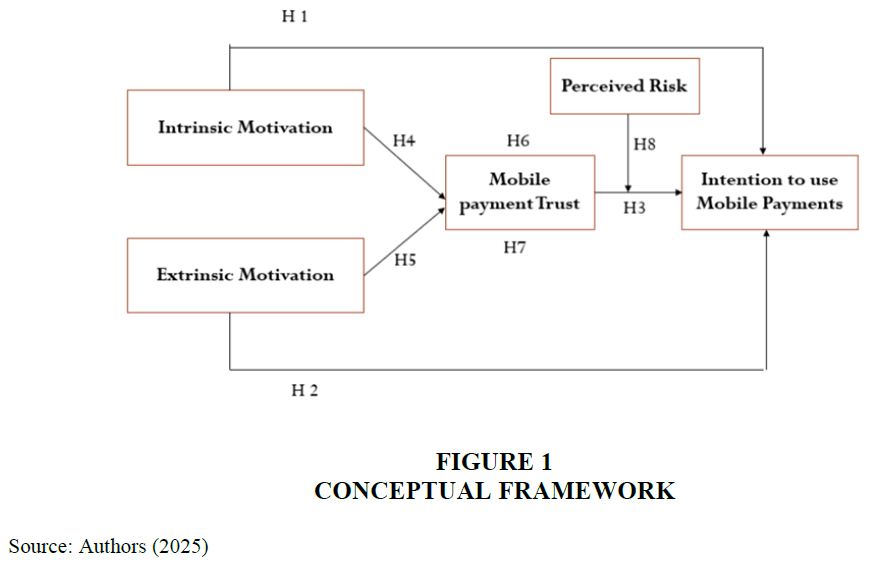
Figure 1 Conceptual Framework
Source: Authors (2025)
H8: Perceived risk moderates the relationship between mobile payment trust and intention to use mobile payments
Methods
Participants and Procedure
The study employed a cross-sectional quantitative research design. Participants were individual mobile payment users (Patil et al., 2020; Chaurasia, Verma & Singh, 2019). Purposive sampling was used with a screening question “Do you use mobile payments?” (San, Martín & Herrero, 2012) to filter mobile payment users and exclude who do not belong the above criteria. Given financial constraints and the challenge of accessing participants in remote areas, an online survey was chosen to gather data from a relatively large sample. The recruitment took place around three months from mid-April 2025 to mid-July 2025. A total of 370 responses were collected and 20 were excluded due to exclusion criteria. This resulted in 342 were used for analysis deleting 8 outliers.
Measurements
Participants demographic information (age, gender, income, educational background) were collected. To access the intention to use mobile payment, prior scale with three items was adopted from (Chaurasia et al., 2019). Responses were measured using five-point Likert scale, measurement ranging from “5 (strongly agree)” to “1 (strongly disagree)” (Chaurasia et al., 2019). The measures for intrinsic motivation and extrinsic motivation have been adopted from Chaurasia et al., (2019), using 4 items and 5 items respectively with five-point Likert scale. Mobile payment trust is the mediating variable on the relationship between intrinsic motivation, extrinsic motivation, and intention to use mobile payments. It was measured using 3 items with a seven-point Likert scale ranging from “7 (strongly agree)” to “1 (strongly disagree)” (Patila et al., 2020). Moderating variable of Perceived risk was measured using 3 items, and responses were identified using a five-point Likert scale (Lewis et al., 2015).
Statistical Analysis
The descriptive statistics were analysed using the measures of central tendency; mean, median, and mode. Normality, multicollinearity, were tested before the hypothesis testing to establish multivariate assumptions. Structural Equation Modelling (SEM) streamlines the testing of mediation and moderation of hypotheses (Hair et al., 2017), providing a comparison to standard regression methods, model fit on the regularity of the hypothesized model, providing the credibility of the assumptions for causality. SEM conjectures a functional relationship elaborated by the conceptual diagram.
Results
Demographic analysis depicts that 193 females (56.4%) and 149 males (43.6%) have undertook the survey highlighting higher female respondents. 38% respondents indicated that they have started using mobile payment applications within 3-4 years of time. Descriptive analysis was performed using SPSS to identify mean and standard deviation values of each variable separately. Thereafter, Harman’s single factor test confirmed that there is no common method bias issue, indicating the initial factor is 43%, which is less than the threshold of 50% (Hair et al., 2017; Malhotra et al., 2013).
Test of multivariate assumptions were conducted including tests for normality, linearity and homoscedasticity, and multicollinearity. Skewness and kurtosis values were between the threshold of +3 and –3, indicating the normality of the data set (Hair et al., 2017; Malhotra et al., 2013). Key variables satisfy the linear homoscedasticity multivariate assumptions. The correlation values were less than the threshold value of 0.9 (Hair et al., 2017; Malhotra et al., 2013), indicating a poor correlation between the hypothesised relationships.
With the scale refinement, only the reliable and valid items were advanced to the structural model to ensure the goodness of fit (Hair et al., 2017). Construct validity was tested using the exploratory factor analysis (EFA) following the Kaizer-Meyer-Olkin (KMO) and Bartlett’s test of sphericity in evaluating the relevance of using EFA (Muthén & Kaplan, 1992). Accordingly, the KMO values were lied between 0.5 – 1, depicting that the sample is sufficient to represent population for all respected variables (Malhotra et al., 2011) and with the significance values denoting less than 0.001 in the Bartlett test, provides that all the variables are significant. This revealed the appropriateness of performing the EFA. The factor loadings of each variable were greater than the threshold value of 0.7 and greater than the threshold value of 50 % of total variance. A reliability value is greater than 0.7 is acceptable to proceed to test the hypothesis (Sekeran & Bougie, 2016) Table 1.
| Table 1 Validity and Reliability Assessment | |||||
| Variable | Measurement Item | Factor Loadings | Average variance extracted (AVE) | Cronbach’s Alpha | Composite reliability (rho_a) |
| Intrinsic Motivation | IM1 | .925 | .732 | .926 | .950 |
| IM2 | .933 | ||||
| IM3 | .858 | ||||
| IM4 | .900 | ||||
| Extrinsic Motivation | EM1 | .929 | .833 | .964 | .980 |
| EM2 | .954 | ||||
| EM3 | .928 | ||||
| EM4 | .947 | ||||
| EM5 | .921 | ||||
| Perceived Risk | PR1 | .885 | .540 | .760 | .850 |
| PR2 | .832 | ||||
| PR3 | .746 | ||||
| Mobile Payment Trust | MPT1 | .861 | .765 | .900 | .950 |
| MPT2 | .948 | ||||
| MPT3 | .930 | ||||
| Intention to Use Mobile Payments | IMP1 | .905 | .686 | .861 | .920 |
| IMP2 | .870 | ||||
| IMP3 | .888 | ||||
Measurement Model
The validity and reliability measures have been conducted for the measurement model. Confirmatory Factor Analysis (CFA) was carried out with the structural equation modelling incorporating variables; intrinsic motivation, extrinsic motivation, mobile payment trust, perceived risk, and intention to use mobile payments to test the convergent validity and ensured that all the items were significant at a 5% level of significance. Thereafter, discriminant validity was conducted and revealed that AVE of all the constructs are higher than the squared multiple correlations between constructs see Table 2.
| Table 2 Discriminant Validity | |||||
| IM | EM | PR | MPT | IMP | |
| IM | 0.732 | ||||
| EM | 0.110 | 0.833 | |||
| PR | 0.199 | 0.114 | 0.540 | ||
| MPT | 0.299 | 0.187 | 0.354 | 0.764 | |
| IMP | 0.247 | 0.195 | 0.272 | 0.421 | 0.686 |
The goodness of fit model was satisfactory see Table 3 by covariation of the model to increase the model fit. CMIN/DF value is 2.254 which is below the threshold value of 3, shows an absolute fit. Incremental indices being closer to 0.9 depicts that model is fit under the assumption of all observed variables are uncorrelated (Hair et al., 2017).
| Table 3 GOF Indices of the Measurement Model | |||||||||
| Absolute fit | Incremental fit | Parsimony adjusted measures | |||||||
| CMIN/DF | GFI | AGFI | RMSEA | IFI | TLI | CFI | PRATIO | PNFI | PCFI |
| 2.254 | .919 | .887 | .061 | .973 | .965 | .972 | .797 | .759 | .775 |
Structural Model
The key objective of the study is to ascertain the possible motivational factors (intrinsic motivation and extrinsic motivation) which drives the intention to use mobile payments. The goodness of fit model was satisfactory see Table 4. CMIN/GF value was reported as 3.892 which is above the threshold level of 3, interpreting it as a moderate fit. However, the goodness of fit model was achieved as the incremental and parsimony indices reported closer to 0.9. (Hair et al., 2017).
| Table 4 GOF Indices of the Structural Model | |||||||||
| Absolute fit | Incremental fit | Parsimony adjusted measures | |||||||
| CMIN/DF | GFI | AGFI | RMSEA | IFI | TLI | CFI | PRATIO | PNFI | PCFI |
| 3.892 | .868 | .818 | .092 | .936 | .920 | .935 | .810 | .742 | .758 |
The structural model is used to check the hypothetical relationship among variables and revealed the interaction between independent and dependent variables (Hair et al., 2017). The hypotheses were tested using structural model following the reliability and validity of the constructs.
Based on the analysis, it depicted that all hypotheses were accepted see Table 5. The study revealed that H1, impact of intrinsic motivation on intention to use mobile payment (β=0.151, p<0.05), H2, extrinsic motivation on intention to use mobile payment (β=0.157, p<0.05) H3, impact of mobile payment trust on intention to use mobile payment (β=0.519, p<0.05), H4, impact of intrinsic motivation on mobile payment trust (β=0.481, p<0.05) H5, impact of extrinsic motivation on mobile payment trust (β=0.329, p<0.05) are significant and positive. However, H8, impact of perceived risk on intention to use mobile payment (β=-0.212, p<0.05) was significant and negative Figure 2.
| Table 5 Results of Hypotheses | ||||
| Path | Hypothesis | Beta Value | P-value | Decision |
| IM - IMP | H1 | 0.151 | 0.000 | Supported |
| EM-IMP | H2 | 0.157 | 0.000 | Supported |
| MPT - IMP | H3 | 0.519 | 0.000 | Supported |
| IM - MPT | H4 | 0.481 | 0.007 | Supported |
| EM - MPT | H5 | 0.329 | 0.002 | Supported |
| PR - IMP | H8 | -0.212 | 0.000 | Supported |
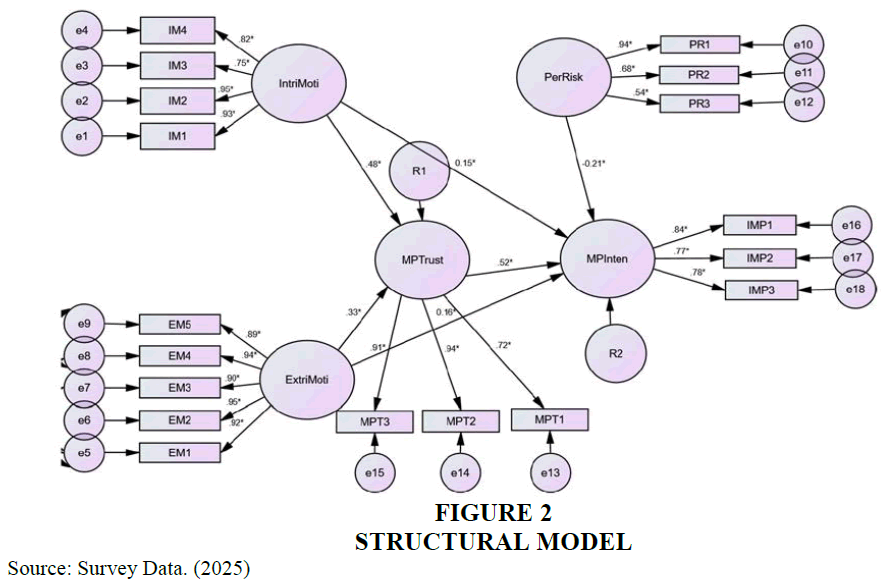
Figure 2 Structural Model
Source: Survey Data. (2025)
Thereafter, mediating analysis was performed to access H6, mediating role of mobile payment trust on the relationship between intrinsic motivation and intention to use mobile payment and H7, mediating role of mobile payment trust on the relationship between extrinsic motivation and intent to use mobile payment. The results see Table 6 revealed a significant indirect effect of intrinsic motivation on intention to use mobile payment (H6: β = 0.372, p<0.005). The total effect of intrinsic motivation and intention to use mobile payment intention to use mobile payment (β = 0.563, p<0.05) and direct effect of intrinsic motivation on intention to use mobile payment (β = 0.919, p<0.05) were significant. Hence, this shows a complementary partial mediation role (Hair et al., 2017). Further, H7, mediating impact revealed a significant indirect effect of intrinsic motivation on intention to use mobile payment (H6: β = 0.304, p<0.005). The total effect of intrinsic motivation and intention to use mobile payment (β = 0.480, p<0.05) and direct effect of intrinsic motivation on intention to use mobile payment (β = 0.176, p<0.05) were significant. Hence, this shows a complementary partial mediation role as well (Hair et al., 2017).
| Table 6 Summary of Mediating Impact | ||
| H6 (IM<MPT<IMP) | ||
| Beta value | P value | |
| Direct path | 0.919 | 0.006 |
| Indirect path | 0.372 | 0.001 |
| Decision | Partial Mediation | |
| Total effect | 0.563 | |
| H7 (EM<MPT<IMP) | ||
| Direct path | 0.176 | 0.002 |
| Indirect path | 0.304 | 0.001 |
| Decision | Partial Mediation | |
| Total effect | 0.480 | |
Moderating impact of perceived risk on the relationship between mobile payment trust and intention to use mobile payment depicted that there is a significant moderating impact see Table 7.
| Table 7 Summary of Moderating Impact | ||||
| Path | Hypothesis | Beta value | P value | Decision |
| MPT<PR<IMP | H8 | -0.315 | 0.000 | Supported |
Discussion
The current study explored the motivational factors which may influence intention to use mobile payments theorizing intrinsic and extrinsic motivation grounded on the self-determination theory. The results interpreted that intrinsic and extrinsic motivations positively and significantly influence intention to use mobile payments making it equal with the previous findings (Chaurasia, 2019; Yoo et al., 2012). Hence, this study provides a clear understanding on how intrinsic and extrinsic motivations influence consumer intention to use mobile payments.
Mediating role of mobile payment trust depicted a partial mediating relationship on both intrinsic and extrinsic motivations on intention to use mobile payments, further validating the previous findings of trust creating consumers perspective towards intention. Moreover, the results denoted that intrinsic motivation playing an impressive role on mobile payment trust. Further, the expanding of self-determination theory improves the predictive power of incorporating trust. Moreover, the empirical contribution of the study satisfies the moderating effect of perceived risk.
Contributions of the Study
The research attempts to broaden the existing knowledge about the possible motivational factors affecting the intention to use mobile payments. As the self-determination theory does not discuss trust as an antecedent, the current study incorporated mobile payment trust as an antecedent in deciding the behavior through the lens of trust transfer theory. With that it contributes to the existing literature on mobile payment intention while incorporating the moderating role of perceived risk to fill the empirical gap identified.
Managerially, financial institutes and banks can initiate programs to enhance the trust over online payment methods. Further, mobile payment system developing companies could develop systems to enhance users’ experience and expectations. Accordingly, current technology-related transactions could help the country to grow with the changing technology.
Limitations and Future Research Areas
The current study adopted purposive sampling which could underrepresent some individuals from the target population and limits the generalizability of the study insights. Further, this study limits only to the motivational factors affecting intention to use mobile payments. Hence, as a future research area, researchers could identify more psychological and internal factors affecting intention to use mobile payments and conducting research using diverse consumer groups without limiting it to the current mobile payment users is recommend.
References
Alkhowaiter, W. A. (2020). Digital payment and banking adoption research in Gulf countries: A systematic literature review. International Journal of Information Management, 53, 102102.
Indexed at, Google Scholar, Cross Ref
Bauer, R. A. (1960). Consumer behavior as risk taking. In R. S. Hancock (Ed.), Dynamic marketing for a changing world (pp. 389–398). American Marketing Association.
Chaurasia, S. S., Verma, S., & Singh, V. (2019). Exploring the intention to use m-payment in India. Transforming Government: People, Process and Policy, 13(3–4), 276–305.
Indexed at, Google Scholar, Cross Ref
Chen, L. D. (2008). A model of consumer acceptance of mobile payment. International Journal of Mobile Communications, 6(1), 32–52.
Indexed at, Google Scholar, Cross Ref
Dahabiyeh, L., Najjar, M. S., & Agrawal, D. (2020). The effect of risk levels on technology adoption decision: The case of online games. Information Technology & People, 33(5), 1445–1464.
Indexed at, Google Scholar, Cross Ref
Dahlberg, T., Mallat, N., Ondrus, J., & Zmijewska, A. (2008). Past, present and future of mobile payments research: A literature review. Electronic Commerce Research and Applications, 7(2), 165–181.
Indexed at, Google Scholar, Cross Ref
Davis, F. D. (1989). Perceived usefulness, perceived ease of use, and user acceptance of information technology. MIS Quarterly, 13(3), 319–340.
Indexed at, Google Scholar, Cross Ref
Deci, E. L., & Ryan, R. M. (1985). Intrinsic motivation and self-determination in human behavior. Plenum.
Indexed at, Google Scholar, Cross Ref
Deci, E. L., & Ryan, R. M. (2000). The “what” and “why” of goal pursuits: Human needs and the self-determination of behavior. Psychological Inquiry, 11(4), 227–268.
Indexed at, Google Scholar, Cross Ref
Gefen, D. (2000). E-commerce: The role of familiarity and trust. Omega, 28(6), 725–737.
Indexed at, Google Scholar, Cross Ref
Gihan, J. (2024). The adoption of mobile banking to banking system in Sri Lanka: Exploring factors affecting the adoption.
Hair, J. F., Ringle, C. M., & Sarstedt, M. (2017). Partial least squares structural equation modeling: Rigorous applications, better results, and higher acceptance. Long Range Planning, 46(1–2), 1–12.
Indexed at, Google Scholar, Cross Ref
Herrero, A., & San Martín, H. (2012). Effects of the risk sources and user involvement on ecommerce adoption: Application to tourist services. Journal of Risk Research, 15(7), 841–855.
Indexed at, Google Scholar, Cross Ref
Kesavan, V., & Srinivasan, K. S. (2023). Present state and future directions of digital payments system: A historical and bibliographic examination. International Journal of Professional Business Review, 8(6), 26.
Indexed at, Google Scholar, Cross Ref
Kim, C., Mirusmonov, M., & Lee, I. (2008). An empirical examination of factors influencing the intention to use mobile payment. Computers in Human Behavior, 26(3), 310–322.
Indexed at, Google Scholar, Cross Ref
Koenig-Lewis, N., Marquet, M., Palmer, A., & Zhao, A. L. (2015). Enjoyment and social influence: Predicting mobile payment adoption. The Service Industries Journal, 35(10), 537–554.
Indexed at, Google Scholar, Cross Ref
Koo, C., Chung, N., & Nam, K. (2015). Assessing the impact of intrinsic and extrinsic motivators on smart green IT device use: Reference group perspectives. International Journal of Information Management, 35(1), 64–79.
Indexed at, Google Scholar, Cross Ref
Kuan, H. H., & Bock, G. W. (2007). Trust transference in brick-and-click retailers: An investigation of the before-online-visit phase. Information & Management, 44(2), 175–187.
Indexed at, Google Scholar, Cross Ref
Kumar, A., Parihar, A. S., Jain, P., & Jain, R. (2025). Emerging technologies and their impact on the evolution of digital payment systems. In Proceedings of the 2025 IEEE International Conference on Interdisciplinary Approaches in Technology and Management for Social Innovation (IATMSI) (Vol. 3, pp. 1–5). IEEE.
Indexed at, Google Scholar, Cross Ref
Kumar, N. K., & Yadav, A. S. (2025). Critical factors of mobile payment usage in the unorganized retail sector in Kerala. Vikalpa, 50(4), 351–388.
Indexed at, Google Scholar, Cross Ref
Kumar, R., Singh, R., Kumar, K., Khan, S., & Corvello, V. (2023). How does perceived risk and trust affect mobile banking adoption? Empirical evidence from India. Sustainability, 15(5), 4053.
Indexed at, Google Scholar, Cross Ref
Lu, Y., Yang, S., Chau, P. Y., & Cao, Y. (2011). Dynamics between the trust transfer process and intention to use mobile payment services: A cross-environment perspective. Information & Management, 48(8), 393–403.
Indexed at, Google Scholar, Cross Ref
Majchrzak, A., & Malhotra, A. (2013). Towards an information systems perspective and research agenda on crowdsourcing for innovation. The Journal of Strategic Information Systems, 22(4), 257–268.
Indexed at, Google Scholar, Cross Ref
Mayer, R. C., Davis, J. H., & Schoorman, F. D. (1995). An integrative model of organizational trust. Academy of Management Review, 20(3), 709–734.
Indexed at, Google Scholar, Cross Ref
Muthén, B., & Kaplan, D. (1992). A comparison of some methodologies for the factor analysis of non-normal Likert variables. British Journal of Mathematical and Statistical Psychology, 45(1), 19–30.
Indexed at, Google Scholar, Cross Ref
Patil, P., Tamilmani, K., Rana, N. P., & Raghavan, V. (2020). Understanding consumer adoption of mobile payment in India. International Journal of Information Management, 54, 102144.
Rousseau, D. M., Sitkin, S. B., Burt, R. S., & Camerer, C. (1998). Not so different after all: A cross-discipline view of trust. Academy of Management Review, 23(3), 393–404.
Indexed at, Google Scholar, Cross Ref
Ryan, R. M., & Deci, E. L. (2020). Intrinsic and extrinsic motivation from a self-determination theory perspective. Contemporary Educational Psychology, 61, 101860.
Sekaran, U., & Bougie, R. (2016). Research methods for business: A skill-building approach. John Wiley & Sons.
Indexed at, Google Scholar, Cross Ref
Shin, D. H. (2010). The effects of trust, security, and privacy in social networking. Interacting with Computers, 22(5), 428–438.
Stewart, K. J. (2003). Trust transfer on the World Wide Web. Organization Science, 14(1), 5–17.
Talukder, M. S., Sorwar, G., Bao, Y., Ahmed, J. U., & Palash, M. A. S. (2020). Predicting antecedents of wearable healthcare technology acceptance by elderly. Technological Forecasting and Social Change, 150, 119793.
Indexed at, Google Scholar, Cross Ref
Tang, Q., Zhao, X., & Liu, S. (2016). The effect of intrinsic and extrinsic motivations on mobile coupon sharing. Internet Research, 26(1), 101–119.
Indexed at, Google Scholar, Cross Ref
Trivedi, H. (2024). Evolution of digital payment system in India. International Research Journal of Humanities and Interdisciplinary Studies, 5(1), 30–48.
Vallerand, R. J., & Bissonnette, R. (1992). Intrinsic, extrinsic, and amotivational styles as predictors of behavior. Journal of Personality, 60(3), 599–620.
Venkatesh, V., Thong, J. Y., & Xu, X. (2012). Consumer acceptance and use of information technology. MIS Quarterly, 36(1), 157–178.
Weiner, B. (1990). History of motivational research in education. Journal of Educational Psychology, 82(4), 616–622.
Yoo, Y., Boland, R. J., Lyytinen, K., & Majchrzak, A. (2012). Organizing for innovation in the digitized world. Organization Science, 23(5), 1398–1408.
Received: 10-Dec-2025, Manuscript No. AMSJ-25-16815; Editor assigned: 11-Dec-2025, PreQC No. AMSJ-25-16815(PQ); Reviewed: 20-Dec-2025, QC No. AMSJ-25-16815; Revised: 29-Dec-2025, Manuscript No. AMSJ-25-16815(R); Published: 10-Jan-2026