Research Article: 2026 Vol: 30 Issue: 4
The Mediating Role of Local Presence in the Relationship between the Marketing Mix and Customer Satisfaction in the Fast-Moving Consumer Goods Market
Asiamah Yeboah, Kumasi Technical University, Kumasi, Ghana
Ebenezer Afrifa-Yamoah, Edith Cowan University, Joondalup, Australia
Citation Information:Yeboah, A. & Yamoah, E.A. (2026). The mediating role of local presence in the relationship between the marketing mix and customer satisfaction in the fast-moving consumer goods market. Academy of Marketing Studies Journal, 30(4), 1-19.
Abstract
Regardless of the considerable studies on the relationship between the marketing mix elements and customer satisfaction, somewhat insufficient consideration has been given to understanding the mechanisms through which marketing mix strategies influence customer satisfaction. This study sought to examine the relationship between the marketing mix and customer satisfaction while investigating the mediating role of local presence in a fast-moving consumer goods market. Convenience sampling was employed to collect data from 200 customers, and analysed via path analysis of structural equation modelling. Results show that product, price, and place had significant direct effects on customer satisfaction, but promotion does not. Again, product and promotion had significant direct effect on local presence. Unexpectedly, local presence failed to mediate the relationships between the marketing mix and customer satisfaction. This non-significant mediation is the notably theory advancement of the study. It shapes theory by indicating that local presence is not a common interpretative mechanism.
Keywords
Local Presence, Marketing Mix, Customer Satisfaction, FMCG, Retail Industry.
Introduction
The Fast-Moving Consumer Goods (FMCG) industry is one of the highly competitive sectors in the global economy. Though the sector contributes immensely to economic growth, job creation, and consumer welfare, yet, hampered by intense competition (Tsey et al., 2022). This competition is as a result of both domestic and multinational brands, advancement in technology, and changing nature of customer needs, lifestyle and preference. The competitive nature of the environment has made sustained customer satisfaction and firm survival very critical. Consequently, this calls for constant review of marketing strategies including the marketing mix (Kotler & Amstrong, 2018), to meet the changing needs of customers, and at the same time differentiating firms from the competition. To achieve this, firms must align all the marketing mix elements, because misalignment would affect competitiveness (Isoraite, 2016). Undoubtedly, the marketing mix (product, price, place, and promotion) continues to be one of the most critical schemes for appreciating how firms create value to satisfy customer needs and achieve firm goals (Helm & Gritsch, 2014; Yusuf & Martin, 2022; Londhe, 2014).
Different studies have concluded that well managed marketing mix elements has positive influence customer purchase decisions, perceptions, satisfaction and loyalty (Arif et al., 2021; Kalim et al., 2022; Kim et al., 2021). However, there are empirical inconsistencies in available literature contrary to the positive influence of marketing mix on satisfaction, purchase decisions, loyalty etc. For example, Blut et al. (2018), found no positive influence of all the marketing mix on customer satisfaction and purchase intention. Additionally, Malelak et al. (2021), also concluded that the importance of the marketing mix is context specific. Thus, this depends on the industry, market, segments and many others. These inconsistencies may provide the reason to believe that the complexity in the relationship between marketing mix strategies and customer satisfaction is far more complicated than ever thought.
However, in the FMCG industry, customer satisfaction has been identified as one of the critical factors for customer retention, repeat purchase, and positive word-of-mouth, that ensures sustainable firm performance. That notwithstanding, there is more to customer satisfaction than products quality or affordability; it involves a number of elements including access to product, distribution adaptability, effective promotion effectiveness, and the extent to which customers see brands as essential to their local environment and everyday lives (Singh, 2012; Pruskus, 2015).
Moreover, in pursuit of customer satisfaction, one concept that is gaining popularity in marketing literature is local presence, which refers to the physical proximity of a firm to its customers, the localization of marketing campaigns and marketing mix, and personalized interactions that foster stronger customer connections. Local presence, marked by physical stores, localized marketing mix and campaigns, community engagement, and personalized customer interactions, is progressively accepted as a key determinant of customer satisfaction and loyalty (Barron & Harris, 2008; Verhagen et al., 2015). It underscores the importance of building strong connections with local customers, which aligns with the broader goals of the marketing mix in enhancing customer satisfaction (Vonkeman et al., 2017). This enables customers to see the firm's products, services, communications, and operations as genuinely embedded within, responsive to, and reflective of the local market. This may be shown by locally fitting products, culturally aligned communication messages, localized distribution channels, community dialogue, local sourcing, and sponsoring community projects. These actions and practices may deepen customers' emotional bonding to brands through improved familiarity, trust, credibility, and anticipated responsibility to local needs.
The rising proliferation of FMCG sector has made local presence more important. In as much as globalization allows firms to obtain economies of scale through uniform marketing strategies, more often than not, customers anticipate products and marketing communications that align with local cultural values, preferences, purchasing power, and consumption patterns. Therefore, firms are required to harmonize universal brand consistency with local receptivity. Consequently, local presence is suspected to provide an essential avenue through which marketing mix strategies convert into superior customer satisfaction.
Regardless of the considerable studies on the relationship between the marketing mix elements and customer satisfaction, somewhat insufficient consideration has been given to understanding the mechanisms through which marketing mix strategies impact customer decisions. Greater percentage of previous research have investigated direct link between marketing mix elements and customer satisfaction (e.g., Sudari et al., 2019; Wahab et al., 2016; Mohamadi & Sohrabi, 2018; Fernandes, 2018; Othman et al., 2020), while ignoring transitional mechanisms that define why some marketing strategies are more effective than others. This presents essential theoretical shortcoming because marketing actions do not work in isolation; instead, their effectiveness relies on how consumers interpret and experience them within their local environments.
This theoretical gap is exceptionally critical in emerging markets, where customer choices are shaped by local cultural norms, community relationships, accessibility of products, and trust in firms operating within local markets. In this case, uniform marketing strategies may not work effectively to generate superior customer satisfaction unless they are aligned with a strong local presence. However, factual evidence confirming this mechanism remains limited. Additionally, previous studies have broadly investigated individual marketing mix elements in isolation, with insufficient integration of local factors that may offer an understanding of customer feedback. Consequently, current marketing literature offers little or no advice on how firms must craft marketing strategies in such a way to achieve strategic consistency and local relevance together.
This study aims at filling these gaps by proposing local presence as a critical mediating mechanism linking marketing mix strategies to customer satisfaction. The study posits that well-crafted marketing mix strategies boost customer satisfaction not just because of the benefits they offer, but because they increase customers' perceptions that firms appreciate, respect, and earnestly partner with their local communities. By examining local presence as an explanatory instrument instead of just coincidental factor, the study extends extant marketing theory by illustrating how and why marketing mix strategies affect customer satisfaction. Therefore, the study adds to marketing theory by advancing traditional marketing mix models farther than their direct influence by proposing local presence as an explanatory mechanism that connects firms marketing strategy with customer perceptions. In practical terms, the results of the study are anticipated to offer FMCG managers with evidence-based advice on crafting localized marketing strategies good enough to enhancing customer satisfaction and build sustainable competitive advantage.
Conceptual Background and Hypotheses Development
Conceptual model and background
Our conceptual research model is based on the background of the problem, the review of the literature and the study objectives. Figure 1 represents the conceptual research model developed for the purposes of this research. It consists of one dependent variable-Customer Satisfaction (CS), one independent variable-the Marketing Mix elements (MM) represented by the 4Ps (Product, Price, Place, and Promotion), and one mediating variable-Local Presence (LP). These variables were derived from prior research, where the dependent variable was affected by the independent variables. However, the dependent variable, the independent variable and the mediating variable had not been combined and tested in one study.
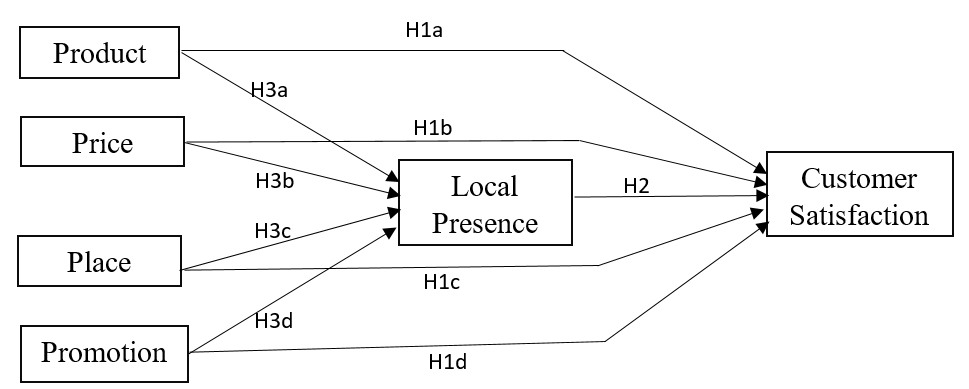
Figure 1 Conceptual Model
Product and customer satisfaction
Product represents the main offering of a firm (Mohammad, 2015), and is any item offered to the market to satisfy a need or a want (Kotler, 1991; Kotler & Amstrong, 2016). Accordingly, the product must be suitable and attractive to customers. For customers to appear satisfied, a firm’s product must best serve their needs. According to Jahmani et al. (2023), product quality, design, features, and overall brand reputation define it. Therefore, firms must provide excellent product to get customer satisfaction. This is because, customer satisfaction can be used to judge product excellence (Caruana et al., 2000), and dependent on value (Howard & Sheth, 1969), and perceived product quality (Anderson et al., 1994; Wantara & Tambrin, 2019). This is so because until customers experiences the product, satisfaction cannot be gained (Anderson et al., 1994). Therefore, better product quality leads to high level of customer satisfaction (Djumarno et al., 2018).
Based on the discussions above, we argue that customer satisfaction can be enhanced by providing products that better match individual preferences, improving the perceived value of the products, and by adapting products to customer demands and cultural nuances. Thus, product quality, design, innovation, and value are the key elements that ensures customer satisfaction in the FMCG markets. Several studies (e.g., Djumarno et al., 2018; Altay et al., 2022; Joudeh et al., 2023; Jahmani et al., 2023; Lim, 2021) have confirmed that product positively and significantly influences customer satisfaction. Therefore, this study proposes the following hypothesis.
• H1a: Product significantly and positively influences customer satisfaction.
Price and customer satisfaction
Pricing and customer satisfaction are critical issues in retailer marketing (Cao et al., 2003), because the price of a product is one of the important drivers of customer satisfaction. Price is “what is given up or sacrificed to obtain a product” (Zeithaml, 1988) or “the amount of money which is sacrificed to obtain something” (Winkler 1995). It is one of the keyways marketers communicate with customers, and the only marketing mix element that produces revenue (Mohammad, 2015). Price plays and important role in customers decision-making processes (Ryu & Han, 2010) and their view of a firm’s price reasonableness in relation to competitors’ prices and value (Han & Kim, 2009). According to Dhurup et al. (2014), the marketing success of firms does not only depend on their ability to continuously enhance their products, but with competitive pricing strategies to improve customer satisfaction. This is because, customer satisfaction is dependent on value (Kotler & Levy, 1969) and affected by price (Anderson et al., 1994). However, the value received from the firm can be viewed as the ratio of perceived quality relative to price or benefits received (Anderson et al., 1994) and in relation to price, and has a direct effect on customer satisfaction (Anderson & Sullivan, 1993; Fornell, 1992). Customers always want value for their money and may be dissatisfied if they feel that the price of products does not match the value received (Wantara & Tambrin, 2019). Previous studies (e.g., Varki & Colgate 2001; Leverin & LiLjander, 2006; Ali Faizan et al., 2016; Han & Hwang, 2017) have confirmed a positive impact of price on customer satisfaction. Therefore, we propose the following hypothesis:
• H1b: Price of a firm’s product significantly and positively influences customer satisfaction.
Place and customer satisfaction
Place, also known as distribution, is another significant element of the marketing mix (Verma & Singh, 2017), which acts as a vehicle for the other elements of the marketing mix (Ahmed & Rahman, 2015). It involves the distribution channel, distribution coverage, outlet locations, inventory levels and location (Koler, 1976), and helps in maximizing the availability of sales channel (Altay et al., 2022). Place is a path through which goods and services flow from the firm to the consumer (Ahmed & Rahman, 2015). Different firms use different distribution methods to meet customer needs, depending on the market, the industry, and the size of the firm. However, in the FMCG industry, place could be direct (maintaining full control of distribution) or indirect (relying on external contractors) (Rambocas et al., 2015; Takata, 2019; Abdullah et al., 2021). Without place, the customer will not have access to the products (Ahmed & Rahman, 2015). Therefore, Place is a major component of customer satisfaction, because, the product may be acceptable, affordable (price), but if not accessible, customers cannot consume to provide judgement (satisfaction or dissatisfaction). Several authors (e.g., Haming et al., 2019; Li et al., 2016; Betancourt et al., 2007; Andri et al., 2022; Altay et al., 2022; Wichmann et al., 2022) have confirmed a direct and positive link between place and customer satisfaction. Therefore, this hypothesis has been proposed.
• H1c: Place has a positive and significant influence on customer satisfaction.
Promotion and customer satisfaction
Promotion which can be face-to-face or through the media (Oreski, 2012), and the last of the marketing mix helps in satisfying customers (Mohammad et al., 2012; Almuhrzi & Alsawafi, 2017). Promotion is any method a firm employ to create awareness of its products (Othman et al., 2020). Mohammad et al. (2015), define promotion as sending a persuasive message about a particular product to customers. Promotion can be viewed as a way of closing the information gap between the would-be sellers and would-be buyers (Wahab et al. 2016). Good promotion will lure customers to increase purchases and customer satisfaction (Amelia et al., 2015). The main function of a promotion strategy is to convince marketers to target customers (Lamb et al., 2001). We argue that without consistent and integrated promotion (communication), customer satisfaction will be difficult to achieve because customer satisfaction is about meeting customer expectations, which is formed because of the firm’s communication. Therefore, if different communication channels do not deliver consistent information and signals, the overall message that customers receive might be fuzzy and confusing (Buchanan-Oliver & Fitzgerald, 2016). Many authors (e.g., Seric et al., 2020; Kim et al., 2019; Othman et al., 2020; Amelia et al., 2015; Ahmed & Rahman, 2015) have established a significant and positive relationship between promotion and customer satisfaction. Based on the above discussion, we propose the following hypothesis.
• H1d: Promotion significantly and positively influences customer satisfaction.
Local Presence and Customer Satisfaction
Local presence highlights the important role of localized strategies in enhancing the marketing mix and customer satisfaction (Garg et al., 2014). Consequently, the concept has generated a lot of interest from researchers (e.g., Verhagen et al., 2014; Vonkeman et al., 2017; Chen & Lin, 2022; Lavoye et al., 2021; Schein et al., 2022; Spangenberger et al., 2022) This concept has gained prominence in recent years, because of the need for firms to build a strong relationship with their local customers. It has been widely used in different contexts (Latoschik & Wienrich, 2022; Tussyadiah et al., 2018) and has been called in extant literature as local presence or spatial presence (Rauschnabel et al., 2022; Verhagen et al., 2014; Vonkeman et al., 2017). In the online environment, products are presented to create a realistic virtual reality (Wateworth, 2001) that brings the product to the environment of the consumer (Lee, 2004). In this study, local presence represents physical stores, local events, community engagement, local products/materials, and personalized interactions with customers to foster deeper customer engagement and relationship. This is because, the study is conducted in the physical context (FMCG/Retail). We argue strongly that local presence can strengthen trust by creating a familiar and reliable face of the brand. It can also foster engagement, create a sense of belonging and personalized experiences, ultimately enhancing customer satisfaction. This is because these factors collectively contribute to heightened customer satisfaction and business success. Based on the above discussion, we argue that local presence can strengthen trust by creating a familiar and reliable face of the brand. It can also foster engagement, create a sense of belonging and personalized experiences, ultimately enhancing customer satisfaction. We argue that, when customers trust the brand, they are more likely to be satisfied with the products. Therefore, we propose the following hypothesis.
• H2: Local presence positively and significantly influences customer satisfaction.
The Mediating Role of Local Presence in the Relationship between Marketing Mix and Customer Satisfaction
Vonkerman et al. (2014; 2017). have underscored the essence of local presence in establishing strong connections with local customers, which aligns with the wider goals of the marketing mix in enhancing customer satisfaction. Local presence can be integrated into marketing strategies to effectively mediate the relationship between the marketing mix elements and customer satisfaction, as it fosters engagement, trust, and personalized experiences that are vital for customer satisfaction in the changing marketing environment. Local presence usually involves personalized interactions with customers, which can be related to the marketing mix. It allows firms to understand and tailor their products to the specific needs and preferences of local customers. By providing personalized product proposals or pricing strategies, firms can improve the perceived value of their offerings. This will help them to improve their bottom line, because when customers feel that the product or service meets their individual needs, it contributes to their overall satisfaction (Garg et al., 2014). Local presence enables firms to execute malleable pricing strategies that consider local market circumstances, competition, and customers’ ability and willingness to pay (Vonkeman et al., 2017).
The study argues that local presence, in the form of physical stores and local engagement helps in creating a sense of proximity and accessibility for customers. Proximity to customers, in the form of local stores or branches, can improve accessibility and convenience. It can make products and services more readily available, which can positively influence customer satisfaction. The ease of access to products and services is a key determinant of customer satisfaction.
Vonkeman et al. (2017), contend that a strong local presence fosters a deeper level of engagement with the local customer. Enhanced customer engagement can be particularly relevant to the ‘promotion’ aspect of the marketing mix. Tailoring promotional efforts to the specific needs and preferences of local customers, increases the effectiveness of promotional activities. For example, localized advertising and event participation can better resonate with local customers, leading to higher engagement and potentially greater customer satisfaction. Satisfied customers who experience the benefits of local presence are more likely to become loyal customers. Loyal customers often become advocates for the brand and its products, contributing to positive word-of-mouth. Based on the above discussion, the following hypothesis has been proposed.
• H3a: Local presence mediates the relationship between product and customer satisfaction.
• H3b: Local presence mediates the relationship between price and customer satisfaction.
• H3c: Local presence mediates the relationship between place and customer satisfaction.
• H3d: Local presence mediates the relationship between promotion and customer satisfaction.
Materials and Methods
Method and Data Collection
The current study has local presence as a mediator that connects marketing mix elements to customer satisfaction. In specific terms, it has been mapped to examine (1) The relationship between the marketing mix elements and customer satisfaction, (2) The relationship between local presence and customer satisfaction, and (3) The relationship between local presence and the marketing mix elements. Thus, the study aims to model the relationships between marketing mix elements and customer satisfaction through local presence, using the structural equation modeling. To study these relationships, a conceptual model has been proposed and mediation analysis has been carried out. The study employed convenience sampling to collect data from 200 customers (shoppers) from the Asokwa retail centre (shopping mall) in Kumasi, Ghana through a pre-tested, structured, and non-disguised questionnaire (Garg et al., 2016). The study employed the interviewer- administered method for data collection for two reasons: 1) This method gives researchers the opportunity to explain and clarify any ambiguity in the question structures to the participants. 2) It encourages participants to respond to the questions (Yeboah & Afrifa-Yamoah, 2023). Consequently, the respondents were supported to respond to the survey questionnaire at the lobby of the shopping mall.
Measurements
To measure customer response, we adapted measurement instruments that had already been validated in previous studies. Therefore, the selection of the items for measurement was preceded by a comprehensive review of literature. Additionally, these items were modified to suit the current purpose, and so, further validation through a pilot study was carried out. The pilot study was done with 15 customers and 3 experts to make sure that the questions were appropriate. The variables involved in the study were six: Product, price, place, promotion (marketing mix); local presence, and customer satisfaction. The questionnaire comprised 45 question items made up of 42 Likert scale items and 3 demographic measures. The 42 items were measured on a 5-point Likert scale (strongly disagree, disagree, neutral, agree, and strongly agree). For positive connotated items, ‘5’ denotes participants strongly agree to the statement and ‘1’ for strongly disagree. Out of the 42 items that measured the constructs, 7 items measured product, 5 items for price, 8 items for place, and promotion was measured with 9 items (Garg et al., 2016). Local presence was measured with 6 items adapted from Vonkeman et al. (2017) & Verhagen et al. (2014). Finally, customer satisfaction was measured with 7 items adapted from Garg et al. (2016), Lee & Lee (2013), and Lee Moghavvemi (2015).
Data Analysis
Descriptive statistics such as frequencies and percentages were used to describe the distributions across key demographics of the study population. The appropriateness of the data was assessed using both univariate and multivariate normality testing (Shapiro Wilk and Henze Zirkler tests respectively), Kaiser Meyer Olkin (KMO) statistic and the Bartlett’s test of sphericity. The reliability of the items in each domain was assessed by Cronbach’s alpha. The Average Variance Extract (AVE), Farnell-Larker Criterion (LFC) and Heterotrait-Monotrarit Ratio (HTMT) were used to assess the convergent and discriminant validity of the instrument. The Partial Least Square Structural Equation Model (PLS SEM) was used to estimate the conceptual model. The goodness-of-fit of models were assessed using appropriate indices such as Comparative Fit Index (CFI), Root Mean Square Error of Approximation (RMSEA), and Tucker–Lewis Index (TLI). We further calculated the Composite Reliability (CR) statistics to establish the construct validity or otherwise of the instrument used. A p-value of less than 0.05 was deemed statistically significant. Statistical analysis was conducted using SmartPLS 3 (Ringle et al., 2015).
Results
Data Suitability Checks and Procedural Remedies
Table 1 briefly presents the demographic profile of the respondents. The sample was fairly gender balance with 51.5% female and 48.5% male respondents. Majority (49%) of the respondents were below the age of 30. In terms of education level, majority (86.5%) of the respondents had at least a diploma, with 41.5% of that sum holding a bachelor’s degree.
| Table 1 Demographics of the respondents | |||
| Variable | Categories | Frequency | Percentage |
| Gender | Male | 97 | 48.5 |
| Female | 103 | 51.5 | |
| Age | Below 30 years | 98 | 49 |
| 31–50 years | 75 | 37.5 | |
| Above 50 years | 27 | 13.5 | |
| Education | High school | 27 | 13.5 |
| Diploma | 73 | 36.5 | |
| Bachelors | 83 | 41.5 | |
| Postgraduate | 17 | 8.5 | |
In assessing the sample adequacy for the proposed statistical modelling, a Kaiser-Meyer-Olkin (KMO) score of 0.803 was observed. This score indicates that the degree of information for the variables reasonably overlap to highlight the presence of a strong partial correlation, which is a necessary requirement for latent factor analysis. Additionally, the Bartlett's test of sphericity produced a p-value<0.001, indicating that the dataset diverges significantly from the identity matrix, making the dataset suitable for data reduction.
Univariate and multivariate normality testing were performed to establish the appropriateness of the application of Maximum Likelihood estimation for the model parameters. Shapiro-Wilk test (all p-value>0.05) revealed that the measurement items were normality distributed. Also, the Henze-Zirkler test reported p-value>0.05 to establish that the items are multivariate normally distributed. In effect the maximum likelihood estimation method was employed in SEM. SEM is applicable in establishing cause-and-effect outcomes (Afrifa-Yamoah, 2016; Yeboah & Afrifa-Yamoah, 2023). Additionally, the Herman’s single factor test revealed that the maximum variance explained by a single factor was 33.67% (which is less than 50%), hence common variance bias is not present in the dataset.
Reliability and Validity of Constructs
Ten (10) non-significant measurement items (all p-values>0.05) were dropped from the model across five measured constructs. Table 2 presents the standardized factor loadings for the Confirmatory Factor Analysis (CFA) model, all of which were statistically significant (p<0.001). The Cronbach's α for the reliability of the instrument was 0.824. The internal consistency of the extracted domains was good with Cronbach’s α and Composite Reliability (CR) statistics lying between 0.7<α<0.9. The observed Average Variance Extract (AVE) scores for all the six constructs were greater than 0.5, implying that convergent validity of the items on their respective constructs was achieved (Table 2). The Fornell-Larcker Criterion (FLC) and Heterotrait-Monotrarit Ratio (HTMT) scores observed between the domains confirmed divergent validity (Table 3). The partial cross-loadings indicate that the correlations between constructs (off diagonal entries in the FLC matrix) are less than the square root of the constructs’ respective AVEs (main diagonal values in the FLC matrix in Table 3). Also, the HTMT criteria scores for each pair of constructs based on the item correlations are all less than 0.85 (Henseler et al., 2015). The assessment indexes indicated that appropriate levels were achieved by the measuring instrument in terms of reliability and construct validity. The measurement model had a good fit (χ2(98)=1139.7, p-value=0.684), as indicated by the Comparative Fit Index (CFI=0.885) and the Tucker-Lewis Index (TLI=0.902 being above the recommended level of 0.90, and Root Mean Square Error Approximation (RMSEA=0.06) being below the cut-off value of 0.08 (Numfam et al., 2022) and Standardized Root Mean Square Residual (SRMR=0.083).
| Table 2 Measurement Items and their Reliability | |
| Constructs and their respective items | Loadings |
| Marketing mix (Product) (Cronbach’s alpha= 0.777, CR=0.848, AVE=0.528) | |
| Mmpro1 - The reliability of the product is very high | Dropped |
| Mmpro2 - The product design is very attractive | 0.717*** |
| Mmpro3 - The product is quite user-friendly | 0.655*** |
| Mmpro4 - The product has very appealing features | 0.782*** |
| Mmpro5 - The company offers a variety of products | 0.726*** |
| Mmpro6 - The company offers warranty on good terms | Dropped |
| Mmpro7 - The product I have bought is a quality leader within its category | 0.748*** |
| Marketing mix (Price) (Cronbach’s alpha=0.764, CR=0.894, AVE=0.808) | |
| Mmpri1 - I have bought the product at a reasonable price | 0.884*** |
| Mmpri2 - The overall price deal I have received is good | 0.914*** |
| Mmpri3 - The point of purchase has provided me with more than one option of payment mode | Dropped |
| Mmpri4 - The company offers options to buy on instalments | Dropped |
| Mmpri5 - The company offers credit | Dropped |
| Marketing mix (Promotion) (Cronbach’s alpha=0.864, CR=0.894, AVE=0.514) | |
| Mmprom1 - The company promotes its products through print media like newspapers and magazines | 0.677*** |
| Mmprom2 - The company also promotes its products through outdoor advertising | Dropped |
| Mmprom3 - The company communicates through TV and internet | 0.756*** |
| Mmprom4 - It also uses social networking sites like Facebook, Twitter to advertise | 0.754*** |
| Mmprom5 - The company advertises the product frequently | 0.778*** |
| Mmprom6 - The company often participates in exhibitions/trade fairs | 0.623*** |
| Mmprom7 - The point of purchase carries out promotional activities | 0.670*** |
| Mmprom8 - The salesperson has given me enough information about services | 0.691*** |
| Mmprom9 - The website of the company provides sufficient information | 0.770*** |
| Marketing mix (Place) (Cronbach’s alpha=0.706, CR=0.809, AVE=0.460) | |
| Mmpla1 - The company sells its products through various channels | Dropped |
| Mmpla2 - The point of purchase stocks other well-known brands as well | 0.690*** |
| Mmpla3 - The company also sells directly through its sales force | 0.625*** |
| Mmpla4 - The company is giving good after sales services | 0.706*** |
| Mmpla5 - The point of purchase offers appealing ambience | 0.650*** |
| Mmpla6 - The product was available at the desired time | Dropped |
| Mmpla7 - The process for contacting for after sales is simple | 0.716*** |
| Mmpla8 - The results of after sales services are satisfactory | Dropped |
| Local presence (Cronbach’s alpha=0.825, CR=0.875, AVE=0.585) | |
| lpred1 - This shopping mall has variety of local brands | 0.778*** |
| lpred2 - The design of the products in the mall reflects the local aspiration | 0.809*** |
| lpred3 - The products in the mall are labelled in local language | 0.748*** |
| lpred4 - The mall environment is designed and decorated with local materials | 0.672*** |
| lpred5 - The mall uses local language to serve its customers | Dropped |
| lpred6 - The mall products have very appealing local features | 0.810*** |
| Customer satisfaction (Cronbach’s alpha=0.819, CR=0.866, AVE=0.480) | |
| Csat1 - I am satisfied with the pre-purchase experience from the mall (e.g., product search, quality information about products) | 0.692*** |
| Csat2 - I am satisfied with the purchase experience from this mall (e.g., ordering, payment procedure) | 0.702*** |
| Csat3 - I am satisfied with the post-purchase experience (e.g., returns, delivery, after sales support) | 0.719*** |
| Csat4 - Based on my overall experience with the mall, I am very satisfied | 0.642*** |
| Csat5 - The shopping experience provided by the mall is above my expectations | 0.640*** |
| Csat6 - Generally, I am very happy with this mall | 0.699*** |
| Csat7 - I am extremely pleased with the quality of service provided by the self-checkout system | 0.751*** |
|
Note: ***bootstrap p-value<0.05 indicating significance of item loading; CR: Composite Reliability; AVE: Average Variance Extract. |
|
| Table 3 Discriminant Validity Analysis | ||||||
| CS | LP | Place | Price | Product | Promotion | |
| Fornell-Larcker Criterion (FLC) | ||||||
| CS | 0.693 | |||||
| LP | 0.290 | 0.765 | ||||
| Place | 0.598 | 0.249 | 0.678 | |||
| Price | 0.505 | 0.229 | 0.416 | 0.899 | ||
| Product | 0.649 | 0.317 | 0.574 | 0.428 | 0.727 | |
| Promotion | 0.404 | 0.377 | 0.503 | 0.310 | 0.294 | 0.717 |
| Heterotrait-Monotrarit Ratio (HTMT) | ||||||
| CS | ||||||
| LP | 0.339 | |||||
| Place | 0.772 | 0.306 | ||||
| Price | 0.628 | 0.276 | 0.571 | |||
| Product | 0.795 | 0.368 | 0.782 | 0.555 | ||
| Promotion | 0.478 | 0.447 | 0.629 | 0.381 | 0.338 | |
| Note: CS: Consumer satisfaction; LP: Local Presence | ||||||
Testing the Effects of Marketing Mix Elements on Customer Satisfaction and Evidence of Mediation Effect of Local Presence
The significance or otherwise of the hypotheses formulated at 0.05 level of significance were tested (Table 4). Marketing mix (product) (critical ratio (cr)=2.442, p-value=0.002), and marketing mix (promotion) (cr=4297, p-value=0.004) had significant direct effect on the mediator (local presence). The four elements of marketing mix only explained 19.4% (R2=0.194) of the variance of local presence. Marketing mix (place) had a non-significant negative relationship with local presence, indicating that shoppers would prefer to shop from markets outside their vicinities.
In assessing the direct effect of the independent variables (four marketing mix elements product, price, place, and promotion) on the dependent variable (customer satisfaction), three of the elements, namely, product (cr=5.863, p-value<0.001), price (cr=3.318, p-value=0.004), and place (cr=3.386, p-value=0.004) had significant direct effects on customer satisfaction. All the four elements of marketing mix had positive relationships with customer satisfaction. The IVs mediated through local presence explained approximately 54% (R2=0.543) of the variance of customer satisfaction.
In assessing the mediation effect of local presence on the relationships between IVs and DV, no mediation effects were observed for all the four elements of the marketing mix.
| Table 4 Regression Weights for the Fit of the Mediated Model between Marketing Mix Constructs and Customer Satisfaction and Summary of Hypotheses Testing | ||
| Hypothesis | Standardized coefficient (SD) | Remark |
| Direct effects | ||
| H1a: Product → Customer satisfaction | 0.391 (0.078)*** | Supported |
| H1b: Price → Customer satisfaction | 0.205(0.072)*** | Supported |
| H1c: Place → Customer satisfaction | 0.232 (0.081)*** | Supported |
| H1d: Promotion → Customer satisfaction | 0.101 (0.072) | Not supported |
| H3a*: Product → Local presence | 0.242 (0.079)*** | Supported |
| H3b*: Price → Local presence | 0.056 (0.075) | Not supported |
| H3c*: Place → Local presence | -0.078 (0.102) | Not supported |
| H3d*: Promotion → Local presence | 0.328 (0.071)*** | Supported |
| H2: Local presence ? Customer satisfaction | 0.023 (0.061) | Not supported |
| Indirect/mediation effects | ||
| H3a: Product → Local presence → Customer satisfaction | 0.006 (0.015) | No mediation |
| H3b: Price → Local presence → Customer satisfaction | 0.001 (0.021) | No mediation |
| H3c: Place → Local presence → Customer satisfaction | -0.002 (0.008) | No mediation |
| H3d: Promotion → Local presence → Customer satisfaction | 0.008 (0.021) | No mediation |
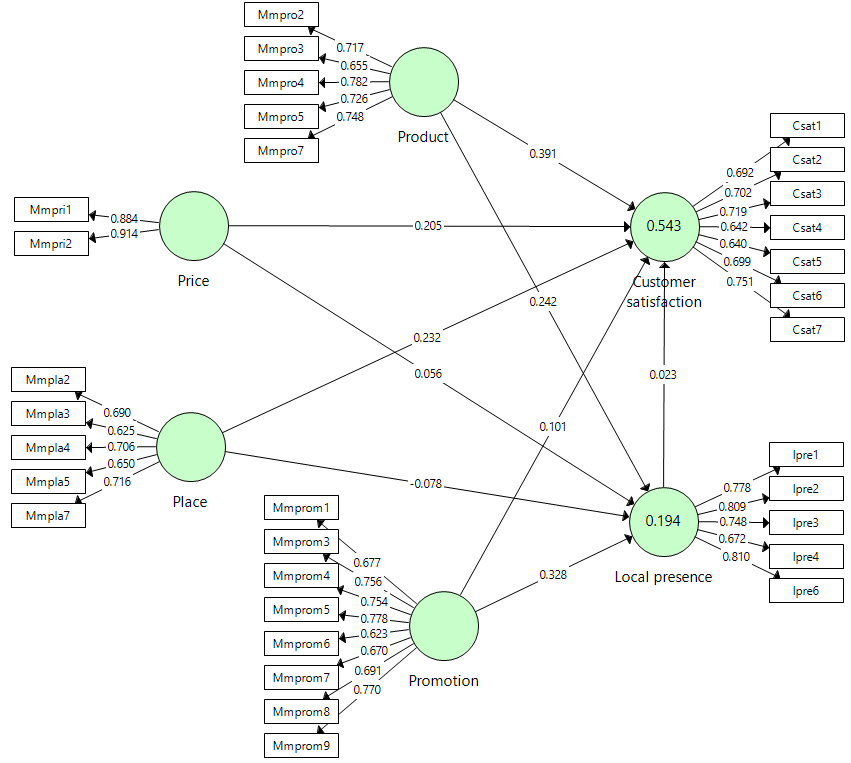
Figure 2 Standardised Estimates of the Mediated Path Analysis Model Evaluating the Relationships between Marketing Mix Elements, and Customer Satisfaction, and the Mediation Effect of Local Presence on These Relationships
Discussion
This study examined the relationship between the marketing mix and customer satisfaction while investigating the mediating role of local presence. The findings confirm that product, price and place have a significant direct effect on customers satisfaction, whilst promotion has no significant direct effect. Despite the fact that product and promotion significantly augment customers' opinions of local presence, local presence itself does not significantly influence customer satisfaction and therefore fails to mediate the relationships between the marketing mix and customer satisfaction. These results offer significant theoretical and practical understanding into the instrument by which marketing strategies affect customers’ decisions in the FMCG industry.
The findings that product, price and place have positive influence on customer satisfaction, but not promotion. This is in line with previous findings and conventional marketing literature, which contends that product quality, functionality, reliability, and value are the key determinants of customer satisfaction (e.g., Al Fahmawee & Jawabreh 2023; Jahmani et al., 2023; Altay et al., 2022; Lim, 2021; Dawi et al. 2018; Djumarno et al., 2018; Han & Ryu, 2009; Cao et al., 2003; Zeithaml, 1988; Tsiotsou, 2006). This means that in FMCG industry, irrespective of the promotional activities and local engagement, customers only buy products that deliver superior value, in line customer value theory, which suggests that consumers derive satisfaction primarily from the functional and perceived quality of products. It is equally important to note that in the FMCG market, pricing and place are also critical in customer satisfaction because customers always compare prices across competing brands, especially in price-sensitive markets, and also not only interested in product attributes but also from the ease with which products are obtained.
Inconsistent with our expectations, promotion did not have significant influence on customer satisfaction. This result indicates that in the FMCG market, promotion alone may not be sufficient to enhance customers' post-purchase evaluations. Undoubtedly, promotional activities may create awareness and could result in trial purchases, customer satisfaction seems to rely more on customers' actual experiences with product quality, pricing, and availability than on promotion. This result is in line with studies contending that promotional activities often exert stronger effects on short-term purchasing behaviour than on long-term satisfaction (Blut et al., 2018).
Additionally, regarding local presence, the study results show a more nuanced account. Product and promotion had significant direct effect on customers view on local presence, implying that superior quality products and perceived locally relevant promotional activities increase customers' perceptions that firms are connected to their communities. Invariably, price and place do not significantly influence local presence, meaning that customers may view pricing and distribution only as economic and operational actions instead of local embeddedness. This stems from the fact that customers often rely on messages provided by retailers and trusted friends for purchasing decision and satisfaction (Yeboah & Afrifa-Yamoah, 2023). This result contradicts with Vonkeman et al. (2017) & Verhagen et al. (2014) who concluded that local presence plays a key role in enhancing all the marketing mix and customer satisfaction.
The most extraordinary result of this study is that local presence does not significantly influence customer satisfaction. Unexpectedly, local presence failed to mediate the relationships between product, price, place, promotion, and customer satisfaction. This result is inconsistent with the proposed conceptual model and challenges the assumption that customers become more satisfied simply because firms show a stronger local presence.
Several reasons may account for this result. First, because purchasing decisions in FMCG are usually routine and low involvement, customers often prioritize tangible product attributes like quality, price, and availability instead of symbolic perceptions of local embeddedness. Second, the increasing uniformity of FMCG products as a result of globalization, may have shifted the essence of local presence as a key determinant of satisfaction. Customers now evaluate brands based on consistent quality, affordability, and accessibility instead of perceived local identity. Third, the result suggests that local presence may operate through different behavioural outcomes instead of customer satisfaction. For instance, local presence may affect brand trust, customer loyalty, or purchase intention rather than immediate satisfaction.
In all, the results show that customer satisfaction in the FMCG industry is principally induced by the marketing mix element especially product, price, and place instead of by customers' perceptions of local presence. Therefore, the study recommends that local presence is not a universal explanatory mechanism linking marketing strategies to customer satisfaction but rather a context-dependent construct whose influence may vary across industries, product categories, and consumer decision-making processes.
Theoretical Implications
The findings show that product, price and place have positive influence on customer satisfaction, but not promotion. This emphasizes the critical role of some of the marketing mix in creating customer satisfaction in the FMCG industry. However, the finding shows that customers are most concern about the quality of products, their prices and availability rather promotion, in the FMCG market. This is in line with customer value theory, which suggests that consumers derive satisfaction primarily from the functional and perceived quality of products and not promotional activities. This means that the effectiveness of marketing mix elements is dependent on context rather than universal.
The study results show a more nuanced account. Product and promotion had significant direct effect on customers’ view on local presence, implying that superior quality products and perceived locally relevant promotional activities increase customers' perceptions that firms are connected to their communities. Customers view price and place as economic more than social. Again, by showing no significant relationship between local presence and customer satisfaction, this study also refines the relationship marketing theory. This stems from the fact that the relationship marketing theory is of the view that assumes closer firm bonding with customers increases positive assessment, the present findings indicate that such effects may depend on industry characteristics and consumer involvement level.
The most notable result of this study is that unexpectedly, local presence failed to mediate the relationships between product, price, place, promotion, and customer satisfaction. This result is inconsistent with the proposed conceptual model and challenges the assumption that customers become more satisfied simply because firms show a stronger local presence. Rather than confirming the proposed model, the finding shows a critical boundary condition. Because the FMCG market is low involvement, customers focus more on functional benefits instead of seeing local embeddedness. This result is a theory advancement addition, because it identifies the circumstances under which local presence is rare to explain customer satisfaction.
Practical Implications
Although the marketing mix and customer satisfaction have been widely explored in the retail environment, their integration with local presence has not been examined and validated in literature. This study confirms that product, price and place are important antecedence of customer satisfaction in the FMCG industry. It has been established that product has the strongest influence on satisfaction, followed by price and then place. This offers retailers the opportunity to enhance customer satisfaction by examining their marketing mix elements to determine their strength, and to identify the element(s) that ought to be developed in line with their customer’s preference. This study recommends improvement in product quality, by investing in product innovation, research and development, and quality assurance rather than increasing promotional expenditure, because product has the strongest influence on customer satisfaction.
Conclusion
Additionally, the findings show that product and promotion of the marketing mix directly affect local presence, whilst place had a non-significant negative relationship with local presence. This result will enable retailers to identify the areas they need to invest in developing and sustaining strategies that will help them to satisfy their existing customers and attract new ones. For example, this result is an indication that customer do not mind where products are sold, once the products meet their preference and have convincing information about them from trusted sources, they will buy. Therefore, retailers can involve intermediaries outside their localities in the distribution channel.
Furthermore, this study also suggests that firms must develop products or adapt their products to the specific needs, preferences, demands and cultural nuances of the local market, enhancing the perceived value of their products and ultimately increasing customer satisfaction. Additionally, firms must stress the importance of local presence in effective promotion in building trust and creating a sense of community among customers. This is because a solid sense of trust in the brand and the firm can be tied to the ‘promotion’ aspect of the marketing mix. This should be done by making use of local influencers, local language, and promotion channels.
Limitations and Recommendations for Further Research
Unquestionably, this study has contributed to extend the extant literature on marketing mix, retail management, local presence, and customer satisfaction. However, it has its shortcomings, which offer opportunities for further research. First, the study sample was taken from customers who buy goods from the face-to-face retail environment in Ghana. Shoppers were conveniently sampled, and the sample size is relatively small. These do affect the generalizability of the findings, especially in context other than FMCG markets. Future research can examine customers who buy from more established retail environment from diverse economies with different cultures to provide more insights and corroborate the findings on customer satisfaction. Secondly, the study was a cross-sectional, making it difficult to test and verify the existence of causal relationships. It is recommended that consideration must be given to a longitudinal design that employ mixed method approaches to investigate the effects of the marketing mix on customer satisfaction, mediated by different variables, such as social presence and customer service.
References
- Abd Wahab, N., Hassan, L. F. A., Shahid, S. A. M., & Maon, S. N. (2016). The relationship between marketing mix and customer loyalty in hijab industry: The mediating effect of customer satisfaction. Procedia Economics & Finance, 37, 366–371.
- Ahmed, S., & Rahman, M. H. (2015). The effects of marketing mix on consumer satisfaction: A literature review from Islamic perspectives. Turkish Journal of Islamic Economics, 2(1), 17–30.
- Ali, F., Amin, M., & Ryu, K. (2016). The role of physical environment, price perceptions, and consumption emotions in developing customer satisfaction in Chinese resort hotels. Journal of Quality Assurance in Hospitality & Tourism, 17(1), 45–70.
- Aljabari, M. A., Joudeh, J. M., Aljumah, A. I., Al-Gasawneh, J., & Daoud, M. K. (2023). The impact of website quality on online purchase intention: The mediating effect of e-WOM, Jordan context. International Journal of Professional Business Review, 8(6), e02143.
- Altay, B. C., Okumus, A., & Adigüzel Mercangöz, B. (2022). An intelligent approach for analyzing the impacts of the COVID-19 pandemic on marketing mix elements (7Ps) of the on-demand grocery delivery service. Complex & Intelligent Systems, 8(1), 129–140.
[Crossref] [Google Scholar] [PubMed]
- Amelia, L. R. (2015). The influence of marketing mix variables on purchase decision and customer satisfaction (Case study of customer of Vitiara rent car Malang).
- &erson, E. W., & Sullivan, M. W. (1993). The antecedents and consequences of customer satisfaction for firms. Marketing Science, 12(2), 125–143.
- &erson, E. W., Fornell, C., & Lehmann, D. R. (1994). Customer satisfaction, market share, and profitability: Findings from Sweden. Journal of Marketing, 58(3), 53–66.
- Andri, P., Jasfar, F., & Kristaung, R. (2022). Effect of product, distribution and service quality on customer loyalty through customer satisfaction at Indonesian marketplace. Devotion Journal of Community Service, 3(4), 321–330.
- Anwar, G., & Abdullah, N. N. (2021). The impact of human resource management practice on organizational performance. International Journal of Engineering, Business & Management, 5.
- Arief, A. S., Putri, S. E., Suroso, A., Syakhrani, A. W., & Rahmini, N. (2021). Digital technology management challenges in marketing local farm products in developing countries: Analysis of international publication findings. Jurnal Iqra': Kajian Ilmu Pendidikan, 6(2), 96–107.
- Arif, M., Hasan, M., Alawi, S. M., & Naeem, M. A. (2021). COVID-19 and time-frequency connectedness between green and conventional financial markets. Global Finance Journal, 49, 100650.
- Arif, W., Sukoco, B. M., & Baroto, M. B. (2021). The effect of marketing mix and local brand on customer satisfaction and customer loyalty in the food delivery service industry. International Journal of Economic Research, 18(9), 357–372.
- Barich, H., & Kotler, P. (1991). A framework for marketing image management. MIT Sloan Management Review, 32(2), 94.
[Google Scholar] [PubMed]
- Baron, S., & Harris, K. (2008). Retailer influence on shopping center image. Journal of Retailing, 84(3), 273–283.
- Bauer, C., Spangenberg, K., Spangenberg, E. R., & Herrmann, A. (2022). Collect them all! Increasing product category cross-selling using the incompleteness effect. Journal of the Academy of Marketing Science, 50(4), 713–741.
- Benyo, B., Sodor, B., Doktor, T., & Fördos, G. (2012). Student attendance monitoring at the university using NFC.
- Betancourt, R. R., Cortiñas, M., Elorz, M., & Mugica, J. M. (2007). The demand for and the supply of distribution services: A basis for the analysis of customer satisfaction in retailing. Quantitative Marketing & Economics, 5, 293–312.
- Bitner, M. J., & Booms, B. H. (1982). Trends in travel and tourism marketing: The changing structure of distribution channels. Journal of Travel Research, 20(4), 39–44.
- Borden, N. H. (1964). The concept of the marketing mix. Journal of Advertising Research, 4(2), 2–7.
- Buchanan-Oliver, M., & Fitzgerald, E. M. (2016). Industry and agency views of social media: Issues implementing dialogic communication. Journal of Marketing Communications, 22(4), 437–454.
- Cao, J. J., Wu, F., Chow, J. C., Lee, S. C., Li, Y., Chen, S. W., An, Z. S., Fung, K. K., Watson, J. G., Zhu, C. S., & Liu, S. X. (2005). Characterization and source apportionment of atmospheric organic and elemental carbon during fall and winter of 2003 in Xi'an, China. Atmospheric Chemistry & Physics, 5(11), 3127–3137.
- Caruana, A., Money, A. H., & Berthon, P. R. (2000). Service quality and satisfaction–the moderating role of value. European Journal of Marketing, 34(11/12), 1338–1353.
- Carvalho, A., & Fernandes, T. (2018). Understanding customer brand engagement with virtual social communities: A comprehensive model of drivers, outcomes and moderators. Journal of Marketing Theory & Practice, 26(1–2), 23–37.
- Chen, H., Zhang, M., Han, L., & Lim, A. (2021). Hierarchical marketing mix models with sign constraints. Journal of Applied Statistics, 48(13–15), 2944–2960.
- Constantinides, E. (2006). The marketing mix revisited: Towards the 21st century marketing. Journal of Marketing Management, 22(3–4), 407–438.
- Dawi, N. M., Jusoh, A., Streimikis, J., & Mardani, A. (2018). The influence of service quality on customer satisfaction and customer behavioral intentions by moderating role of switching barriers in satellite pay TV market. Economics & Sociology, 11(4), 198.
- Dhurup, M., Mafini, C., & Dumasi, T. (2014). The impact of packaging, price and brand awareness on brand loyalty: Evidence from the paint retailing industry. Acta Commercii, 14(1), 1–9.
- Di Fede, G., Catania, M., Morbin, M., Rossi, G., Suardi, S., Mazzoleni, G., Merlin, M., Giovagnoli, A. R., Prioni, S., Erbetta, A., & Falcone, C. (2009). A recessive mutation in the APP gene with dominant-negative effect on amyloidogenesis. Science, 323(5920), 1473–1477.
- Doerner, R., Tesch, A., Hildebrand, A., Leenders, S., Tropper, T., Wilke, W., Winkler, C., Hillig, J., Pestov, A., Walsh, J. A., & Thomas, B. H. (2022). VR/AR case studies. In Virtual and Augmented Reality (VR/AR): Foundations and Methods of Extended Realities (XR) (pp. 331–369). Cham: Springer International Publishing.
- Dubihlela, J., & Ngxukumeshe, T. (2016). Eco-friendly retail product attributes, customer attributes and the repurchase intentions of South African consumers. International Business & Economics Research Journal (IBER), 15(4), 163–174.
- Afrifa-Yamoah, E. (2016). Achievement motivation as a function of participation, strive, willingness to work and maintaining work: Application of structural equation modelling (SEM). International Journal of Psychology & Behavioral Sciences, 6(3), 133–138.
- Farooq, M. S., Kalim, Z., Qureshi, J. N., Rasheed, S., & Abid, A. (2022). A blockchain-based framework for distributed agile software development. IEEE Access, 10, 17977–17995.
- Fornell, C. (1992). A national customer satisfaction barometer: The Swedish experience. Journal of Marketing, 56(1), 6–21.
- Garg, N., Kumar, V., & Telang, R. (2016). Is it time to split marketing mix? In Advances in Electronic Marketing (pp. 53–63). Springer.
- Garg, S., Gentry, C., Halevi, S., Raykova, M., Sahai, A., & Waters, B. (2016). Candidate indistinguishability obfuscation and functional encryption for all circuits. SIAM Journal on Computing, 45(3), 882–929.
- Haming, M., Murdifin, I., Syaiful, A. Z., & Putra, A. H. P. K. (2019). The application of SERVQUAL distribution in measuring customer satisfaction of retails company. Journal of Distribution Science, 17(2), 25–34.
- Han, X., Li, H., Pan, H., & Hu, Z. (2021). How does “mobile” change the game? The roles of marketing mix in the mobile context on customer satisfaction. Internet Research, 31(2), 499–525.
- Hancock, D. R., Algozzine, B., & Lim, J. H. (2021). Doing case study research: A practical guide for beginning researchers.
- He, Q., Lin, Z., Chen, H., Dai, X., Li, Y., & Zeng, X. (2022). Bi-level optimization based two-stage market clearing model considering guaranteed accommodation of renewable energy generation. Protection & Control of Modern Power Systems, 7(1), 1–13.
- Helm, R., & Gritsch, S. (2014). Examining the influence of uncertainty on marketing mix strategy elements in emerging business to business export-markets. International Business Review, 23(2), 418–428.
- Henseler, J., Ringle, C. M., & Sarstedt, M. (2015). A new criterion for assessing discriminant validity in variance-based structural equation modeling. Journal of the Academy of Marketing Science, 43(1), 115–135.
- Howard, J. A., & Sheth, J. N. (1969). The theory of buyer behavior. New York, 63, 145.
- Hudaya, A., Djumarno, D., & Djubaedah, S. (2021). The influence of service quality and product quality on customer satisfaction that implications on repurchase interest. Dinasti International Journal of Management Science, 3(1), 150–160.
- Imaningsih, E. S., & Rohman, S. (2018). The model of product quality, promotion, price, and purchase decisions. Jurnal Ekonomi, 23(2).
- Išoraite, M. (2016). Marketing mix theoretical aspects. International Journal of Research-Granthaalayah, 4(6), 25–37.
- Jahmani, A., Jawabreh, O., Abokhoza, R., & Alrabei, A. M. (2023). The impact of marketing mix elements on tourist's satisfaction towards five stars hotel services in Dubai during COVID-19. Journal of Environmental Management & Tourism, 14(2), 335–346.
- Joergens, C. (2016). The impact of product assortment strategy on online retailers' stockouts and SKU variety. International Journal of Physical Distribution & Logistics Management, 46(2), 105–126.
- Kalim, A., Anis, A., Yasir, A., & Aslam, S. (2022). Does the online marketing mix influence customer satisfaction in online shopping? An empirical study. Journal of Open Innovation: Technology, Market, & Complexity, 8(1), 21.
- Kim, H. J., Kim, H., & Kim, S. H. (2021). Examining the effects of marketing mix on customer satisfaction: A study of the fast-food industry in South Korea. International Journal of Environmental Research & Public Health, 18(16), 8547.
- Kim, S., Chen, J., Cheng, T., Gindulyte, A., He, J., He, S., Li, Q., Shoemaker, B. A., Thiessen, P. A., Yu, B., & Zaslavsky, L. (2021). PubChem in 2021: New data content and improved web interfaces. Nucleic Acids Research, 49(D1), D1388–D1395.
- Kotler, P., & Armstrong, G. (2016). Principles of marketing (16th ed.).
- Kotler, P., & Levy, S. J. (1969). Broadening the concept of marketing. Journal of Marketing, 33(1), 10–15.
- Lavoye, V., Mero, J., & Tarkiainen, A. (2021). Consumer behavior with augmented reality in retail: A review and research agenda. The International Review of Retail, Distribution & Consumer Research, 31(3), 299–329.
- Lee, C., & Griffith, D. A. (2004). The marketing strategy-performance relationship in an export-driven developing economy: A Korean illustration. International Marketing Review, 21(3), 321–334.
- Lee, C. J., Lim, Y., Kim, H. S., & Han, C. (2009). Optimal gas-to-liquid product selection from natural gas under uncertain price scenarios. Industrial & Engineering Chemistry Research, 48(2), 794–800.
- Leverin, A., & Liljander, V. (2006). Does relationship marketing improve customer relationship satisfaction and loyalty? International Journal of Bank Marketing, 24(4), 232–251.
- Li, K. J. (2018). Behavior-based pricing in marketing channels. Marketing Science, 37(2), 310–326.
- Lim, W. M., & Guzmán, F. (2022). How does promotion mix affect brand equity? Insights from a mixed-methods study of low involvement products. Journal of Business Research, 141, 175–190.
- Lin, Z., Hamill, P. A., Li, Y., Sun, Z., & Waterworth, J. (2020). How did order-flow impact bond prices during the European Sovereign Debt Crisis? International Review of Economics & Finance, 67, 13–24.
- Londhe, B. R. (2014). Marketing mix for next generation marketing. Procedia Economics & Finance, 11, 335–340.
- Mackenzie, S. B., Podsakoff, P. M., & Podsakoff, N. P. (2011). Challenge-oriented organizational citizenship behaviors and organizational effectiveness: Do challenge-oriented behaviors really have an impact on the organization's bottom line? Personnel Psychology, 64(3), 559–592.
- McCarthy, E. J. (1960). Basic marketing: A managerial approach. Homewood, IL: Richard D. Irwin.
- Mohammad, H. I. (2015). 7PS marketing mix and retail bank customer satisfaction in northeast Nigeria. British Journal of Marketing Studies, 3(3), 71–88.
- Mohammadi, M., & Sohrabi, T. (2018). Examining the effect of marketing mix elements on customer satisfaction with mediating role of electronic customer relationship management. Industrial Engineering & Management Systems, 17(4), 653–661.
- Norsyaheera, A. W., & Lailatul-Faizah, A. H. (2016). The influence of marketing mix and customer satisfaction on customer loyalty among hijab consumers. Advances in Business Research International Journal.
- Nunfam, V. F., Asitik, A. J., & Afrifa-Yamoah, E. (2022). Personality, entrepreneurship education and entrepreneurial intention among Ghanaian students. Entrepreneurship Education & Pedagogy, 5(1), 65–88.
- Othman, B., Harun, A., Sadq, Z. M., Rashid, W. N., Abdullah, K. M., Mohammed, H. O., & Faeq, D. K. (2020). Effects of service marketing mix on umrah customer satisfaction: Empirical study on umrah traveling industry in Malaysia. TEST Engineering & Management, 83, 22895–22909.
- Pantouvakis, A., & Lymperopoulos, K. (2008). Customer satisfaction and loyalty in the eyes of new and repeat customers: Evidence from the transport sector. Managing Service Quality: An International Journal, 18(6), 623–643.
- Park, S., Lee, J., Hwang, G., & Choi, J. K. (2017). Event-driven energy trading system in microgrids: Aperiodic market model analysis with a game theoretic approach. IEEE Access, 5, 26291–26302.
- Peng, L. S., & Moghavvemi, S. (2015). The dimension of service quality and its impact on customer satisfaction, trust, and loyalty: A case of Malaysian banks. Asian Journal of Business & Accounting, 8(2).
- Pruskus, V. (1998). Marketing of political services.
- Rauschnabel, P. A., Babin, B. J., tom Dieck, M. C., Krey, N., & Jung, T. (2022). What is augmented reality marketing? Its definition, complexity, and future. Journal of Business Research, 142, 1140–1150.
- Ringle, C. M., Wende, S., & Becker, J.-M. (2015). SmartPLS 3. Boenningstedt: SmartPLS.
- Ryu, K., & Han, H. (2010). Influence of the quality of food, service, and physical environment on customer satisfaction & behavioral intention in quick-casual restaurants: Moderating role of perceived price. Journal of Hospitality & Tourism Research, 34(3), 310–329.
- Schein, E. H., & Schein, P. A. (2021). Humble inquiry: The gentle art of asking instead of telling. Berrett-Koehler Publishers.
- Šeric, M., Ozretic-Došen, Ð., & Škare, V. (2020). How can perceived consistency in marketing communications influence customer–brand relationship outcomes? European Management Journal, 38(2), 335–343.
- Shipley, D., & Jobber, D. (2001). Integrative pricing via the pricing wheel. Industrial Marketing Management, 30(3), 301–314.
- Simangunsong, E. (2018). Generation-Z buying behaviour in Indonesia: Opportunities for retail businesses. MIX: Jurnal Ilmiah Manajemen, 8(2), 243–253.
- Singh, A., & Verma, P. (2017). Factors influencing Indian consumers' actual buying behaviour towards organic food products. Journal of Cleaner Production, 167, 473–483.
- Singh, M. (2012). Marketing mix of 4P’s for competitive advantage. IOSR Journal of Business & Management, 3(6), 40–45.
- Sudari, S., Tarofder, A., Khatibi, A., & Tham, J. (2019). Measuring the critical effect of marketing mix on customer loyalty through customer satisfaction in food and beverage products. Management Science Letters, 9(9), 1385–1396.
- Takata, H. (2019). Transaction costs and capability factors in dual or indirect distribution channel selection: An empirical analysis of Japanese manufacturers. Industrial Marketing Management, 83, 94–103.
- Tsey, S. K., Boachie-Mensah, F., & Agyapong, G. (2022). Distribution channel strategies and customer choice in the fast-moving consumer goods industry: A case study in the Upper East Region, Ghana. International Conference “Universities, Entrepreneurship and Enterprise Development in Africa”.
- Tussyadiah, I. P., & Sigala, M. (2018). Shareable tourism: Tourism marketing in the sharing economy. Journal of Travel & Tourism Marketing, 35(1), 1–4.
- Varadarajan, R. (2010). Strategic marketing and marketing strategy: Domain, definition, fundamental issues, and foundational premises. Journal of the Academy of Marketing Science, 38, 119–140.
- Varki, S., & Colgate, M. (2001). The role of price perceptions in an integrated model of behavioral intentions. Journal of Service Research, 3(3), 232–240.
- Verhagen, T., Dolen, W. V., & Jansen, W. (2015). The influence of online store beliefs on consumer online impulse buying: A model and empirical application. Information & Management, 52(3), 270–279.
- Verhagen, T., Van Nes, J., Feldberg, F., & van Dolen, W. (2014). Virtual customer service agents: Using social presence and personalization to shape online service encounters. Journal of Computer-Mediated Communication, 19(3), 529–545.
- Vonkeman, C., Verhagen, T., & van Dolen, W. (2017). Role of local presence in online impulse buying. Information & Management, 54(8), 1038–1048.
- Wantara, P., & Tambrin, M. (2019). The effect of price and product quality towards customer satisfaction and customer loyalty on Madura batik. International Tourism & Hospitality Journal, 2(1), 1–9.
- Wei, Y., O'Neill, H., Lee, R. P., & Zhou, N. (2013). The impact of innovative culture on individual employees: The moderating role of market information sharing. Journal of Product Innovation Management, 30(5), 1027–1041.
- Wichmann, J. R., Uppal, A., Sharma, A., & Dekimpe, M. G. (2022). A global perspective on the marketing mix across time and space. International Journal of Research in Marketing, 39(2), 502–521.
- Winker, K., Rappole, J. H., & Ramos, M. A. (1995). The use of movement data as an assay of habitat quality. Oecologia, 101, 211–216.
- Yeboah, A., & Afrifa-Yamoah, E. (2023). The influence of social presence on customer loyalty in emerging market retail industry: The mediating role of trust. Journal of African Business, 1–22.
- Yu-Ke, C., Hassan, M. S., Kalim, R., Mahmood, H., Arshed, N., & Salman, M. (2022). Testing asymmetric influence of clean and unclean energy for targeting environmental quality in environmentally poor economies. Renewable Energy, 197, 765–775.
- Zeithaml, V. A. (1988). Consumer perceptions of price, quality, and value: A means-end model and synthesis of evidence. Journal of Marketing, 52(3), 2–22.
Received: 20-Jan-2026, Manuscript No. amsj-26-15028; Editor assigned: 22-Jan-2026, PreQC No. amsj-26-15028 (PQ); Reviewed: 05-Feb-2026, QC No. amsj-26-15028; Revised: 12-Aug-2026, Manuscript No. amsj-26-15028(R); Published: 19-Aug-2026