Research Article: 2026 Vol: 30 Issue: 2
The Moderating Influence of Customer Orientation (CO) on correlation Between Entrepreneurial Orientation (EO) and Small Firm Growth
Rakesh Gupta, IIM-Nagpur
Citation Information: Gupta., R. (2026) The moderating influence of customer orientation (CO) on correlation between entrepreneurial orientation (EO) and small firm growth. Academy of Marketing Studies Journal, 30(2), 1-19.
Abstract
Research in the field of firm level entrepreneurship defined as entrepreneurial orientation (EO) has resulted in the development of a rich body of literature in this field, but there are some concerns about the performance implications of EO on firm growth (Mantok et al., 2019). Past studies have highlighted the need to consider various contextual factors, which can act as moderating variable to throw better light on this gap in literature. There has been increasing clamour to integrate entrepreneurship and marketing disciplines as it is widely believed that EO represented through the dimensions of innovativeness, proactiveness and risk-taking provide better customer value through customer orientation (CO), which leads in better firm performance. In the past, there have been few studies who have examined the role of CO as a moderating variable in influencing EO-Firm performance relationship. This resulted in exploring the moderating influence of customer orientation but on individual dimensions of entrepreneurial construct rather than the whole EO construct and small firm growth in the context of emerging economy like India. A total of 290 pen and paper questionnaires were circulated among owners/ senior executives of small and medium firms and finally a total of 189 valid responses were obtained. The study employed quantitative empirical approach with partial least squares structural equation modelling to analyse data. The study contributes to ongoing scholarly conversation by examining synergetic effect of entrepreneurial (long-term) and customer (short-term) orientations on small firm growth through specific dimensions thus showing interesting relationships in the context of emerging economies. The results revealed that small firms with limited resources should avoid pursuing both these orientations together to drive their growth.
Keywords
Entrepreneurial Orientation Construct, Dimensional Nature, Customer Orientation, Small Firm Growth (Smes), Emerging Economies.
Introduction
Firms today are operating in intensely competitive, fluid and fast-changing business environment where small firms are increasingly struggling to cope-up with these changes and their resource constraints add to this pressure. The evolving business landscape with rapid changes in technology and rising customer demands and expectations has created very tough and challenging business environment for small firms. These firms are always struggling to mitigate the influence of this increasingly challenging environment by searching ways to find new sources of competitive advantage, which provide them some levers for growth (Smith et al., 2017). This rapidly changing and evolving business environment and growing competitive pressures are increasingly making traditional business strategies become ineffective and obsolete (Almajali et al., 2016; Whalen et al., 2016). So, small firms are always in search of new ways or combinations to meet their goals and growth objectives. Since small firms play an important role in any country’s economic growth and job creation, so understanding the factors contributing to their well-being is an important policy and research objective.
Entrepreneurship has gained increasing importance as there is a growing realization that it leads to better firm performance, contribute to economy’s growth and job creation. A vibrant and strong entrepreneurial ecosystem is considered as an important driver of firm growth (Sturm et al., 2023). In entrepreneurship discipline, the concept of Entrepreneurial Orientation (EO) has gained wider acceptance and emerged as the most widely researched construct. There have been many researchers, who have examined performance implications of EO construct and reported a positive linkage (Kusa et al., 2024; Shepherd and Wiklund, 2005). The EO construct helps firms to adopt innovative practices, act proactively while taking necessary risks resulting in identifying new opportunities thus having positive performance implications (Nguyen et al., 2020). At the same, few scholars have reported a non-linear relationship between EO and small firm performance and reported diminishing returns (Dai et al., 2014). While there can be various reasons behind these inconsistent results, one of the main reasons can be how EO construct is operationalized treating it as a unidimensional one in which its various dimensions covary (Gupta & Sebastian 2017). Based on these contradictory findings some leading scholars have stated that EO construct alone may not be sufficient for firm growth, in the process highlighting the importance to examine the role of various moderating variables, which might affect this relationship (Lekmat et al. 2018). Since EO is a resource intensive strategic posture, small firms may not be able to realize the full potential of EO and limited understanding about the role of customers in creating right value for them (Chen & Liu, 2020). For small firms to grow, they need to spot new opportunities and capitalize on them by adopting entrepreneurial posture while satisfying their customers’ existing and latent needs (Naidu et al., 2023). Researchers argue that firms need to act proactively, focus on innovations to meet the future needs of customers (Slater and Narver 1995). While EO research so far considered the role of many contextual variables, which moderates its relationship with small firm growth, there are hardly studies, which have focused on the moderating influence of customer orientation (CO) (Dung et al., 2021). CO examines the needs, wants and desires of customers and then try to deliver them to satisfy customers thus driving firm performance (Berthon et al., 1999).
Many researchers argue that since customer centric organizations are sharply focused on addressing the stated needs of customers, they might end-up missing opportunities in developing new products, which customers are unable to articulate (Christensen & Bower 1996). Hamel & Prahalad (1994) term this as tyranny of served market, where managers see the world only through the eyes of their existing customers. Foxall (1984) believed CO is a reactive response to customer needs and current competitor actions while EO is a proactive approach resulting in product innovation with high risk-taking capabilities. Since CO is more focused on customers’ immediate needs, so it develops no new insights about customers thus building limited customer loyalty leading to short-term performance impact (Narver et al., 2004). Since the firm focuses on what the customers articulate, the long-term growth through CO alone is likely to be minimal (Eggers et., al, 2010). Slater & Narver (1995) stated that firms can realize their true potential when they display entrepreneurial behaviour along with strong customer orientation (CO). Webb et al. (2011) pointed out that while customer orientation results in providing far better awareness about customers but it is EO as an antecedent construct, which provides alertness as well as the necessary stimulus to build a desirable future outcome.
Atuahene-Gima & Ko (2001) argued that firm’s experience better performance outcomes when firm’s EO and customer orientation (CO) are aligned. This has resulted in growing calls to examine the integration of entrepreneurship and marketing fields for better value creation and firm performance (Morris, Schindehutte, & LaForge, 2002). Despite these strong convergences, both marketing and entrepreneurship disciplines have made limited efforts to explore firm’s entrepreneurial behavior and customer orientation in conjunction. While research in the past has examined the role of various contextual factors on EO-firm growth, few studies have examined how customer orientation may influence this relationship (Yordanova 2011). This is clearly exemplified by Webb et al. (2011, p. 537) observation; “Despite their tight integration in practice, marketing and entrepreneurship as domains of scholarly inquiry have largely progressed within their respective disciplinary boundaries with minimal cross-disciplinary fertilization”.
So, firms with better alignment of both EO & CO orientations may have better understanding of its customers current and future demands and the ability to meet them through proactively seeking new products/services development through innovative approach while taking necessary risks. While there is a broader consensus that strategic orientations like Entrepreneurial Orientation (EO) and Customer Orientation (CO) are strongly related to success of firms but empirical studies have reported varying results (Eggers et., al, 2010). In principle, CO should drive better firm performance as the customer is at the centre of every organization’s efforts but research has indicated that customer orientation alone is not enough (Thoumrungroje & Racela, 2013). Past research examining the joint influence of EO & CO on firm growth has provided mixed results with some researchers reporting positive results (e.g. Atuahene-Gima & Ko, 2001; Boso, Cadogan, et al., 2012), while some reported negative results (Beliaeva et al., 2020; Morgan et al., 2015).
Many emerging economies in recent past have experienced major institutional transformations, which have resulted in the emergence of new opportunities and challenges. Most of these changes have resulted in these emerging economies moving towards market-driven structures and policies in an effort to stimulate their economic growth (Bettis et., al., 2016). In this direction, firms operating in these economies need to focus on both entrepreneurial orientation (EO) and customer orientation (CO). The studies on the potential business performance outcomes of these two orientations are biased by results coming western settings, meaning that the benefits or costs of investing in these strategic orientations in emerging economies are relatively unknown (Hakala, 2011). However, existing literature has not examined whether it makes sense for firms to aggressively focus on EO and CO simultaneously in the challenging and fast-changing conditions that exist in emerging economies (Cadogan, 2012). So, India provides an ideal emerging economy setting for a quasi-replication research to be done to examine the influence of EO Construct and complementarity between these two orientations (EO & CO). As the research horizon expands to evolving economies, it is critical to know more about ‘‘what’s going on?’’ in these economies (Meyer 2015).
This research marks several contributions to accessible literature; first by operationalizing EO construct through its individual aspects in the context of an emerging economy like India, which is socially, and culturally different from developed markets, we extend the findings of earlier EO studies in a diverse context to underscore the significance of investigating EO as an internationally contextualized phenomenon. This study by taking a granular view of EO Construct contributes to literature by highlighting the need to treat EO as a multifaceted construct, which can explain many different ways for firms to be entrepreneurial rather than the display of all EO dimensions in equal measure. Second, this study examines how customer orientation moderates the relationship between individual EO dimensions and small firm growth. By doing so, the study advances the literature in this field by trying to answer calls for joint research in the area of entrepreneurship and marketing especially in the context of emerging economy setting.
Third, the study goes a step deeper to understand the specific levers of growth for small firms through various combinations of entrepreneurial strategies (individual EO aspects namely innovativeness, proactiveness and risk-taking) and CO to drive better performance implications for small firms to use their limited resources more judiciously. This can also throw better light on the findings of some of the previous studies in this discipline who found contradictory results. The study provides a better understanding about the complementary and conflictual aspects of the distinctive EO strategies through its individual dimensions in alignment with CO on small firm growth, which get masked when we examine the regulating influence on the EO as a unidimensional construct. Thus, this study tries to answer the question: whether small firms’ gain specific performance benefits through individual EO dimensions as well as a combination of strong EO and CO and to what extent when operating in emerging economy?
Literature Review
This section focuses on the emergence and evolution of entrepreneurial orientation (EO) construct, and its conceptualization. It focuses on EO-Firm performance relationship and the impact of various moderating variables on this relationship, which have been examined in literature so far. The latter part focuses on the function of customer orientation (CO) and the need to study it in conjunction with individual EO dimensions and its implications on SMEs growth.
Entrepreneurial Orientation (EO) Construct
The definitional roots of what constitutes firm-level entrepreneurship construct can be attributed to the pioneering effort by Mintzberg (1973) where he categorised firms based on their strategy-making modes. He mentioned ‘entrepreneurial strategy’ mode as one where firms proactively search for new opportunities. Khandwala (1977) talked about risk-taking as part of entrepreneurial strategy to spur better performance. Miller & Friesen (1982) highlighted the role of firm’s innovative approach to strategy making tool for better firm performance. Based on preceding research, Miller (1983, p.771) talked about firm-level entrepreneurship as a strategic approach in his seminal work and operationalized it as “one that engages in product-market innovation, undertakes somewhat risky ventures, and is first to come up with proactive innovations, beating competitors to the punch”. Most researchers have employed Miller’s (1983) approach of unidimensional nature of EO Construct comprising three dimensions of innovativeness, risk-taking and proactiveness, which co-vary (Hakala, 2011). Innovativeness refers to firm’s willingness to support new ideas, encourage creativity and experimentation, which results in the development of new products, services or processes (Ramezan et al., 2013). Proactiveness is defined as acting ahead of other and have a futuristic view while developing new products/services or improving current ones by anticipating new opportunities ahead of their rivals (Storey & Hughes, 2013). Risk-taking denotes the extent to which firms are willing to commit resources to risky projects (Balodi, 2014).
While most researchers have used the gestalt approach to EO, Lumpkin & Dess (1996) have described EO construct as multifaceted in nature where the dimensions act independently and have a unique and differential influence on firm functioning. They held that the trouble with unidimensional EO Construct is it ignores the influence of individual dimensions. While a clear consensus about the dimensional nature of EO construct is yet to emerge, this has resulted in two different streams of thought within the field of entrepreneurship about EO construct. There is a growing body of mainstream research that has started treating EO as a multifaceted construct, where individual dimensions act independently (Hughes & Morgan 2007). Miller (2011), while commenting on the evolution of EO research, stressed on the need to examine EO as a multifaceted construct where each dimension act independently, stating that this might explain the entrepreneurial behaviour of firms in a better way rather than the composite construct. The ongoing debate about nature of EO Construct has resulted in a situation where researchers have examined EO dimensions both independently and collectively (Gupta &Sebastian 2017). There is a possibility that all EO dimensions are equally valuable, but it is also possible that only a subset of them are valuable in a given context, and this combination or sub-set may keep on changing (Gupta et. al., 2021). It is little surprising that even after an incredible volume of scholarship emerging in EO field examining its influence on firm performance, still there are some residual doubts and questions about the composition and operationalization of the construct and its performance implications (Wales et al., 2021).
EO Construct & Role of Moderators
While there is a strong view that EO contributes to higher firm performance but there have been studies, which found inconsequential or contradictory results and this calls for further examination to understand the reasons behind these mixed findings (Wales, Gupta, & Mousa, 2013). These results may be due to the operationalization of EO construct (Wales 2016). Researchers have pointed out the importance of the context in shaping and influencing this relationship (Suder et al., 2025; Lomberg et al. 2017). Many studies have argued that various internal or external factors, which can be the contextual variable who can moderate EO-Firm performance relationship and its strength (Freixanet et al., 2021). This has led researchers to investigate the role of many moderators that can potentially influence this relationship (Schepers et. al., 2014). These moderators include external environment (Tang & Hull, 2012), national culture (Brettel et al., 2015), social capital (Engelen et al., 2015), organizational structure (Covin & Slevin, 1989), leadership (Engelen et al., 2015), strategy (Escrib´a-Esteve et al., 2008), rationality of decision making (Deligianni et al., 2016), networking (Su et al., 2015), human resources (Irwin et al., 2018), organizational learning (Alegre and Chiva, 2013), competencies and resources (Poudel et al., 2019), and open innovation (Freixanet et al., 2021). education and networks (Ferreira et al. 2021), knowledge integration (Jiang et al. 2018) and some other variables.
Customer Orientation (CO) as Moderating Variable
As per Drucker (1954, p. 37) “It is the customer who determines what a business is. For it is the customer, and he alone, who through being willing to pay for a good or for a service, converts economic resources into wealth, things into goods.” Customer orientation (CO) focuses on satisfying customer needs and refers to series of steps taken by organizations to develop a better understanding about customers and then find ways to create better value for them (Kirca et al., 2005). CO reflects the degree of keenness and attentiveness displayed by firms to learn about their customers and then respond to their stated needs by providing appropriate solutions (Real et al., 2014). Firms with strong customer orientation try to develop and maintain strong relationships with their customers and stay close to them to get their feedback (Zhou & Li, 2010). Firms who follow customer-centric approach ‘stay close to customer’, which is a way to identify, understand and monitor their needs. Firms with high CO prioritize customer preferences, and find ways to address these preferences to satisfy customers (Baker & Sinkula, 2009). Customer-oriented firms improve firm performance by improving the commitment and loyalty of customers (Osman Zainal Abidin, 2024). A debate has been going on within marketing discipline about the possible role of CO in influencing firm performance by creating better customer value (Hult et al., 2005).
But CO has a narrower, short-term customer-oriented approach solely focusing on satisfying the immediate needs of customers in the process ignoring potential opportunities that might foster better results through identifying and satisfying their latent needs (Narver et al. 2004). Slater & Narver (1998), stressed the need to keep in mind that being customer-led only provides insufficient stimulus for strong firm performance and this limitation can be addressed by considering CO in conjunction with EO, thus contributing to better outcomes both in the short and long-run. EO focuses on innovations proactively for which markets do not currently exist while taking considerable risk with potential for high rewards. Narver & Slater, (1990), held that EO enables firms to balance the requirements of existing customers by focusing on product line extensions and develop a deeper understanding of their latent needs by focusing on new product development for future. Researchers have suggested about the possible linkages and the need to combine EO with CO to make companies forward looking and perform better (Li et al., 2009). While the impact of EO and CO on firm performance individually has been well examined, researchers have suggested the need to study the simultaneous influence of EO and CO (Todd & Anokhin, 2023; Boso, Story, & Cadogan, 2013; Morgan et., al, 2015). While there is a general belief that EO and CO may interact with each other leading to better performance implications for firms, the existing literature has found mixed outcomes (Hakala, 2011).
Hypotheses Development
This research goes beyond examining the EO and CO construct together but delves deeper by examining the interactions between individual EO dimensions with CO to see their influence on small firm growth. It examines how CO moderates this relationship between individual EO dimensions namely innovativeness, risk-taking and proactiveness and small firm growth. By understanding the nuanced nature of EO and CO can result in better performance implications for firms and this calls for examining the moderating effect of CO on individual EO dimensions. Based on this, we have developed the below-mentioned hypothesis to take the existing research forward in this field.
Individual EO Dimensions and Growth of SMEs
In today’s hypercompetitive business environment, the firm’s ability to innovate, pro-actively anticipate changes, ability to take risk are crucial to explore and exploit opportunities. Innovativeness focuses on small firm’s keenness to develop and encourage new ideas, continuously experiment to develop creative solutions, which result in developing new products or services. As per (Lumpkin & Dess, 2001, p. 142), “Innovativeness reflects a firm’s tendency to engage in and support new ideas, novelty, experimentation, and creative processes that may result in new products, services, or technological processes”. It helps the firms in entering new markets through new product-development, strengthens its presence in existing markets and build competencies to identify new opportunities thus improving their long-term performance (Hult & Ketchen 2001). Highlighting the importance of innovation in firm level entrepreneurship is extensive literature highlighting positive linkage between innovativeness and growth of small firms (Tan & Tan 2005; Zahra & Bogner 2000). Gupta & Pandit (2013) found innovativeness as the most important factor behind firm growth.
Proactiveness refers to anticipating changes and quickly responding to them in the marketplace, thus creating opportunities by identifying latent needs and satisfying them ahead of competitors (Hamel & Prahlad 1994). Kreiser et al. (2002) reported that pro-activeness is positively linked with sales growth. Hughes and Morgan (2007) pointed out that by being “inert to inertia”, proactive firms reap the rewards thus overcome inertia. Kraus et al. (2012) reported in their study that pro-activeness was positively related to firm growth. Risk-taking means the degree to which firms allocate resources, commit themselves and then absorb possible outcomes in the form of gains/losses coming out of these decisions. Firms who are cautious or risk-averse over time become unresponsive to changing market conditions, thus losing their competitive edge (Covin & Slevin 1991). Risk-taking carry enormous cost in the face of fast-changing customer demands, which change regularly. Firms must show risk appetite and resolve to continuously challenge the existing order, which might accrue superior returns (Hughes & Morgan 2007).
Based on these arguments, we hypothesise;
H1: There exists a significant positive linkage between innovativeness and growth of SMEs.
H2: There exists a significant positive linkage between pro-activeness and growth of SMEs.
H3: There exists a significant positive linkage between risk-taking and growth of SMEs.
Moderating Role of Customer Orientation (CO)
The individual dimensions of EO together with CO points toward firm’s efforts to understand and serve customers well in the short and long-run (Baker and Sinkula, 2009). Entrepreneurial firms develop successful innovations when they identify a gap between what their customer needs and what is currently being offered and then focus their energies in bridging this gap (Todd & Anokhin, 2023). Those firms who continuously work towards developing successful innovations regularly collect and synthesize information about evolving needs of their customers to spot new opportunities. While most innovations are the outcome of strong entrepreneurial focus but they ultimately turn into better products or services based on deeper customer insights (Wales et., al., 2023). Most quality innovations at their initial stages are imperfect but once refined based on customer feedback, they deliver better value. Berthon et al. (2003) talked about developing innovative products and services, which result in satisfying existing customers if they are targeted towards their requirements. So, Firm’s entrepreneurial behavior through its strong focus on innovativeness can improve growth by increasing customer satisfaction and loyalty (Kirca et al., 2005). SMEs may better cope with resource limitations by focusing more on innovative practices (Seo & Park, 2022).
Entrepreneurial firms proactively search for new opportunities ahead of others and are more responsive to customers latent needs to strengthen their customer loyalty (Li et al., 2009). Proactive firms have greater ability to manage business environment and chance to alter the competitive landscape by not only serving existing customers’ needs better but also responding to their future needs ahead of rivals and also target new set of customers (Boso et., al., 2013). Entrepreneurial firms take calculated risks and continuously seek customer opinion to develop new insights that might help them in mitigating risk. Narver and Slater (1990) state that entrepreneurial firms should develop strong symbiotic relationship with customer orientation that will result in better acceptance of innovative solutions leading to higher returns for risk-taking. But entrepreneurial firms with strong CO may end-up taking additional risks to satisfy the articulated needs of their customers thus hampering their performance (Berthon et al., 2004). Companies that foster entrepreneurship through its various dimensions use CO to understand customer better and learn what they want, and then calibrate their efforts by being innovative, taking risks to proactively serve their customers better (Baker and Sinkula, 2009; Li et al., 2009). CO should improve firm’s performance as customer is main focus of any organization but the downside of this is that new products may be technology driven with high risk of market failure and this may call for the need to strike a balance between CO and EO (Hamel & Prahalad 1994). Higher levels of EO means that proactive firms are keen about acquiring unique customer information leading to developing innovative products/services based on better customer insights and are more likely to take the risk of pursuing new opportunity (Eggers 2010). Small firms while exploring new opportunities that lie outside their current focus by committing their limited resources may expose them to undue risks, which might have negative influence on their performance (Mustak, 2019). Based on these arguments, it is pertinent to examine both entrepreneurial and customer orientation together, which led to examining the moderating effect of CO on individual EO dimensions.
Many studies have indicated that the EO–CO interplay by implementing them together can enhance firm performance (Baker and Sinkula, 2009; Boso et al., 2013). While there is strong rationale that simultaneous implementation of both EO & CO may be beneficial for firms, this is not always true. Boso, Story, et al. (2013) in their study found positive influence of EO and CO in SMEs from Ghana, while Morgan et al. (2015) found a negative linkage in Swedish SMEs. Beliaeva et al. (2020) found a negative impact for the simultaneous EO and CO implementation on Russian SMEs. These contradictory findings call for examining the EO-CO relationship through a different lens, one of the possibilities can be to examine the moderating influence of CO on the individual dimensions of EO. While studying the moderating influence of CO on individual EO dimensions can provide a fine-grained analysis, which can also possibly explain these contradictory findings. Since SMEs possess limited resources compared to large firms, it is imperative for them to effectively deploy these resources via right combination of different strategic orientation for the survival and growth of SMEs (Morgan et al., 2019). This led this study to examine the moderating influence of CO on the individual dimensions of EO to see whether it throws better insights and explain possible reason behind the above contradictory findings.
Based on this, we hypothesise:
H4a: Customer Orientation moderates the relationship between innovation and growth of SMEs significantly.
H4b: Customer Orientation moderates the relationship between proactiveness and growth of SMEs significantly.
H4c: Customer Orientation moderates the relationship between risk-taking and growth of SMEs significantly.
Research Design
Sample
The present study used cross-sectional research design employing survey method. The respondents were the owners or senior managers of small firms. The rationale for choosing small firms as the sample was that they represent the key criteria of new venture creation (Birch, 2000). The sampling technique employed was purposive in nature, and small and medium enterprises (SMEs) were chosen as per Government guidelines from Delhi and adjoining areas called the National Capital Region (NCR) for data collection. The data was gathered through a field survey. Total 290 pen and paper questionnaires were distributed to owners/senior executives of SMEs. Out of the distributed questionnaires, a total of 254 small and medium enterprises returned the surveys, and after removing incomplete responses, finally a total of 189 valid responses were found complete for analysis purpose. Hair et al. (2019), has suggested that the sample size should be five times the number of scale items for better analysis. Since the number of scale items in this study were 19, this sample size is close to 10 times the number of scale items, while the minimum sample size requirement for this study was (n = 95) whereas the actual number utilized for the data analysis purpose was far higher. Thus, the sample size was adequate for PLS-SEM analysis. Further due care was taken to collect data from small firms operating both in the services and manufacturing sectors for gaining better understanding of the wider context of the small firms. The data was collected from Delhi as well as the national capital region, which included industrial hubs like Gurugram, Noida, Faridabad, Ghaziabad and Sonipat to make it more representative. Delhi-NCR being the industrial hub and microcosm of the country is an ideal place to collect a representative data. Further the data from small firms was collected representing a wide array of industries.
This study adopted multi-industry empirical examination of entrepreneurial small firms operating in India. The sampling frame was developed from state-wise company register database of SMEs. The selected small firms were shortlisted based on the following criteria: (1) All these SMEs were independent firms and none of them were part of a big company or group (Wiklund & Shepherd, 2011); (2) all these SMEs were owned and run by individual entrepreneurs with majority stake with senior professional managers working at responsible positions (Goedhuys and Sleuwaegen, 2010); (3) these firms employed a minimum of five to a maximum of 500 full-time employees (Goedhuys and Sleuwaegen, 2010); and (4) all these firms were either manufacturers of products or service providers and all were engaged in productive business activities (Morgan et al., 2012) Table 1.
| Table 1 Sample Characteristics | |||
| N | Percentage | ||
| Firm type | |||
| Service sector | 78 | 41.27 | |
| Manufacturing | 111 | 58.73 | |
| Firm size | |||
| Less than 50 employees | 73 | 38.62 | |
| 51 - 100 employees | 69 | 36.51 | |
| More than 100 employees | 47 | 24.87 | |
| Firm age | |||
| Upto 5 years | 24 | 12.70 | |
| More than 5 to10 years | 54 | 28.57 | |
| More than 10 years | 111 | 58.73 | |
Measures
All the items EO, CO and SME growth was measured by using the existing measures. This study used the scales developed in the past to capture each of the three EO dimensions. A total of 13 items were chosen to measure the three dimensions on a seven-point Likert-type scale. While innovation and risk-taking dimensions were captured through five items each. Out of these three items in each case were from the original scale of Covin & Slevin (1989) to capture the EO Construct, and the remaining two items were developed by Lumpkin (1996). Whereas pro-activeness was measured by three items developed by Covin & Slevin (1989). The customer orientation (CO) was measured through four items scale developed by Narver & Slater (1990) and adapted by Gatignon & Xuereb (1997) focused towards measuring responsiveness of customers.
The available literature clearly highlights that there exists no specific and standard tool to capture the performance of small firms. Still, there exists some frequently used market-based and accounting-based measures. In fact, for small firms, survival or closure rates might be an appropriate proxy measure (Cooper 1995). Though accounting-based measures are more accurate but still it is very difficult to get the right information from small firms as the information provided is largely guided by how the owner perceives it. So, this study chose sales and employment growth to measure the performance of SMEs in India. The owners/ senior managers were requested to share their perceptions on the above two measures in the past three years, which was captured on a 7-point Likert scale.
Control Variables
The growth implication of small firms can be influenced by a number of other factors, so it is very important to control their effect. We decided to control the influence of small firm age, size, and type. Firm age was captured by capturing the year in which the firm was founded. The nature of the industry can have a strong bearing on its performance, so we decided the type of business as a control measure (Covin & Slevin 2019) and asked whether the firm was operating in the service or manufacturing sector to know the nature of their business. Past studies have shown that size of the firm influences firm growth, so it was controlled by checking how many full-time employees are employed by them.
Measurement Model Assessment
The suggested structural model was tested using the partial least squares-based structural equation modelling (PLS-SEM) statistical technique (Vinzi et al., 2010). PLS-SEM was preferred considering the limited size of data (Hair et al., 2013). The PLS-SEM was an appropriate method for this study because of its suitability to Likert-type scale data, and theory development over testing of structural association as the primary purpose of this research (Hair et al., 2021). Smart PLS 3 software was used for hypothesis testing. The model obtained recommended values of Cronbach’s alpha, composite reliability and average variance extracted (AVE) for the variables were considered in this study (Hair et al. 2013). Indicator reliability was captured by outer loadings (Hair et al., 2013). Some of the items with low loadings (<0.70) were dropped, and it also improved the reliability and validity of the measures (Hair et al., 2013).
#1CA: Cronbach’s alpha; #2CR: composite reliability; #3AVE: average variance extracted; #4: the off-diagonal bold values represent square root of AVE of that variable; #5: these values represent HTMT values; #6: these values represent inter-variable correlations; Proactive: proactiveness; Risk: risk-taking; Innov: innovativeness; CO: Customer Orientation; Firm Growth: Growth of SMEs
Table 2 shows inter-variable correlations (values below diagonal) were less than the square root of the AVE of that variable, addressing discriminant validity (Fornell & Larcker 1981). Further, HTMT values (above the diagonal) were lower than 0.90, validated discriminant validity (Hair et al. 2013). Furthermore, the cross-loadings criterion (Hair et al. 2013), that is cross-loadings of the items were lower than the loading on their own constructs, validated discriminant validity (refer to Table 3).
| Table 2 Reliability and Validity | ||||||||
| Construct | CA | CR | AVE | Proactive | Risk | Innov | CO | Firm Growth |
| Proactive | 0.862#1 | 0.916#2 | 0.784#3 | 0.886#4 | 0.565#5 | 0.711 | 0.576 | 0.637 |
| Risk | 0.658 | 0.808 | 0.588 | 0.420#6 | 0.767 | 0.842 | 0.336 | 0.752 |
| Innov | 0.706 | 0.823 | 0.544 | 0.552 | 0.662 | 0.738 | 0.659 | 0.826 |
| CO | 0.738 | 0.836 | 0.565 | 0.464 | 0.178 | 0.463 | 0.752 | 0.710 |
| Firm Growth | 0.650 | 0.850 | 0.739 | 0.470 | 0.513 | 0.619 | 0.513 | 0.860 |
| Table 3 Cross-Loadings | |||||
| Items | Proactive | Risk | Innov | RE | Firm Growth |
| PA1 | 0.883 | 0.460 | 0.498 | 0.484 | 0.419 |
| PA2 | 0.902 | 0.286 | 0.409 | 0.308 | 0.405 |
| PA3 | 0.872 | 0.367 | 0.556 | 0.438 | 0.424 |
| R1 | 0.324 | 0.883 | 0.505 | 0.150 | 0.515 |
| R2 | 0.304 | 0.643 | 0.326 | 0.148 | 0.238 |
| R3 | 0.359 | 0.754 | 0.668 | 0.122 | 0.385 |
| I1 | 0.392 | 0.225 | 0.524 | 0.534 | 0.478 |
| I2 | 0.300 | 0.583 | 0.801 | 0.150 | 0.484 |
| I3 | 0.446 | 0.668 | 0.812 | 0.266 | 0.441 |
| I4 | 0.483 | 0.448 | 0.775 | 0.400 | 0.373 |
| CO1 | 0.313 | 0.184 | 0.449 | 0.875 | 0.475 |
| CO2 | 0.260 | 0.195 | 0.411 | 0.788 | 0.359 |
| CO3 | 0.549 | 0.202 | 0.390 | 0.726 | 0.406 |
| FG1 | 0.469 | 0.452 | 0.491 | 0.328 | 0.832 |
| FG2 | 0.352 | 0.449 | 0.569 | 0.537 | 0.887 |
Structural Model Assessment
The model was analysed after assessing the validity and reliability of the model. R2 values for endogenous variables, growth was 0.621, indicating 62.10% of growth was explained by exogenous variables. Q2 value obtained through blindfolding technique with an omission distance of 8 for growth was 0.321, higher than zero, indicated predictive relevance for the model. Cohen’s f2 was medium for the structural paths since the effect size was between 0.02 and 0.15. Table 4 showed that innovation (β = 0.210, p = 0.020) was found significant with growth, supporting hypothesis H1 (refer to Figure 1). The relationship of pro-activeness (β = 0.261, p = 0.001) was positively linked with growth. Hence hypothesis H2 was accepted. The risk (β = 0.284, p = 0.001) was positively related to growth, indicating support for hypothesis H3. Further, the moderating role of the customer orientation was analysed using two-stage approach. The CO positively moderated the effect of innovation (β = 0.181, p = 0.033) and pro-activeness (β = 0.260, p = 0.001) on growth. However, CO negatively moderated the effect of risk-taking (β = -0.329, p = 0.000) on firm growth, indicating an inverse relationship. Hence, hypotheses H4a, H4b and H4c were accepted.
| Table 4 Results | ||||
| Hypothesis | Structural path | Path coefficient | P Values | Decision |
| H1 | Innov -> Firm Growth | 0.210* | 0.020 | Accepted |
| H2 | Proactive -> Firm Growth | 0.261** | 0.001 | Accepted |
| H3 | Risk -> Firm Growth | 0.284** | 0.001 | Accepted |
| H4a | CO*Innov -> Firm Growth | 0.181* | 0.033 | Accepted |
| H4b | CO*Proac -> Firm Growth | 0.260*** | 0.000 | Accepted |
| H4c | CO*Risk -> Firm Growth | -0.329 | 0.000 | Accepted |
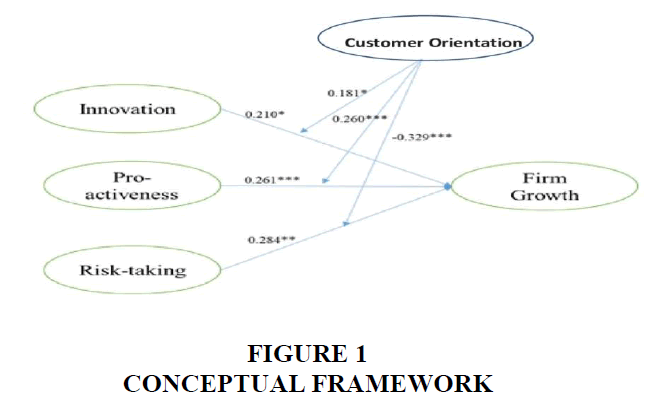
Figure 1 Conceptual Framework
Three control variables, namely firm type, firm size and firm age, were incorporated in the main structural model to assess their impact on firm growth. The results indicated that firm type (β = -0.083, p = 0.517), firm size (β = -0.008, p = 0.925) and firm age (β = 0.140, p = 0.216) had no significant influence on firm growth.
Results and Discussion
The purpose of this study was two-fold; first to examine the influence of individual EO dimensions on small firm by doing a replication study in the context of emerging economy like India. The intention was to operationalize EO construct through the individual dimensions to find out the specific levers for growth for small firms for a resource intensive EO orientation in the context of emerging economies. The 2nd objective was to study an under-examined field of joint effect of entrepreneurial and customer orientation by considering CO as a moderating variable and examine its performance implications on small firms. Further this study extended its research boundaries to examine the moderating influence of CO on individual EO dimensions to see whether it throws better insights than some of the previous studies done in this field.
The entrepreneurship literature has suggested the criticality of replicating findings along with some nuances when examining relationships within emerging market contexts (Sharikova. G et., al., 2022). This study did quasi-replication by examining whether entrepreneurial firms through its specific dimensions accrue performance benefits in emerging economies using a sample of Indian SMEs. Further it extends the horizon by examining whether EO dimensions by simultaneously aligning with CO in emerging economy context lead to better performance outcomes. While stronger CO is critical for a rapid response to current market needs and preferences, it also carries the risk of structural inertia, which lead to firms focusing less on entrepreneurial strategies, which are of critical importance for small firms. As is the case with most emerging economies, the business-supporting systems are weak and still developing in India, it provides a strong context for doing a quasi-replication study (Sharikova. G et., al., 2022).
The findings further strengthen the emerging body of research about the conceptualization of EO Construct and have immense implications for how to categorize a firm entrepreneurial (Wales et., al., 2020). These results build on the earlier arguments of researchers that firms need not be innovators all the times but can choose to imitate some aspects of other firms and still be entrepreneurial. In a way this builds on the argument of Kreiser et al. (2002) that it is quite possible for both innovative as well as fast follower firms to be considered entrepreneurial as pro-activeness doesn’t necessarily need to be first mover all the times. It also means that firms don’t always need to take avoidable risks, which for resource constrained small firms can be a double-edged sword and can adopt even risk-mitigation strategies to grow and still be termed entrepreneurial. The results build on a strategic choice perspective and provides the firms the cushion that they can choose to focus on specific EO dimension or a combination of them based on their strengths and assessment about their role in improving their performance. The results go a long way in helping small firms as it provides them with the flexibility to focus on specific drivers of entrepreneurship rather than the whole EO construct, in the process saving a limited resource of small firms. Also, the study points out that in the context of emerging economy like India, all three individual EO dimensions contribute to small firm though independently and have differential influence.
Since there has been calls about the need to study the integrative effect of entrepreneurship and marketing. This research explores this under-researched area in literature about the need to examine whether firms’ entrepreneurial strategies in conjunction with strong customer orientation lead to better firm performance (Wales, 2016). This research set out to examine the possible reasons behind the inconsistent findings as shown by limited studies that have been done in this field by examining the role of CO as a moderating variable as contextual variables do moderate EO-Firm relationship. To throw light on the above point, this study examined the moderating influence of CO on individual EO dimensions (namely innovativeness, proactiveness and risk-taking) to see whether it provides better explanation about the inconsistent findings of previous studies (Beliaeva, Shirokova, Wales, & Gafforova, 2018; Liu, Li, & Xue, 2011). The findings from the study indicate that an integrative approach to EO and CO don’t yield greater returns than in isolation. However, when the moderating influence of EO was examined on individual EO dimensions (innovativeness, proactiveness, and risk-taking), the results were mixed. While studying the moderating influence of CO, the results were positive in the case of innovativeness and pro-activeness (hypotheses 4a & 4b) on small firm growth, whereas with risk-taking (hypotheses 4c), the moderating influence was negative. Further the moderating influence of CO on innovativeness and proactiveness rather than strengthening the small firm performance weakened it. The implication is that small firms who have resource constraints spread their limited resources on chasing too many objectives it dilutes their performance. Further, the results show when small firms focus their energies on delivering better customer value through taking excessive risks, it has a negative influence on their growth. This can be due to the fact that the high cost of doing business in emerging economies force firms to take high-risk approach, which in turn gets multiplied while focusing on customer needs but this is counter-productive for firms. The fact that CO is short-term orientation while EO is a long-term one, when the firm tries to focus on both the orientations simultaneously, it dilutes the impact on their performance. Studies examining CO-EO relationship with EO as unidimensional construct can potentially lead to misleading interpretations as it is quite possible that in such case the relationship of dominant EO dimension would have carried the day while masking the influence of individual dimensions, which is very different. This could be one of the possible reasons behind some studies found negative performance implication for firms when they examined EO & CO together at they treated EO as a unidimensional construct, which potentially masked the effect that it could one dimension namely risk-taking in this study, which had negative influence.
By considering small firm growth from a longer-term perspective, EO drives growth through its individual dimensions because of its emphasis on innovativeness, proactiveness and risk-taking abilities but simultaneous focus on CO might stifle small firm growth owing to its myopic focus on satisfying their current needs. SMEs suffer from resource constraints and need to be cautious about dual strategic pursuits of EO and CO together unless they are confident about the positive outcome of this joint initiative on their performance implications. It is far better to examine the exact levers and combinations, which contribute to their growth to make the most of limited resources. Studies examining CO-EO relationship with EO as unidimensional construct can potentially lead to misleading interpretations as it is quite possible that in such case the relationship of dominant EO dimension would have carried the day while masking the influence of individual dimensions, which is very different.
Managerial & Policy Implications
The outcome of this study is significant and have important implications for current managerial practice as well as policy formulation. The very fact that dimensions of EO Construct vary independently provides small firm owners/managers with the strategic flexibility about selectively adopting elements of entrepreneurial strategy, which they deem beneficial as per their requirements depending on their stage of development. The results are useful for policymakers, as it clearly indicates the potential impact of their decisions concerning individual levers of entrepreneurship based on the resource strengths of that particular economy and how it can foster growth of small firms in emerging economies. The significance of this study lies in the fact that it provides managers and policy makers alike with the much-needed choice and flexibility by providing them with various entrepreneurial levers to choose from based on their availability and requirements leading to better performance for small firms while effectively utilizing their limited resources. The results indicate that small firm owners/managers need to prioritize their focus and resources in such a way that foster individual EO dimensions based on their requirements. The results support the prior studies (Rosecká & Machek, 2023), that have highlighted on focusing on the individual EO dimensions. For researchers, it indicates the emerging direction on how to operationalize EO construct and provide pointers towards how to define ‘being entrepreneurial’ as mentioned by Wales et., al (2020) and many others in their studies.
While this study builds on the need to integrate the marketing and entrepreneurship fields for examining their combined influence through EO-CO Constructs on firm performance. But it throws many pointers in the form that many times for small firms trying to focus both on EO & CO to chase long-term and short-term growth can dilute performance implications rather than strengthening it. It is not necessary that coming together of EO & CO aspects will always have positive implications for small firm growth as demonstrated by the moderating influence on risk-taking and small firm growth. It alerts the policy makers as well as small firm owners to realize the pitfalls of taking excessive risks while going too far in trying to serve customer needs better as this would have a negative pay-off. Firms that espouse EO through its various dimensions along with CO are better positioned to discover market needs and exploit opportunities. Being attentive to customers and by displaying proactive and innovative approach, small firms can overcome their resource limitations. This means that firms should be cautious about examining the relationship on specific dimensions of EO construct rather than the overall EO. Lastly, this further cautions us against treating EO as a unidimensional construct, in which case the moderating influence of CO on risk-firm growth could have masked the entire relationship with construct indicating that CO moderates EO-Small firm growth negatively leading us to draw a very different conclusion, which could have resulted in very different interpretations by firm owners in terms of relying on EO & CO together. By examining the interactions of CO with individual EO dimensions, this research suggests the specific levers and throws light on the possible reasons behind the contradictory findings in the past about the joint EO-CO influence.
Limitations & Future Research Directions
The research has its own share of limitation, which should not be ignored. The sample was drawn from Delhi, and National Capital Region of India, so extending these findings in other geographies especially other emerging economies without considering their unique context may not be right approach. While India shares many commonalities with other emerging economies including institutional mechanism and socio-economic inequality and, therefore, offers a rich context to examine the joint impact of EO-CO orientations from an emerging economy perspective (Acquaah, 2007). However, other emerging economies may possess unique and varied contextual elements that needs to be examined for theory development. There exist many contextual differences within emerging economies themselves, so it will be prudent to study the robustness of the complementary effects of this relationship in other environmental contexts for theoretical advancements in marketing and entrepreneurship literature, so this can be an interesting area for future research in different emerging economies. This study employed cross-sectional research design approach to collect data through survey method, which acts as a major limitation as a longitudinal research design spanning over a longer time period would have investigated this issue in far greater detail about the evolving or changing role of individual EO dimensions and at various stages of evolution in small firm’s life cycle. Since, this study has focused only on the selective triggers of EO construct in the form of individual dimensions and has not considered the various combinations of EO dimensions and how they might contribute to firm growth, this can be a promising area of research for future researchers to explore.
Conclusion
This research has filled some of the existing gaps in entrepreneurship and marketing literature about the possible reasons behind inconsistent findings about the performance implications of EO construct on small firm growth as well as the joint effect of EO-CO orientations. To conclude, this study makes a small beginning by exploring an under-examined research area that lays emphasis on firms adopting entrepreneurial strategies in conjunction with better focus on customer needs and whether this synergy deliver better value for small firms or not. It suggests to go for fine-grained analysis where CO works with individual dimensions of EO Construct, which shows far sharper and finer results with potentially insightful implications for firms’ owners and researchers and explaining some of the past inconsistencies. Thus, this research makes important contributions in this field by examining relatively a lesser explored area of how specific aspects of entrepreneurial strategy together with stronger focus on customer orientation can affect small firm growth either way. This can further improve our understanding about the possible coming together of these two different but overlapping disciplines in the challenging and difficult times for firms looking for various ways to develop competitive advantage and grow. The other contribution this study makes is to check the influence of these two orientations in the context of emerging economies, which has become the mainstay of world economy and where the future of firms lies. Since the emerging economies are taking centre stage and becoming the magnet for firms looking for future growth, it is important to examine the joint impact of these two orientations in these economies and this study is an effort in that direction.
References
Acquaah, M. (2007). Managerial social capital, strategic orientation, and organizational performance in an emerging economy. Strategic management journal, 28(12), 1235-1255.
Indexed at, Google Scholar, Cross Ref
Almajali, D. A., Masa'deh, R. E., & Tarhini, A. (2016). Antecedents of ERP systems implementation success: a study on Jordanian healthcare sector. Journal of Enterprise Information Management, 29(4), 549-565.
Indexed at, Google Scholar, Cross Ref
Atuahene-Gima, K., & Ko, A. (2001). An empirical investigation of the effect of market orientation and entrepreneurship orientation alignment on product innovation. Organization science, 12(1), 54-74.
Indexed at, Google Scholar, Cross Ref
Baker, W. E., & Sinkula, J. M. (2009). The complementary effects of market orientation and entrepreneurial orientation on profitability in small businesses. Journal of small business management, 47(4), 443-464.
Beliaeva, T., Shirokova, G., Wales, W., & Gafforova, E. (2020). Benefiting from economic crisis? Strategic orientation effects, trade-offs, and configurations with resource availability on SME performance. International Entrepreneurship and Management Journal, 16(1), 165-194.
Indexed at, Google Scholar, Cross Ref
Berthon, P., Hulbert, J. M., & Pitt, L. F. (1999). To serve or create? Strategic orientations toward customers and innovation. California management review, 42(1), 37-58.
Indexed at, Google Scholar, Cross Ref
Berthon, P., Mac Hulbert, J., & Pitt, L. (2004). Innovation or customer orientation? An empirical investigation. European Journal of Marketing, 38(9-10), 1065-1090.
Indexed at, Google Scholar, Cross Ref
Bettis, R. A., Helfat, C. E., & Shaver, J. M. (2016). The necessity, logic, and forms of replication. Strategic Management Journal, 37(11), 2193-2203.
Indexed at, Google Scholar, Cross Ref
Birch, D. L. (2000). The job generation process. Small business: Critical perspectives on business and management, 2, 431-465.
Boso, N., Story, V. M., & Cadogan, J. W. (2013). Entrepreneurial orientation, market orientation, network ties, and performance: Study of entrepreneurial firms in a developing economy. Journal of business Venturing, 28(6), 708-727.
Indexed at, Google Scholar, Cross Ref
Cadogan, J. W. (2012). International marketing, strategic orientations and business success: reflections on the path ahead. International Marketing Review, 29(4), 340-348.
Indexed at, Google Scholar, Cross Ref
Christensen, C. M., & Bower, J. L. (1996). Customer power, strategic investment, and the failure of leading firms. Strategic management journal, 17(3), 197-218.
Indexed at, Google Scholar, Cross Ref
Covin, J. G., & Slevin, D. P. (1989). Strategic management of small firms in hostile and benign environments. Strategic management journal, 10(1), 75-87.
Indexed at, Google Scholar, Cross Ref
Covin, J. G., & Slevin, D. P. (1991). A conceptual model of entrepreneurship as firm behavior. Entrepreneurship theory and practice, 16(1), 7-26.
Indexed at, Google Scholar, Cross Ref
Covin, J. G., & Wales, W. J. (2019). Crafting high-impact entrepreneurial orientation research: Some suggested guidelines. Entrepreneurship theory and practice, 43(1), 3-18.
Indexed at, Google Scholar, Cross Ref
Dai, L., Maksimov, V., Gilbert, B. A., & Fernhaber, S. A. (2014). Entrepreneurial orientation and international scope: The differential roles of innovativeness, proactiveness, and risk-taking. Journal of business venturing, 29(4), 511-524.
Indexed at, Google Scholar, Cross Ref
Deligianni, I., Dimitratos, P., Petrou, A., & Aharoni, Y. (2016). Entrepreneurial orientation and international performance: The moderating effect of decision-making rationality. Journal of Small Business Management, 54(2), 462-480.
Dung, T. Q., Bonney, L. B., Adhikari, R., & Miles, M. P. (2021). Entrepreneurial orientation and vertical knowledge acquisition by smallholder agricultural firms in transitional economies: The role of interfirm collaboration in value-chains. Journal of Business Research, 137, 327-335.
Indexed at, Google Scholar, Cross Ref
Eggers, F. (2010). Grow with the flow: entrepreneurial marketing and thriving young firms. International Journal of Entrepreneurial Venturing, 1(3), 227-244.
Indexed at, Google Scholar, Cross Ref
Engelen, A., Gupta, V., Strenger, L., & Brettel, M. (2015). Entrepreneurial orientation, firm performance, and the moderating role of transformational leadership behaviors. Journal of management, 41(4), 1069-1097.
Indexed at, Google Scholar, Cross Ref
Fornell, C., & Larcker, D. F. (1981). Evaluating structural equation models with unobservable variables and measurement error. Journal of marketing research, 18(1), 39-50.
Freixanet, J., Braojos, J., Rialp-Criado, A., & Rialp-Criado, J. (2021). Does international entrepreneurial orientation foster innovation performance? The mediating role of social media and open innovation. The International Journal of Entrepreneurship and Innovation, 22(1), 33-44.
Indexed at, Google Scholar, Cross Ref
Gatignon, H., & Xuereb, J. M. (1997). Strategic orientation of the firm and new product performance. Journal of marketing research, 34(1), 77-90.
Indexed at, Google Scholar, Cross Ref
Gupta, R., & Pandit, A. (2013). Innovation and growth of small and medium enterprises: role of environmental dynamism and firm resources as moderating variables. International Journal of Entrepreneurship and Innovation Management, 17(4-6), 284-295.
Indexed at, Google Scholar, Cross Ref
Gupta, R., & Sebastian, V. J. (2017). Configuration approach to strategic & entrepreneurial orientation construct & small firm growth: evidence from India. Theoretical Economics Letters, 7(5), 1261-1281.
Indexed at, Google Scholar, Cross Ref
Gupta, R., Pandey, R., & Sebastian, V. J. (2021). International Entrepreneurial Orientation (IEO): A bibliometric overview of scholarly research. Journal of Business Research, 125, 74-88.
Indexed at, Google Scholar, Cross Ref
Hair, J. F., Ringle, C. M., & Sarstedt, M. (2013). Partial least squares structural equation modeling: Rigorous applications, better results and higher acceptance. Long range planning, 46(1-2), 1-12.
Hair, J. F., Risher, J. J., Sarstedt, M., & Ringle, C. M. (2019). When to use and how to report the results of PLS-SEM. European business review, 31(1), 2-24.
Hakala, H. (2011). Strategic orientations in management literature: Three approaches to understanding the interaction between market, technology, entrepreneurial and learning orientations. International journal of management reviews, 13(2), 199-217.
Hamel, G., & Prahalad, C. K. (1994). Competing for the future. Harvard business review, 72(4), 122-128.
Hughes, M., & Morgan, R. E. (2007). Deconstructing the relationship between entrepreneurial orientation and business performance at the embryonic stage of firm growth. Industrial marketing management, 36(5), 651-661.
Indexed at, Google Scholar, Cross Ref
Hult, G. T. M., & Ketchen Jr, D. J. (2001). Does market orientation matter?: A test of the relationship between positional advantage and performance. Strategic management journal, 22(9), 899-906.
Indexed at, Google Scholar, Cross Ref
Hult, G. T. M., Ketchen Jr, D. J., & Slater, S. F. (2005). Market orientation and performance: an integration of disparate approaches. Strategic management journal, 26(12), 1173-1181.
Indexed at, Google Scholar, Cross Ref
Irwin, K. C., Landay, K. M., Aaron, J. R., McDowell, W. C., Marino, L. D., & Geho, P. R. (2018). Entrepreneurial orientation (EO) and human resources outsourcing (HRO): A “HERO” combination for SME performance. Journal of business research, 90, 134-140.
Indexed at, Google Scholar, Cross Ref
Jiang, X., Liu, H., Fey, C., & Jiang, F. (2018). Entrepreneurial orientation, network resource acquisition, and firm performance: A network approach. Journal of Business Research, 87, 46-57.
Indexed at, Google Scholar, Cross Ref
Kirca, A. H., Jayachandran, S., & Bearden, W. O. (2005). Market orientation: A meta-analytic review and assessment of its antecedents and impact on performance. Journal of marketing, 69(2), 24-41.
Indexed at, Google Scholar, Cross Ref
Kraus, S., Rigtering, J. C., Hughes, M., & Hosman, V. (2012). Entrepreneurial orientation and the business performance of SMEs: a quantitative study from the Netherlands. Review of Managerial Science, 6(2), 161-182.
Indexed at, Google Scholar, Cross Ref
Kreiser, P. M., Marino, L. D., & Weaver, K. M. (2002, August). REASSESSING THE ENVIRONMENT-EO LINK: THE IMPACT OF ENVIRONMENTAL HOSTILITY ON THE DIMENSIONS OF ENTREPRENEURIAL ORIENTATION. In Academy of Management Proceedings (Vol. 2002, No. 1, pp. G1-G6). Briarcliff Manor, NY 10510: Academy of Management.
Indexed at, Google Scholar, Cross Ref
Kusa, R., Suder, M., & Duda, J. (2024). Role of entrepreneurial orientation, information management, and knowledge management in improving firm performance. International Journal of Information Management, 78, 102802.
Indexed at, Google Scholar, Cross Ref
Lekmat, L., Selvarajah, C., & Hewege, C. (2018). Relationship between Market Orientation, Entrepreneurial Orientation, and Firm Performance in Thai SMEs: The Mediating Role of Marketing Capabilities. European Journal of Pediatric Dermatology, 28(4).
Lomberg, C., Urbig, D., Stöckmann, C., Marino, L. D., & Dickson, P. H. (2017). Entrepreneurial orientation: The dimensions’ shared effects in explaining firm performance. Entrepreneurship theory and practice, 41(6), 973-998.
Indexed at, Google Scholar, Cross Ref
Lumpkin, G. T. (1996). The entrepreneurial orientation (EO) of new entrants: Performance implications of alternative configurations of EO, environment, and structure. The University of Texas at Arlington.
Lumpkin, G. T., & Dess, G. G. (1996). Clarifying the entrepreneurial orientation construct and linking it to performance. Academy of management Review, 21(1), 135-172.
Indexed at, Google Scholar, Cross Ref
Lumpkin, G. T., & Dess, G. G. (2001). Linking two dimensions of entrepreneurial orientation to firm performance: The moderating role of environment and industry life cycle. Journal of business venturing, 16(5), 429-451.
Indexed at, Google Scholar, Cross Ref
Mantok, S., Sekhon, H., Sahi, G. K., & Jones, P. (2019). Entrepreneurial orientation and the mediating role of organisational learning amongst Indian S-SMEs. Journal of Small Business and Enterprise Development, 26(5), 641-660.
Indexed at, Google Scholar, Cross Ref
Meyer, K. E. (2015). Context in management research in emerging economies. Management and Organization Review, 11(3), 369-377.
Indexed at, Google Scholar, Cross Ref
Miller, D. (1983). The correlates of entrepreneurship in three types of firms. Management science, 29(7), 770-791.
Indexed at, Google Scholar, Cross Ref
Miller, D. (2011). Miller (1983) revisited: A reflection on EO research and some suggestions for the future. Entrepreneurship theory and practice, 35(5), 873-894.
Indexed at, Google Scholar, Cross Ref
Miller, D., & Friesen, P. H. (1982). Innovation in conservative and entrepreneurial firms: Two models of strategic momentum. Strategic management journal, 3(1), 1-25.
Indexed at, Google Scholar, Cross Ref
Mintzberg, H. (1973). Strategy-making in three modes. California management review, 16(2), 44-53.
Indexed at, Google Scholar, Cross Ref
Morgan, N. A., Katsikeas, C. S., & Vorhies, D. W. (2012). Export marketing strategy implementation, export marketing capabilities, and export venture performance. Journal of the academy of marketing science, 40(2), 271-289.
Indexed at, Google Scholar, Cross Ref
Morgan, T., Anokhin, S. A., & Wincent, J. (2019). Influence of market orientation on performance: the moderating roles of customer participation breadth and depth in new product development. Industry and Innovation, 26(9), 1103-1120.
Morgan, T., Anokhin, S., Kretinin, A., & Frishammar, J. (2015). The dark side of the entrepreneurial orientation and market orientation interplay: A new product development perspective. International Small Business Journal, 33(7), 731-751.
Mustak, M. (2019). Customer participation in knowledge intensive business services: Perceived value outcomes from a dyadic perspective. Industrial Marketing Management, 78, 76-87.
Indexed at, Google Scholar, Cross Ref
Naidu, S., Singh, G., & Narayan, J. (2023). Revisiting the contingency theory: dissection of entrepreneurial orientation elements in retail franchisee performance. International Journal of Emerging Markets, 18(9), 2343-2362.
Indexed at, Google Scholar, Cross Ref
Narver, J. C., & Slater, S. F. (1990). The effect of a market orientation on business profitability. Journal of marketing, 54(4), 20-35.
Indexed at, Google Scholar, Cross Ref
Narver, J. C., Slater, S. F., & MacLachlan, D. L. (2004). Responsive and proactive market orientation and new‐product success. Journal of product innovation management, 21(5), 334-347.
Indexed at, Google Scholar, Cross Ref
Nguyen, L. T., An, J., Ngo, L. V., & Hau, L. N. (2020). Transforming social capital into performance via entrepreneurial orientation. Australasian Marketing Journal, 28(4), 209-217.
Indexed at, Google Scholar, Cross Ref
Osman Zainal Abidin, J. (2024). An empirical investigation into the significance of intellectual capital and strategic orientations on innovation capability and firm performance in Malaysian information and communications technology (ICT) small-to-medium enterprises (SMEs) (Doctoral dissertation, RMIT University).
Indexed at, Google Scholar, Cross Ref
Poudel, K. P., Carter, R., & Lonial, S. (2019). The impact of entrepreneurial orientation, technological capability, and consumer attitude on firm performance: A multi‐theory perspective. Journal of Small Business Management, 57, 268-295.
Indexed at, Google Scholar, Cross Ref
Ramezan, M., Sanjaghi, M. E., & Rahimian Kalateh baly, H. (2013). Organizational change capacity and organizational performance: An empirical analysis on an innovative industry. Journal of Knowledge-based Innovation in China, 5(3), 188-212.
Indexed at, Google Scholar, Cross Ref
Real, J. C., Roldán, J. L., & Leal, A. (2014). From entrepreneurial orientation and learning orientation to business performance: analysing the mediating role of organizational learning and the moderating effects of organizational size. British Journal of Management, 25(2), 186-208.
Indexed at, Google Scholar, Cross Ref
Seo, R., & Park, J. H. (2022). When is interorganizational learning beneficial for inbound open innovation of ventures? A contingent role of entrepreneurial orientation. Technovation, 116, 102514.
Indexed at, Google Scholar, Cross Ref
Slater, S. F., & Narver, J. C. (1995). Market orientation and the learning organization. Journal of marketing, 59(3), 63-74.
Slater, S. F., & Narver, J. C. (1998). Customer‐led and market‐oriented: let's not confuse the two. Strategic management journal, 19(10), 1001-1006.
Indexed at, Google Scholar, Cross Ref
Smith, A. D., Damron, T., & Melton, A. (2017). Aspects of corporate wellness programs: comparisons of customer satisfaction. Benchmarking: An International Journal, 24(6), 1523-1551.
Storey, C., & Hughes, M. (2013). The relative impact of culture, strategic orientation and capability on new service development performance. European Journal of Marketing, 47(5-6), 833-856.
Indexed at, Google Scholar, Cross Ref
Sturm, S., Hohenstein, N. O., & Hartmann, E. (2023). Linking entrepreneurial orientation and supply chain resilience to strengthen business performance: an empirical analysis. International Journal of Operations & Production Management, 43(9), 1357-1386.
Indexed at, Google Scholar, Cross Ref
Suder, M., Kusa, R., Duda, J., & Karpacz, J. (2025). Exploring impact of entrepreneurial orientation on firm performance–moderators’ variability under changing market conditions. Review of Managerial Science, 19(3), 797-842.
Tan, J., & Tan, D. (2005). Environment–strategy co‐evolution and co‐alignment: a staged model of Chinese SOEs under transition. Strategic management journal, 26(2), 141-157.
Tang, Z., & Hull, C. (2012). An investigation of entrepreneurial orientation, perceived environmental hostility, and strategy application among Chinese SMEs. Journal of Small Business Management, 50(1), 132-158.
Thoumrungroje, A., & Racela, O. (2013). The contingent role of customer orientation and entrepreneurial orientation on product innovation and performance. Journal of Strategic Marketing, 21(2), 140-159.
Wales, W. J. (2016). Entrepreneurial orientation: A review and synthesis of promising research directions. International Small Business Journal, 34(1), 3-15.
Indexed at, Google Scholar, Cross Ref
Wales, W. J., Parida, V., & Patel, P. C. (2013). Too much of a good thing? Absorptive capacity, firm performance, and the moderating role of entrepreneurial orientation. Strategic management journal, 34(5), 622-633.
Indexed at, Google Scholar, Cross Ref
Webb, J. W., Ireland, R. D., Hitt, M. A., Kistruck, G. M., & Tihanyi, L. (2011). Where is the opportunity without the customer? An integration of marketing activities, the entrepreneurship process, and institutional theory. Journal of the Academy of Marketing Science, 39(4), 537-554.
Indexed at, Google Scholar, Cross Ref
Whalen, P., Uslay, C., Pascal, V. J., Omura, G., McAuley, A., Kasouf, C. J., ... & Deacon, J. (2016). Anatomy of competitive advantage: towards a contingency theory of entrepreneurial marketing. Journal of Strategic Marketing, 24(1), 5-19.
Wiklund, J., & Shepherd, D. A. (2011). Where to from here? EO-as-experimentation, failure, and distribution of outcomes. Entrepreneurship theory and practice, 35(5), 925-946.
Yordanova, D. I. (2011). Entrepreneurial orientation in family and non-family firms: evidence from Bulgaria. International Journal of Economic Sciences and Applied Research, 4(1), 185-203.
Zahra, S. A., & Bogner, W. C. (2000). Technology strategy and software new ventures' performance: Exploring the moderating effect of the competitive environment. Journal of business venturing, 15(2), 135-173.
Indexed at, Google Scholar, Cross Ref
Zhou, K. Z., & Li, C. B. (2010). How strategic orientations influence the building of dynamic capability in emerging economies. Journal of Business Research, 63(3), 224-231.
Indexed at, Google Scholar, Cross Ref
Received: 20-Dec-2025, Manuscript No. AMSJ-26-16911; Editor assigned: 21-Dec-2025, PreQC No. AMSJ-26-16911(PQ); Reviewed: 28-Jan-2026, QC No. AMSJ-26-16911; Revised: 18-Feb-2026, Manuscript No. AMSJ-26-16911(R); Published: 11-Mar-2026