Research Article: 2026 Vol: 30 Issue: 3
Trust and Value Co-creation under Service-Dominant Logic: Examining the Moderating Role of Organizational Culture Behaviour
Rupa Mahajan, Department of Commerce, University of Jammu, Jammu & Kashmir, India
Citation Information: Mahajan., R. (2026). Trust and value co-creation under service-dominant logic: examining the moderating role of organizational culture behaviour markets. Academy of Marketing Studies Journal, 30(S3), 1-33.
Abstract
This Systematic Literature Review examines value co-creation within the Service-Dominant Logic (SDL) perspective by integrating the TCCM (Theory–Context–Characteristics–Methodology) framework to structure and synthesise existing research. Using a Critical Systematic Literature Review guided by the PRISMA approach, the study analyses peer-reviewed articles to identify dominant theories, research contexts, key constructs, and methodological patterns related to trust, organizational culture, and value co-creation across service ecosystems. The findings reveal that SDL-based studies are largely grounded in value co-creation and relationship marketing theories, with trust functioning as both an antecedent and an outcome of co-creation processes. Contextually, research is concentrated in developed economies and traditional service settings, while emerging markets and digitally enabled service ecosystems remain underexplored. In terms of characteristics, inconsistencies in the conceptualisation of trust and limited attention to organizational culture contribute to fragmented empirical outcomes. Methodologically, the literature is dominated by empirical, cross-sectional studies, highlighting a need for longitudinal and mixed-method research designs. Applying the TCCM framework, this review identifies critical research gaps and emerging themes, including culturally embedded trust-building mechanisms, technology-enabled resource integration, and collaborative service design. Based on these insights, the study proposes integrated, trust-based, and culturally informed conceptual frameworks to advance SDL research. The review offers practical implications for researchers, practitioners, and organizations aiming to operationalize value co-creation strategies that enhance sustained relationships and value creation across service ecosystems. The paper concludes by outlining key findings, limitations, and directions for future research.
Keywords
Trust, Value, Co-Creation, Service-Dominant Logic, Organizational Culture Behaviour.
Introduction
A clear illustration of customers creating value before, during, and after purchase can be observed in the domain of IT products and services. In this context, change and performance are not only critical but act as the core drivers of service innovation (Ostrom et al., 2015). Technology companies hold a distinct advantage in the Service-Dominant Logic (SDL) paradigm because they can design bold and differentiated value propositions. This makes consumer technology an especially relevant domain for examining SDL, as customers are no longer passive recipients but active participants in the firm’s transition from a goods-oriented to a service-oriented logic (Chahal & Mahajan, 2016; Hartwig et al., 2021). SDL removes the traditional boundary between goods and services; physical products increasingly function as platforms for advanced service experiences, leading to the conceptualization of “product–service” offerings in which both components are inseparable contributors to value co-creation (Lusch & Vargo, 2015; Vargo, 2018).
What ultimately matters to customers in technology-related offerings is the perceived benefit—how well a brand’s features align with their needs (Vera-Martínez, 2021). Consumers evaluate these benefits through core product–service attributes, which significantly shape purchase decisions (Loureiro, 2013). Strong performance on these attributes enhances perceived value and satisfaction, which in turn fosters brand loyalty (Busacca & Padula, 2005; Vera-Martínez & Ornelas, 2019; Canguende-Valentim & Vale, 2023). As the link between specific features and customer outcomes strengthens, these features become increasingly influential determinants of buying behavior. However, customer satisfaction and loyalty depend not only on what firms offer but also on how effectively brands design and deliver meaningful experiences (Anderson & Mittal, 2000). Traditional marketing viewed functional value as a simple exchange—customers pay money and receive benefits (Sweeney & Soutar, 2001). SDL reframes this entirely: value is not created at the moment of purchase but emerges as customers interact with the product, use it, and participate through feedback or recommendations (Lemke et al., 2011; Grönroos & Voima, 2013; Vargo & Lusch, 2016). This active participation is what drives satisfaction and repeat purchases (Chahal & Mahajan, 2015; Bhattacharya et al., 2019).
SDL has evolved into a unifying marketing theory that brings coherence to a vast range of concepts (Vargo et al., 2023). When first introduced (Lusch & Vargo, 2014; Vargo & Lusch, 2004) and later expanded (Lusch & Vargo, 2018), it was built upon foundational premises (FPs). These were later synthesized into four core axioms (Vargo & Lusch, 2014), with the remaining FPs derivable from them. Over time, research has expanded SDL by deepening concepts such as value-in-use, which evolved into value-in-context (Chandler & Vargo, 2011), and further into value-in-social-context (Edvardsson et al., 2011). Studies have also advanced understanding of value co-creation (Payne et al., 2008), value propositions (Chandler & Lusch, 2015), and brand co-creation (Merz et al., 2009; Payne et al., 2009). The influence of SDL has spread across fields including logistics (Randall et al., 2010), information technology (Yan et al., 2010), and hospitality management (Shaw et al., 2011). It has also become foundational to service science (Spohrer & Maglio, 2008) and is widely used to adopt ecosystem perspectives on markets (Vargo & Lusch, 2010).
A major evolution in SDL is the shift from narrow dyadic firm–customer exchanges to a holistic understanding of value creation within large, interconnected networks. Value creation is now viewed as dynamic, contextual, and distributed across entire service ecosystems. This broader lens reveals underlying structures that micro-level research frequently overlooks while simultaneously enriching the understanding of micro phenomena (Chandler & Vargo, 2011). Central to this expanded view are institutions—the shared norms, rules, symbols, and practices that enable coordinated value creation. Institutional arrangements connect these shared elements within the network. Despite their importance, institutions have historically been underexamined in marketing research, even though they are central in disciplines such as economics, sociology, and organizational studies (Giesler, 2008; Humphreys, 2010).
Recently, SDL scholarship has increasingly recognized institutions and institutional arrangements as foundational elements of value co-creation (Akaka et al., 2013; Lusch & Vargo, 2014; Vargo & Lusch, 2011; Vargo et al., 2015; Venkatesh et al., 2006). These interconnected networks form adaptive service ecosystems that continuously integrate resources and co-create value across multiple levels. This shift—from dyads to networks and ecosystems—represents one of the most significant theoretical advancements in SDL. It has led scholars to reconsider its foundational premises and even propose a potential fifth axiom (or eleventh premise) to fully capture the central role of institutions in the value co-creation process.
Development and rationale of SDL
In their landmark 2004 Journal of Marketing article, “Evolving to a New Dominant Logic for Marketing, Vargo and Lusch argued that traditional marketing thought had long been guided by a goods-dominant (G-D) logic, which viewed tangible goods as the primary basis of economic exchange. They proposed instead an alternative framework—service-dominant (S-D) logic—which positions service provision as the fundamental foundation of all exchange and value creation. This growing influence demonstrates how the service-based perspective on exchange and value creation has become central to contemporary marketing and related fields (for a detailed discussion on the diffusion of S-D logic” (Vargo & Lusch, 2017).
The purpose of shifting from a G-D logic to an S-D logic perspective. Specifically, we examine four defining characteristics of S-D logic as a mindset: it is transcending, unifying, accommodating, and transformative. Each of these properties represents part of the larger scientific objective of simplifying and thereby comprehending complex phenomena (Simon 1996). In this light, these properties stand out as conceptual tools in both theoretical and practical perspectives. Theoretically, they imply conceptual inversions challenging conventional wisdom while practically leading to the implications of forming mid-range theories and other counterintuitive strategic insights for practitioners.
As briefly explained above, S-D Logic was developed as an alternative mindset to G-D Logic, which conceptualizes exchange primarily in terms of tangible outputs-that is, goods-and considers their production and exchange as the core focus of business and economics (Vargo & Lusch, 2004a; Vargo et al., 2008). The G-D logic frame is closely related to neoclassical economics, which depicts market participants as rational, profit- and utility-maximizing actors operating in equilibrium-driven markets characterized by high levels of informational and resource efficiency. According to some scholars, G-D logic can be referred to as "manufacturing logic" (Normann, 2001) or as a "company-centric, efficiency-driven view of value creation" (Prahalad & Ramaswamy, 2004).
However, a number of critical limitations are inherent in the G-D logic perspective, particularly with respect to where it directs managerial and theoretical attention. Goods-centric focus: The G-D logic fosters a goods-centered view about exchange, where tangible products are put forward as the most ideal and primary unit of value creation (Vargo & Lusch, 2004a, 2004b).
Firm-Centric Value Creation: It places the firm at the centre—and often as the sole creator of value, suggesting that value is produced and embedded in goods during manufacturing and later transferred to passive consumers who merely “destroy” value through consumption (Vargo & Lusch, 2004a, 2011).
Monetary Preoccupation: The linear, firm-oriented value creation model is then generally accompanied by a narrow focus on monetary value as the dominant measure of value (Vargo et al., 2008).
In general, the strong emphasis on goods, firms, and money in G-D logic has served to entrench a number of restrictive dichotomies that hold back the evolution of a more expansive and inclusive understanding of economic and social exchange, such as producer-consumer, tangible-intangible, and value creation-value destruction.
A key aim of S-D Logic was to present an alternative conceptualization of the focus on value creation, one that exceeded the restrictions and assumptions of G-D Logic. Using their path-breaking article from 2004, Vargo and Lusch described a number of developing trends, especially in marketing sub-disciplines, that stood in juxtapose to the traditional underpinnings of G-D logic. Together, these perspectives pointed toward:
The increasing relevance of intangible resources, as well as tangible resources, in creating value.
The shift away from competition to collaboration as a source of value creation.
The focus on relationships and ongoing exchanges, as opposed to one-time value exchanges.
Building off these insights, Service-Dominant (S-D) Logic has re-conceptualized all economic activity: based on service-for-service exchange, rather than good-for-good or good-for-money exchange. From this view, service - the application of specialized competences (both knowledge and skills) for the benefit of one’s self or someone else - is the true base of exchange. Goods become a mere means of deliverance or a means of transporting service.
Over the last two decades, this narrative under S-D Logic has progressed to a view of the marketplace being made up of actors, integrating resources (themselves) by co-creating value in service exchange in overlapping and nested ecosystems, all of which are shaped and organized by institutions formed by the actors (Vargo & Lusch, 2016).
Of importance, S-D Logic captures the complexity of real-world interactions - spontaneously arising structures and relationships that are formed from simple, basic principles - and is conceptually much less complex than G-D Logic. It breaks down many of the historical rigid dichotomies (e.g., producer and consumer; firm and market; tangible and intangible) that have so strongly controlled economic and marketing thinking.
As such, the unifying perspective of S-D Logic allows scholars and practitioners to reframe established constructs and generate integrative new ones. A particular aspect of this approach is the epistemological/inquiry stance to converge rather than diverge towards commonalities and connections between concepts that may often be framed separately or in an oppositional relation. In this way, S-D Logic aims to integrate/mitigate tensions and plural logics for a more holistic understanding about exchange, value and markets (Vargo & Lusch, 2008a, 2017).
S-D Logic provides a process-oriented view on exchange by stressing that all forms of exchange require engaging one's resources for the benefit of another, or collectively, providing a service. This approach overcomes the popular distinction typical for G-D logic, which differentiates between exchanges involving tangible goods and those involving services. Focusing on the underlying process of service exchange enables S-D logic to explain a much greater variety of economic and social phenomena with fewer conceptual distinctions.
Basically, S-D logic does not claim that G-D logic is fundamentally wrong; instead, it suggests that the latter has a limited, narrow view of value creation by focusing on specific exchanges that are essentially output-based. Rather than conceptualize G-D and S-D logics as competing frameworks, G-D logic can be best described as a subset or special case within the more inclusive met theoretical framework of S-D logic. Hence, while S-D logic encompasses the insights of G-D logic, it extends to explain a more general and comprehensive understanding of exchange and value creation.
Strategic Themes Associated with S-D Logic
Vargo and Lusch (2004) stress that "interactivity, integration, customization, and co-production are the defining features of a service-centered perspective and its inherent emphasis on the customer and relationships. Moreover, S-D logic is in natural alignment with normative principles such as investment in people/resources (operants), long-term relationships, high-quality service flows, and--in a more indirect way--symmetrical relationships, transparency, ethical exchanges, and sustainability” (Lusch & Vargo, 2006b).
Likewise, Ballantyne and Aitken (2007) “underline that S-D logic is built on the focus on communicative interaction, reciprocal service, resource sharing, solution orientation, and value co-creation. Overall, according to Lusch, Vargo, and O’Brien (2007), S-D logic is underpinned by a deep commitment to collaborative processes with customers, partners, and employees.
Drawing upon the defining characteristics of Service-Dominant (S-D) logic and on the insights obtained in the broad literature review, Table 1 identifies six key S-D strategic themes that hold normative strategic relevance. The table also links these with associated S-D logic premises, their strategic implications, and any potential customer outcomes”.
| Table 1 Foundational Premise of SDL | |||
| Foundational Premise | 2004 | 2008 | Update |
| FP1 | The application of specialized skills and knowledge is the fundamental unit of exchange. | Service is the fundamental basis of exchange. | No Change – AXIOM STATUS |
| FP2 | Indirect exchange masks the fundamental unit of exchange. | Indirect exchange masks the fundamental basis of exchange. | No Change |
| FP3 | Goods are distribution mechanisms for service provision. | No Change | No Change |
| FP4 | Knowledge is the fundamental source of competitive advantage. | Operant resources are the fundamental source of competitive advantage. | Operant resources are the fundamental source of strategic benefit. |
| FP5 | All economies are service economies. | No Change | No Change |
| FP6 | The customer is always the co-producer. | The customer is always a co-creator of value. | Value is co-created by multiple actors, always including the beneficiary. – AXIOM STATUS |
| FP7 | The enterprise can only make value propositions. | The enterprise cannot deliver value, but only offer value propositions. | Actors cannot deliver value but can participate in the creation and offering of value propositions. |
| FP8 | Service-centered view is customer oriented and relational. | A service-centered view is inherently customer oriented and relational. | A service-centered view is inherently beneficiary oriented and relational. |
| FP9 | — | All social and economic actors are resource integrators. | No Change – AXIOM STATUS |
| FP10 | — | Value is always uniquely and phenomenologically determined by the beneficiary. | No Change – AXIOM STATUS |
| FP11 | — | — | New: Value co-creation is coordinated through actor-generated institutions and institutional arrangements. – AXIOM STATUS |
These six strategic themes capture the essence of effective, meaningful interaction and reciprocal resource integration between firms and customers as partners in a value network, requiring:
Value-in-context focus: value is viewed as a contextual and phenomenological outcome determined by each individual customer;
Relationship focus: customers are considered social relationship partners - and not isolated targets - and relationships are cultivated together;
Values¹ orientation: Ensuring customer interactions and resource integration are directed by ethical principles to achieve long-term shared well-being;
Co-production focus-viewing customers as active-capable contributors who can improve service processes and outcomes;
Operant resource focus-operant resources of customers are their skills, knowledge, and competencies, which are necessary in the effective integration of resources and realization of value; and
Process flow focus - understanding service as a series of interconnected processes of resource integration, both within and across value networks that include customers.
Each of these themes is of strategic importance in that they address conditions for meaningful, mutually beneficial resource integrations as a means to connect value propositions to value actualization, as set forth in the foundational premises of S-D logic.
Fragmentation observed in the existing literature signifies the need for a systematic and comprehensive review to address the identified research gaps in the current study. This study, therefore, integrates a wider range of relevant papers and scholarly articles that take into account various countries and institutional contexts. It employs multiple data sources to capture variations in the evaluation frameworks within SDL and value co-creation. Hence, Table: 2 outlines summary of prior studies with focus area and key findings.
| Table 2 Summary of Literature Reviews with Findings | ||||
| Study / Author(s) | Focus Area | Nature of Evidence |
Key Findings / Claims |
Remarks / Limitations |
| Hartwig et al. (2021) | Service-Dominant Logic (SDL) in technology-based firms | Conceptual / Theoretical | Technology firms enable radical value propositions through SDL; customers drive transition from goods-dominant to service-dominant logic. | Concentrates on conceptual framing; lacks behavioral integration. |
| Lusch & Vargo (2018); Vargo (2018) | Goods–service integration under SDL | Theoretical | Goods serve as mechanisms for delivering service; value co-creation viewed as holistic and inseparable. | No empirical evidence; abstract conceptualization. |
| Vera-Martínez (2021); Loureiro (2013) | Consumer-perceived benefits in technology products | Quantitative (Perception Analysis) | Perceived product–service attributes influence satisfaction and purchasing decisions. | Focused on consumer perception; limited to individual-level analysis. |
| Busacca & Padula (2005); Vera-Martínez & Ornelas (2019); Canguende-Valentim & Vale (2023) | Attribute performance, satisfaction, and brand loyalty | Quantitative (SEM / Survey) | High attribute performance increases perceived value and loyalty; satisfaction mediates the relationship. | Limited focus on dynamic co-creation processes. |
| Lemke et al. (2011); Grönroos & Voima (2013); Vargo & Lusch (2016); Bhattacharya et al. (2019) | Value co-creation through customer experience | Mixed (Empirical and Conceptual) | Value emerges through product use and interaction; customer engagement enhances satisfaction and repurchase intentions. | Focuses mainly on customer side; organizational mechanisms underexplored. |
| Edvardsson et al. (2011); Vargo et al. (2023) | Service ecosystem and value co-creation process | Conceptual Review | Value co-creation viewed as a dynamic and asymmetrical process within service ecosystems. | Lacks empirical evidence connecting behavioral and cultural dimensions. |
| Lemke et al. (2011) | Customer experience quality in SDL | Empirical | Customer experience quality reflects need fulfillment and satisfaction during firm–customer interaction. | Doesn’t explore trust or culture as moderating variables. |
| Vera-Martínez et al. (2025) | Service Experience & Value Co-creation | Quantitative (SEM) | Service experiential attributes enable value co-creation under S-D Logic; trust and satisfaction drive intentions. | Focus on customer tech products; doesn't test culture as a moderator directly. |
| Iddrisu (2025) | Organizational Culture & Trust | Quantitative (SEM) | Organizational culture mediates trust's effect on firm performance and value co-creation. | Examines mediation, not full moderation; sector-specific sample. |
| Liu et al. (2024) | Cultural Enterprises & Co-creation | Quantitative (SEM) | Organizational capabilities/culture foster trust and co-creation, boosting competitive advantage. | Only cultural/creative industries; limited generalizability. |
| Adikari et al. (2021) | S-D Logic, Open Innovation, Culture | Mixed Methods | S-D Logic redefines consumer value co-creation roles; organizational culture shapes trust/value creation dynamics. | Integrates qualitative/quantitative data; less direct assessment of moderation. |
| Vargo & Lusch (2025) | Theoretical—S-D Logic Foundations | Conceptual Review | Institutional and cultural contexts underpin trust and co-creation, shaping value outcomes in ecosystems. | Conceptual only; lacks empirical moderation tests. |
| Stead (2025) | Digital S-D Logic, Trust & Culture | Conceptual/Case Study | Trust and collaborative behaviors moderate the impact of organizational learning culture in cross-disciplinary innovation. | Digital transformation focus; based on case evidence. |
| Ohman et al. (2025) | Digital Leadership & Value Co-creation | Quantitative Survey | Value co-creation acts as both mediator and moderator within organizational innovation cultures. | Limited to digital leadership context; no industry comparison. |
| Svingstedt (2025) | Service Logic & Strategic Listening | Theoretical | Communication climate and culture impact strategic trust and service value outcomes. | Focused on listening context; not empirically tested. |
| Tuan et al. (2025) | Customer Value Co-creation (E-Commerce) | Quantitative Survey | Customer value co-creation in e-commerce mediated by practice theory and organizational culture under S-D logic. | E-commerce focused; emphasizes practice theory integration. |
| Jia et al. (2023) | Peer Service Providers & Co-creation | Longitudinal + Experiments | Customer unfriendliness impacts shared value creation; organizational factors moderate experience. | Uses multiple survey waves; peer-to-peer context. |
| Terblanche (2024) | Employee Perspective on Value Co-creation | Empirical | Value co-creation can have negative impacts (“gloomy side”) for service employees depending on organizational factors. | Employee-focused; explores downside risks. |
| Zhou (2024) | Customer-Dominant Logic in E-Services | Quantitative Modeling | Customer interactions drive value co-creation and stickiness; organizational systems moderate these outcomes. | E-services focus; customer-dominant logic model. |
| Kundi (2021) | Organizational Culture as Moderator (Healthcare) | Cross-sectional Survey | Organizational culture moderates link between workplace facilities and employee performance and cooperation. | Context: health professionals; facilities-focused. |
| Kombo (2025) | Knowledge Strategy, Trust, and Culture | Cross-sectional Survey | Organizational culture moderates impact of knowledge strategy and trust on firm performance; calls for strategic alignment. | Multi-firm sample; tests moderation with advanced analytics. |
| Sondari et al. (2025) | SDL, Brand Engagement, Emotional Attachment | Quantitative | Service-dominant logic enhances value co-creation, emotional attachment, and brand engagement via organizational influences. | Hospitality sector; focus on customer-brand relationships. |
| Mahajan (2025) | Application of Service-Dominant Logic (S-D Logic) to understand how recent graduates perceive value in training experiences. | quantitative investigation | Co-creation through structured training activities has a stronger impact on perceived value than resource integration alone, highlighting collaborative value creation between trainers and trainees as the key driver of value perception. | Focused on recent graduates only, which may limit generalisability to other cohorts |
Conceptual model
This study is grounded in Service-Dominant Logic (SDL), which views value creation as a collaborative process emerging from interactions among multiple actors within a service ecosystem.
The above conceptual model for the study shows that under Service-Dominant Logic (SDL), value is co-created through interactions among actors within a service ecosystem. Trust serves as a critical relational mechanism that facilitates open communication, resource sharing, and collaborative engagement, thereby enabling effective value co-creation. When trust is present, actors are more willing to participate actively in service exchanges and jointly contribute to value outcomes.
Organizational culture behaviour moderates the relationship between trust and value co-creation by shaping norms, attitudes, and interaction patterns within the organization. A culture that promotes openness, collaboration, service orientation, and innovation strengthens the positive effect of trust on value co-creation by institutionalizing trust-based behaviors. In contrast, restrictive or hierarchical cultures may weaken this relationship by limiting empowerment and collaborative engagement.
Thus, within the SDL framework, organizational culture behaviour functions as an enabling institutional context that determines how effectively trust is translated into sustained value co-creation.
Research problem, objectives and scope
Although there has been an extended theoretical discussion of SDL, its practical integration with organizational and behavioral constructs like trust, engagement, innovation, and service-oriented culture remains fragmented. Much of the research to date has also focused on SDL from a purely marketing perspective, neglecting its interdisciplinary potential for value co-creation, organizational trust, and institutional performance. The current study aims to contribute a more thorough understanding of how trust and organizational culture behavior interact in an SDL framework to enable continued value creation.
Using an SLR informed by the PRISMA 2020 framework, this research synthesises global and contemporary literature from 2010 to 2025 that identifies key conceptual linkages, behavioral drivers, and contextual moderators of trust-based co-creation across organizations. We specifically review how organizational culture behaviour-in terms of openness, collaborative, and participative norms-plays a moderating role in the association between SDL-driven value co-creation processes and the development of intra-organizational and inter-organizational trust.
The strength of this paper is the ability to express the behavioral and cultural aspects of SDL in a way that shifts the conversation from transactional or marketing-based frame to the frame of organizational behaviors and relational governance. Given this, the paper provides an extension of the SDL framework toward a more holistic, behavioral-informed, and context-based model of co-creation through the inclusion of trust as both an outcome and antecedent of value co-creation, with organizational culture representing the moderating mechanism. This synthesis emphasizes the critical role of organizational culture behaviors in the formation of trust-based relationships to enrich the sustainability of value co-creation systems in the Service-Dominant Logic framework.
The rest of the article proceeds as follows. Section 3 discusses the theoretical framework by unpacking the key traction points for the SDL application and exploring organizational culture as a mediator of the relationship between value co-creation and trust in organizations. Section 4 states the PRISMA-based systematic literature review approach taken to identify, screen, and map their findings in the topic area. Section 5 presents and discusses the findings from the review, while Section 6 elaborates on the theoretical and practical implications of the research. Finally, Section 7 concludes with a summary of the key insights from the study and the limitations of the current state of research.
Research Methodology
This SLR is performed with the PRISMA 2020 guidelines according to Page et al. (2021) and includes methodological insights by Sauer and Seuring (2023). Given the growing interest among scholars and practitioners in SDL for value co-creation, this review outlines the interrelationship between trust, co-creation practices, and organizational cultural behavior. Much has been written about SDL and co-creation, but only a few studies have investigated how organizational culture influences the trust–value co-creation relationship in service ecosystems. This review fills this gap by systematically analysing studies between 2020 and 2025 exploring SDL applications, the process of developing trust, and cultural dynamics in organizational contexts. Through the integration of these perspectives, the review endeavours to develop a comprehensive understanding of how organizational cultural behavior serves to influence the effectiveness of SDL-based value co-creation and the building of trust through various business environments.
A literature search was carried out using SCOPUS and Web of Science databases for peer-reviewed academic journal articles published in the English language and published up to June 2025. The search strategy targeted the capturing of contemporary studies at the juncture of SDL, value co-creation, trust, and organizational culture behaviour. Keywords used in the search include "service-dominant logic, "value co-creation," "trust," "organizational culture," "behaviour," and "moderating effects." Multiple iterations of the search were conducted with the aim of maximizing coverage while ensuring high relevance to the objectives of the study.
Data screening, selection and extraction
In applying the PRISMA 2020 framework to this review, further screening criteria were added that included studies focused on interpersonal or inter-organizational trust, A2A interactions, and cultural or behavioral moderators of co-creation processes. Synthesis focused on a thematic analysis of literature between 2010 and 2025, which identified conceptual linkages among SDL principles, trust development mechanisms, and cultural behaviours either enabling or constraining effective co-creation. The approach allowed for the identification of causal pathways that link SDL-driven value co-creation with trust outcomes but also realized the mediating and moderating influence of organizational culture in shaping the relationship.
This adapted approach has been designed to investigate the interrelationship between trust, SDL practices, and organizational culture behavior, whereas more traditional approaches have considered value co-creation under SDL from a broad perspective across global contexts. The search algorithm was refined to capture those pieces of literature that would place greater emphasis on A2A interactions, trust development, and cultural or behavioral moderators within organizational contexts. Given the increasing interest in relational dynamics, collaborative engagement, and trust development through culture within service ecosystems, the timeframe for the review was further extended to cover 2020-2025.
These methodological changes are warranted by the distinct importance of culture as a behavioral and institutional process that drives value co-creation into trust within-firm or cross-firm. Lastly, a context-based PRISMA - based approach enables systematic identification of conceptual misalignments, contextual contingencies, and behavioral enablers or barriers affecting co-creation processes. This type of approach aligns with and adds value to the context-based and systematic reviews conducted by Sauer and Seuring (2023) thus is fitting for exploring new organizational paradigms where key drivers of SDL - based trust outcomes are formed by cultural dynamics, institutional context, and behavior pattern.
The search algorithms employed for the review were focused on trust, value co-creation, and behavior of organizational culture within the SDL context. For SCOPUS, the search strategy integrated index terms, such as "Service-Dominant Logic," "Value Co-creation," "Co-production," "Trust Formation," "Organizational Behaviour," "Organizational Culture," "Collaborative Engagement," and "Actor-to-Actor Interactions" with title, abstract, and keyword searches with phrases such as: "trust and co-creation," "service ecosystems," "relationship quality," "culture as a moderator, etc."Refinement filters were incorporated to ensure conceptual depth and contextual relevance for organizational and cultural contexts, such as "organizational trust," "employee engagement," "service organizations," and "cultural orientation." A parallelled structure for searching through the Web of Science was used, focusing on studies between 2020 and 2025 to make sure comprehensive coverage of conceptual and empirical research is attained about the interlinking between SDL, trust, and culture. Together, these algorithms provided a robust dataset for analyzing how organizational culture behaviour moderates the trust-value co-creation relationship across diverse service and institutional contexts.
Inclusion and exclusion criteria
Thus, a total of 120 research papers were initially retrieved from the databases of SCOPUS and Web of Science. After removing 20 duplicate records, 100 unique papers were retained for detailed review. PRISMA 2020 was used in the review process, which included a strategy of two-phase screening and evaluation in order to ensure conceptually robust and contextually relevant studies.
In the first phase, titles and abstracts were screened for studies that explicitly focused on the development of trust, co-creation of value, or organizational culture behaviour in the context of SDL. This encompasses works related to A2A interactions, mechanisms of co-production, or even behavioural/cultural moderators influencing the outcomes of trust. The review preferably focused on academic quality through studies published in peer-reviewed journals ranked Level 1 or higher by the Chartered Association of Business Schools (ABS). Nevertheless, to provide comprehensive coverage of ways and some context-specific understanding of emerging perspectives, we have opted to also include some influential conceptual or region-specific studies published in unranked journals and conference proceedings, next related to trust behavior formation and cultural contingencies in SDL research. The second stage was a full-paper review and quality assessment of the studies identified that specifically examined trust mechanisms and organizational culture in the SDL framework related to co-creation of value in service contexts. The source was included in the screening review process when methodological value was determined to be relevant based on theoretical underpinning in service-based, internal organizational dimensions of leadership and employee engagement and external relational stakeholder trust/value creation in a stakeholder network.
Papers were excluded when no or minimal depth of empirical insight was determined between organizational culture and co-value co-creation behavior based on trust that was outlined in SDL. Additionally, the screening and review process also had a thematic and contextual filter review strategy to either support or guide the representational courage across service sectors and or contextual organizations to ensure the heterogeneous cultural moderation of co-creation behavior for trust-based relationships was addressed.
The inclusion criteria, following the screening of titles and abstracts, were carefully drafted to ensure that only those dealing with trust and value co-creation at an organizational or service-system level and considering organizational culture as a key moderating factor were considered. These selected papers addressed the mechanisms through which trust is formed, collaborative value is created, and relational exchange is culturally enabled under the framework of Service-Dominant (S-D) Logic. Studies on inter-organizational collaboration, such as Vargo and Lusch 2008; customer participation in co-creation, such as Grönroos 2011; and cultural determinants of behavioral alignment within organizations, such as Hartmann 2016, have been selected. Other inclusions involved studies that empirically validate theoretical S-D Logic models or probe into value co-creation through cultural orientation and behavioral norms. In those instances, where the abstracts were inadequate in terms of detailing methodologies, sections dealing with methodology were sought from full texts for relevance and appropriate rigor. Drawing from these sources, a total of 60 pertinent studies were gathered, out of which only 5 could not be entirely assessed, due to access issues.
As part of the last stage of the review process, a full-text review was conducted along three dimensions: Methodological rigor, theoretical contribution, and providing discussion and findings in relation to trust-based relationships and cultural moderation in co-creation processes. Studies that did not have actionable discussions in terms of how organizational culture can facilitate or strengthen trust and value co-creation practices were eliminated from inclusion. In addition, papers published in non-ABS ranked or emerging regional journals were considered, as long as they presented new insights in terms of context and/or behaviours. As a result of this inclusive and methodological review process, a comprehensive synthesis of the literature is presented which advances the scholarly conversations on the complex and evolving relationship of trust, organizational culture and value co-creation conceptualized through the Service-Dominant logic lens. A clear PRISMA 2020 flowchart is presented below Figure 1:
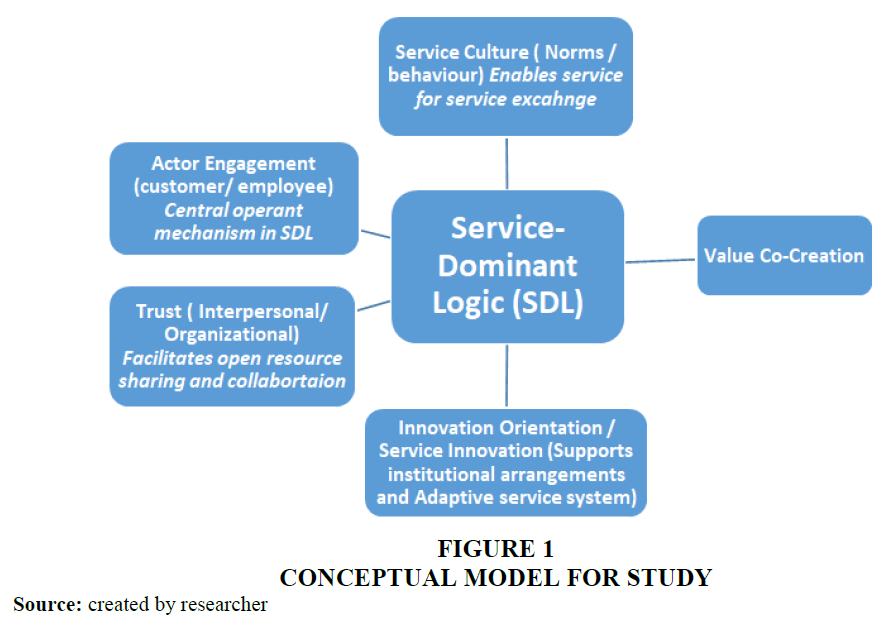
Figure 1 Conceptual Model for Study
Source: created by researcher
Findings and Discussion
This section synthesises the literature on trust and value co-creation within the Service-Dominant Logic (SDL) framework from theoretical (T), contextual (C), characteristics (C), and methodological (M) perspectives. The TCCM framework serves as a structured analytical lens, ensuring a comprehensive review of the theoretical foundations of trust and value co-creation, the diverse service and organizational contexts in which they operate, the key behavioural and cultural characteristics influencing these relationships, and the range of research methodologies employed. By applying this framework, the section systematically examines the moderating role of organizational culture in shaping trust-based value co-creation behaviours across service ecosystems Figure 2.
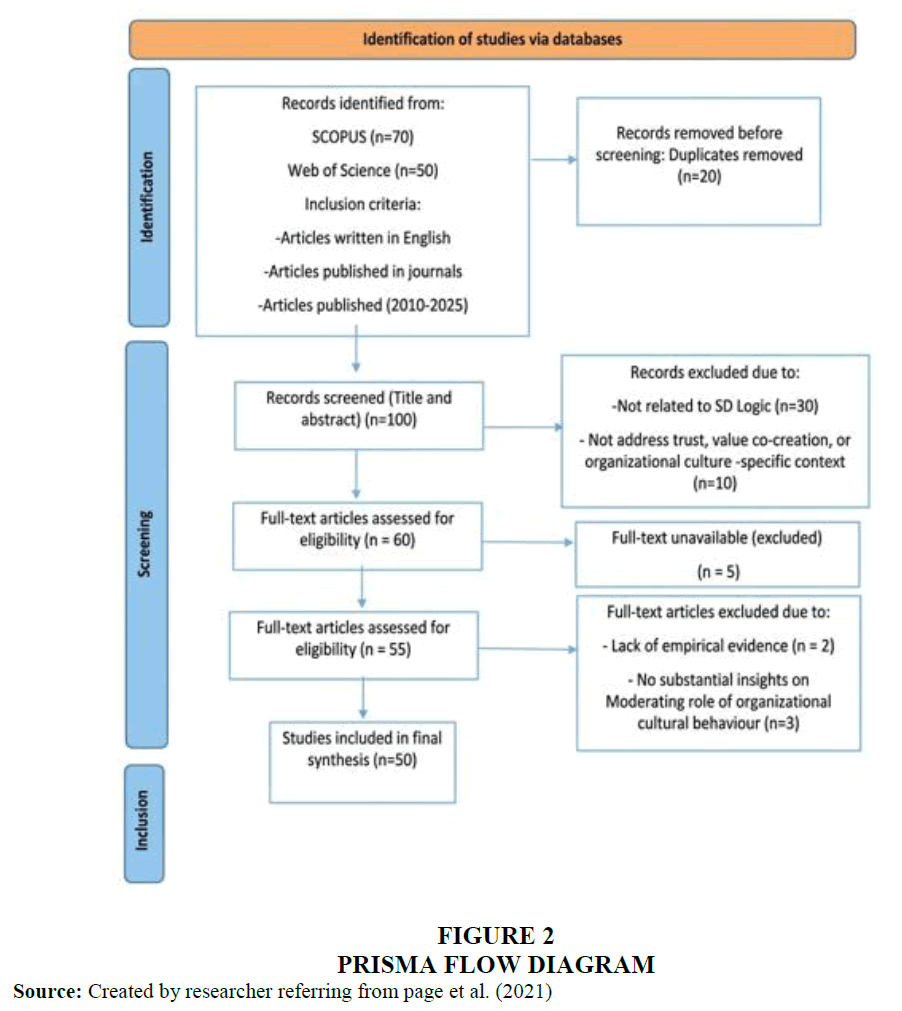
Figure 2 Prisma Flow Diagram
Source: Created by researcher referring from page et al. (2021)
Theoretical Perspective
Social Exchange Theory
According to George Homans’ Social Exchange Theory (1958), interpersonal interactions depend on individuals’ evaluations of the rewards and costs associated with a social transaction. Building on this logic, the present study applies Social Exchange Theory to explain the factors that trigger Customer Citizenship Behaviours (CCBs), as the theory suggests that people reciprocate based on their emotional states—such as affective commitment formed through perceptions of organizational support (Gong et al., 2022; Hur et al., 2018). Within such an exchange relationship, customers may willingly engage in voluntary, discretionary actions—offering constructive suggestions, assisting employees, or giving feedback—to help the organization enhance its performance (Choi & Lotz, 2018; Mahajan, 2025).
Service-Dominant Logic (Vargo & Lusch, 2004)
Service-Dominant Logic represents a conceptual shift away from the Goods-Dominant Logic view, which perceives goods as the fundamental unit of exchange, toward service being the basic unit of exchange (Vargo & Lusch, 2004). Embedded in relationship marketing and stakeholder theory, SDL explains Value Co-Creation, or VCC, from a broad perspective (Yi & Gong, 2013), where the interaction between the resources of the firm and customers is the essence (Barrutia et al., 2016; Chandler & Lusch, 2015; Grönroos & Voima, 2013; Ind & Bjerke, 2007; Prahalad & Ramaswamy, 2004; Vargo & Lusch, 2004, 2008, 2016).
A fundamental proposition of SDL is that the customer is always a co-creator of value (Vargo & Lusch, 2008). Value co-creation essentially involves the convergence of the firm's and the customer's roles (Vargo & Lusch, 2011), reflecting the active, informed, connected, and empowered nature of contemporary consumers (Prahalad & Ramaswamy, 2004). Customers can co-create value by bringing experiences, knowledge, skills, and motivation (Grönroos & Voima, 2013; Ranjan & Read, 2016; Vargo & Lusch, 2016).
According to the VCC, value is created in the interactions between many stakeholders; every touch point is an opportunity for value creation and value extraction (Grönroos & Voima, 2013; Uhrich, 2017; Prahalad & Ramaswamy, 2004).
Even prior to the formalization of the concept of VCC, various scholars expressed the importance of co-creation of value. Toffler (1980) proposed the term “prosumer” as a means to underline the active role of customers in producing value. Later, Normann and Ramirez (1998) came to argue that economic actors are obliged to co-produce value, while Gummesson (1996) underlined the value of dyadic integration in co-producing value. Etgar (2008), on this matter, took a step further by introducing the term “co-production’’ and developing a decision-making model which describes the individual’s participation in the process of co-production (Chahal & Mahajan, 2015).
Payne et al. (2009) identified three relational phases in the co-creation process: acquisition, stabilization, and enhancement. According to them, the extent of co-creation grows when customer experience deepens. Maglio et al. (2009), in turn, suggest a five-stage model of co-creation: interaction, service, proposal, agreement, and realization. Verganti proposes that innovative firms need to invest in collective laboratories that combine external knowledge with internal expertise to enable innovation. Finally, Grönroos and Voima (2013) conceptualized three spheres of value creation: the provider sphere, the customer sphere, and the joint sphere. According to them, it is within the joint sphere that true value is created.
Co-created value is essentially determined by the customer in terms of value-in-use, as identified in the works of Grönroos & Voima (2013), Lusch & Vargo (2004, 2006, 2008), Ranjan & Read (2016), and Woodruff & Flint (2006). The very definition of value-in-use suggests that customers create and control value through the act of usage-an interaction involving physical and mental activities, practices, and experiences.
In SDL, the customer realizes and evaluates the value during consumption. Value creation, therefore, is the generation of value-in-use by the customer in interaction with the firm's offering. This is a continuous and experiential process based on the knowledge, reasoning, and capabilities of the customer to extract meaningful benefits from the firm's value proposition.
Context
In this systematic literature review, we examined both the research papers and the individual studies contained within them to gain a granular understanding of the evidence base. Of the final sample, the majority of papers comprised a single empirical or conceptual study, while others reported multiple studies within a single publication. Collectively, the review encompasses a substantial body of studies investigating trust and value co-creation under the Service-Dominant Logic (SDL) framework, with particular attention to the moderating role of organizational culture behaviour.
Consistent with the PRISMA 2020 guidelines (Page et al., 2021) and methodological insights from Sauer and Seuring (2023), this review systematically synthesises contemporary literature published between 2020 and 2025. While prior SDL research has extensively explored value co-creation, comparatively limited attention has been paid to how organizational culture shapes trust-building mechanisms and co-creation outcomes within service ecosystems. This review addresses this gap by analysing studies across diverse service sectors and geographical contexts, thereby outlining how cultural behaviours influence actor-to-actor (A2A) interactions, trust formation, and the effectiveness of SDL-based value co-creation practices.
Trust and Value co-creation in SDL
Based on the identified studies on trust and co-creation of value in the SDL paradigm, five main theme areas emerge: (1) trust as an outcome of co-creation, (2) trust as an enabler of co-creation, (3) trust in digital and service-based ecosystems, (4) the conceptual integration of co-creation under SDL, and (5) the moderating influence of organizational culture. All these themes together depict the multidimensional role of trust, both as an outcome and a driver, in co-creation systems influenced by organizational behavior and culture.
The studies of Royo-Vela (2024), Sohaib (2023), Nguyen (2024), and Ocloo (2021) focus on how trust is a relational outcome in customer–firm collaboration in co-creation contexts. By applying quantitative and mixed-methods approaches-coupled surveys with SEM analysis-these works identify co-creation intensity, levels of engagement, perceived fairness, and the quality of relational interaction as major determinants. all the studies indicate the same merit of trust development and improvement as an outcome when both parties are increasingly engaged in the collaborative value creation process, while also improving both satisfaction and performance. Under this lens, trust is not simply a by-product, but it is also a strategic relational resource, and a means by which long-term relationships are reinforced, as well as customer loyalty further solidified. Together, this evidence conveys that co-creation enhances the perceived value of experiences, all the while developing relational trust which again supports the dynamic principles underlying SDL exchange (Mahajan, 2025).
Drawing from Nguyen (2024), Sohaib (2023), and Ullah (2025), these frameworks similarly explore trust as a precursor or facilitator of value co-creation, and by way of structural modeling and case-based designs, identify determinants of trust such as: mutual dependency; transparency of communication; the commitment of stakeholders. The empirical findings suggest that higher levels of trust provide a basis for openness, sharing knowledge, and collaborating-indispensable capabilities for ongoing innovation and ongoing collective value improvement. Theoretically, continually supports that these values find trust as a prerequisite and outcome of SDL exchanges-a self-reproducing element in sustaining actor-to-actor (A2A) relationships in service ecosystems. Trust can function as the binding mechanism which allows for purposeful and productive resource integration and co-production within organizational networks.
Royo-Vela (2024) and Ocloo (2021) delve into the emergence of trust within virtual and hybrid co-creation settings in the context of digital service environments. They discuss how precursors of trust, such as the quality of digital interaction, reliability of technology and safety assurance, are assessed through quantitative survey-based methods and comparative case studies. They assert that high levels of digital transparency, user involvement and the use of safe platforms greatly support trust in value-co-creation contexts. Therefore, they explore the manner in which mediation mechanisms of digital interfaces preserve the SDL principle of service exchange in e-co-creation, particularly in e-commerce, online service and/or platform-based business models. They reiterate that trust is central to sustaining digital co-creation ecosystems, encouraging the relationships between technology, transparency and service experience.
Works like Vargo & Lusch 2022, Ranjan & Read 2023, and Ngugi 2024 provide conceptual groundings for SDL and situate resource integration and institutional arrangements within co-creation processes. Building upon conceptual frameworks and empirical syntheses, they further their contention about co-creation being a dynamic, relational, and context-dependent outcome of actor interactions in institutional contexts. They forge theoretical relationships (links) among trust, co-creation, and institutional logs, which positions SDL as a meta-framework with breadth beyond mere marketing frameworks. Their key contribution is to lay out how trust-based interactions support institutional integrity and value created and co-created now or in the future within a service ecosystem.
Hult et al. (2020), Sohaib (2023), and Ullah (2025) highlighted constructive roles of organizational cultural behaviors as a moderating variable in exploring trust-co-creation relationships. Drawing on quantitative modeling and organizational surveys, they identified collaborative norms, shared values, openness to innovation, and participative leadership as factors that shape trust-relationships strength, revealing a supportive, transparent and participative culture, thus increasing the effectiveness of co-creation efforts on organizational resilience and adaptive capacity. Collectively, they empirically contribute to the field by tying behaviorally framed culture dynamics to trust-based co-creation study, highlighting a conceptual link between SDL and organizational psychology. More importantly, these recent studies illustrate how culture is not simply a passive contextual variable, instead, it is an active moderator through which trust builds co-created value Table 3.
| Table 3 Trust and Outcome and Enabler of Value Co-Creation | |||||
| Authors (Year) | Methodology | Aim of the Study | Determinants | Insights / Findings | Main Contribution |
| Royo-Vela (2024); Sohaib (2023); Nguyen (2024); Ocloo (2021) | Quantitative and mixed-method approaches using survey and SEM analysis | To examine how trust evolves as a result of collaborative engagement between firms and customers under co-creation activities. | Co-creation intensity, customer engagement, perceived fairness, relational interaction | Trust strengthens when both parties engage in shared value-creation processes; trust acts as a performance-enhancing mechanism. | Establishes that co-creation not only enhances value perception but also serves as a foundation for relational trust in SDL frameworks. |
| Nguyen (2024); Sohaib (2023); Ullah (2025) | Structural modeling and case-based analysis | To investigate the role of trust as a facilitator of mutual collaboration and resource integration. | Mutual dependence, communication transparency, stakeholder commitment | Trust enhances openness and collaboration, enabling sustained co-creation and innovation. | Provides conceptual justification for positioning trust as both antecedent and outcome in SDL-driven value networks. |
| Royo-Vela (2024); Ocloo (2021) | Survey-based quantitative analysis and comparative case studies | To explore trust formation in virtual and hybrid co-creation environments. | Digital interaction quality, technology reliability, perceived security | High digital transparency and user involvement promote trust and participation in value co-creation. | Demonstrates how digital platforms mediate trust and co-creation under SDL, supporting digital transformation strategies. |
| Vargo & Lusch (2022); Ranjan & Read (2023); Ngugi (2024) | Conceptual framework and empirical synthesis | To conceptualize co-creation through resource integration and institutional arrangements in service ecosystems. | Resource sharing, institutional logic, actor collaboration | Co-creation is dynamic, relational, and dependent on contextual resource integration. | Provides the foundational theoretical structure linking trust, co-creation, and institutional frameworks under SDL. |
| Hult et al. (2020); Sohaib (2023); Ullah (2025) | Quantitative modeling and organizational surveys | To assess how cultural behaviour moderates the link between trust and co-creation outcomes. | Organizational values, collaboration norms, openness to innovation | Supportive and participative cultures strengthen the trust–co-creation relationship. | Empirically validates that organizational culture behaviour enhances the effectiveness of trust-driven co-creation initiatives. |
The integrated insights from these studies affirm that trust acts both as an enabler and an outcome of value co-creation, forming the psychological and relational foundation of SDL. At the same time, organizational culture behavior serves as a moderating mechanism in shaping quality, depth, and sustainability for trust-based exchanges. This synthesis underlines the need for a holistic, behaviorally grounded SDL model-one that should connect institutional structures, trust dynamics, and cultural values for enhanced collaborative value creation within modern service ecosystems.
SDL value co-creation
In conclusion, three important thematic areas have arisen from the literature review of SDL, and value co-creation: (1) SDL as a conceptual framework of value co-creation, (2) value co-creation mechanisms; and (3) institutional and contextual enablers of SDL. Collectively, these thematic areas provide a comprehensive understanding about SDL, both as a theoretical framework and practical framework for trust-based and culture-led co-creation processes.
Research conducted by Daskou, Masouras & Reppa (2023), Ullah (2025) and Maijala (2024) also demonstrate that SDL is conceptually strong as a theorizing meta-theoretical framework for understanding value-generating actor-to-actor (A2A) interactions grounded in shared institutional logics. A conceptual and systematic literature review methodology fully extends the boundaries of service exchange and opens the doorway to challenges in explaining the value co-creation process beyond firm and consumer boundaries. The emerging determinants-actor engagement, resource integration and institutional environment-indicate that value co-creation is not a singular transactional moment but an ongoing process that is relational and context driven. Overall, these studies expand SDL to network-based and exosystemic views of value creation, encouraging SDL to be understood as a supervisory theory across disciplines (Mahajan, 2025).
Royo-Vela (2024), Sohaib (2023), and Nguyen (2024) investigate behavioral and technological mechanisms within value co-creation. Employing empirical and mixed-method approaches (for example, surveys and PLS-SEM), these studies assess customer participation, interaction quality, technological readiness, and relational trust. In all three research episodes, trust, transparency, and engagement are seen to be central factors contributing to co-created value outcomes. Additionally, customer participation and co-production behavior reinforce SDL’s premise of joint responsibility between provider and customer through enhancing feelings of customer satisfaction, loyalty, and perceived value. With respect to the above research contributions, empirical studies build depth pointing to a plausible explanation of SDL principles manifested through behavioral factors in the context of service ecosystems and technology-enabled psychology.
The third thematic cluster contains research by Clauss & Laudien (2021) and Taghizadeh (2020) concerning the importance of the enabling organizational culture and leadership for SDL within the firm. Both employ organizational surveys and case-based empirical methods and recognize open culture, learning orientation, and participative leadership as the key enablers of SDL-based value creation. They assert organizational culture is a strategic moderator enhancing internal trust and collaboration to ensure effective co-creation. By using culture as both a behavioral foundation and a governance mechanism, these two works extend SDL into the realm of organizational behavior and management theory to bridge service logic with performance at the firm Table 4.
| Table 4 SDL and Value Co-Creation | |||||
| Authors (Year) | Methodology | Aim of the Study | Determinants | Insights/Findings | Main Contribution |
| Daskou, Masouras & Reppa (2023); Ullah (2025); Maijala (2024) | Conceptual analysis and systematic literature review | To establish Service-Dominant Logic (SDL) as a meta-theoretical framework where value emerges through actor-to-actor (A2A) interactions and shared institutional logics. | Actor engagement, resource integration, institutional environment | Emphasizes value co-creation as a dynamic, relational process shaped by mutual service exchange and institutional structures. | Extends SDL beyond firm-customer dyads toward a network-based understanding of value creation. |
| Royo-Vela (2024); Sohaib (2023); Nguyen (2024) | Empirical and mixed-method studies (survey, PLS-SEM) | To explore behavioural mechanisms—such as customer participation, information sharing, and joint problem-solving—that foster value co-creation. | Interaction quality, customer participation, technological readiness, relational trust | Demonstrates that trust, transparency, and active engagement significantly enhance co-created value outcomes. | Empirically validates SDL’s application in service ecosystems by linking behavioural mechanisms to trust and perceived value. |
| Clauss & Laudien (2021); Taghizadeh (2020) | Empirical analysis using organizational surveys and case studies | To identify organizational enablers (e.g., open culture, learning orientation, participative leadership) that facilitate SDL adoption. | Organizational culture, leadership, learning orientation | Reveals that a supportive culture and participative leadership strengthen SDL-based value creation and internal trust. | Highlights culture as a strategic moderator influencing the success of SDL implementation. |
The overall convergence from the reviewed studies is that SDL provides a holistic and relational framework in which trust, engagement, and organizational culture are key to sustaining co-created value. While conceptual analyses clarify the theoretical underpinning of SDL, it is the empirical studies that operationalize its constructs in real-world service ecosystems. Yet, a gap persists in understanding how organizational culture behaviour moderates the trust–value co-creation relationship, which forms the central focus of the current research.
The customer is always a co-creator of value
Of all the Foundational Premises outlined in Table 1, perhaps none has been the source of as much confusion—and, occasionally, contention—as FP6. At the root of the misunderstanding is the false assumption that value co-creation is equivalent to a customer’s active contribution to the design, definition, or creation of a firm’s offering, its value proposition. As Vargo (2008) acknowledges, the authors themselves are partially to blame for this misunderstanding because of their use of the term co-production in the original FP6 (Vargo & Lusch, 2004).
This was later qualified in Lusch and Vargo 2006, and most explicitly in Vargo and Lusch 2008, in which the former is differentiated from the latter. Thus, while co-production involves the activities of designing, defining, and producing the value proposition, value co-creation refers to a broader set of interactions among multiple actors, most of whom do not necessarily realize they are contributing to one another's well-being. The point is worth reiterating because much of the continued debate about FP6-a prospective EU research framework program underlies a lingering misconception; however, there are other reasons why the discussion continues.
Ironically, the debates surrounding FP6 emanate from two largely opposing perspectives—one normative and the other positive. From the normative perspective, some scholars seem to interpret FP6 as arguing that firms should always involve customers (and sometimes other actors) in the design, definition, creation, or completion (e.g., self-service) of firm outputs—that is, in co-production. However, as has been repeatedly clarified (e.g., Vargo, 2008; Vargo & Lusch, 2008), the view is that co-production is discretionary, according to various factors such as the beneficiary’s knowledge and willingness and the provider’s understanding of customer preferences among other factors Table 5.
| Table 5 Customer as Co-Creator of Value | |||||
| Authors (Year) | Methodology | Aim of the Study | Determinants | Insights / Findings | Main Contribution |
| Vargo & Lusch (2004, 2006, 2008) | Conceptual clarification and theoretical refinement | To differentiate between co-production (customer participation in design/production) and co-creation (broader value formation through interaction). | Actor engagement, resource integration, institutional context | Co-production is optional, depending on customer knowledge and willingness; co-creation is inherent in all exchanges. | Establishes the conceptual distinction between co-production and co-creation, positioning co-creation as a universal principle in service ecosystems. |
| Vargo (2008); Ramaswamy & Ozcan (2014) | Theoretical discourse and critical literature review | To analyze the conflicting interpretations of FP6 as either a prescriptive managerial directive or a descriptive systemic property. | Customer involvement, interdependence, system specialization | The normative perspective views co-creation as something firms should do; the positive perspective asserts that co-creation always happens naturally. | Reframes FP6 as a positive statement explaining value creation as a systemic and unavoidable feature of human and market interactions. |
| Grönroos & Voima (2013) | Conceptual critique and theoretical evaluation | To challenge the claim that value is always co-created, arguing instead that it occurs only through direct interaction. | Provider–customer interaction, value facilitation, contextual engagement | Suggests that firms often only facilitate customer value creation rather than co-create it directly. | Introduces an alternative perspective distinguishing co-creation from facilitation, prompting deeper analysis of value realization contexts. |
| Vargo & Lusch (2008) | Theoretical expansion and systems-based synthesis | To expand FP6 beyond the firm–customer dyad and recognize value creation as emerging from multi-actor networks. | Actor networks, resource integration, institutional arrangements | Value creation occurs through multiple interdependent actors across public, private, and market systems. | Broadens SDL’s scope, identifying value co-creation as a network-based, systemic phenomenon rather than a dyadic process. |
| Vargo & Lusch (2008); Vargo (2009) | Conceptual synthesis | To position value co-creation as the foundational concept for understanding service ecosystems and market exchange. | Service ecosystem, specialization, interdependence | Value co-creation forms the basis of all market and social exchange, shaping how firms, customers, and institutions interact. | Establishes FP6 as a core pillar of Service-Dominant Logic, redefining marketing as a process of ongoing, multi-actor value co-creation. |
By contrast, value co-creation is a positive statement—it describes an inherent characteristic of human systems, which, due to specialization and interdependence, always involve the co-creation of value. As a result—unlike co-production—value co-creation is not optional. This chronic misunderstanding of the concepts as normative imperatives has been further reinforced by their frequent treatment as such, particularly in managerial and practitioner-oriented literature (Chahal & Mahajan, 2015; Ramaswamy & Ozcan, 2014).
Nevertheless, value co-creation is a positive concept, and several scholars have criticized the breadth of this concept (e.g., Grönroos & Voima, 2013). In their view, co-creation of value occurs only under quite specific conditions-namely, when there is direct, personal interaction between the provider and the beneficiary. In other circumstances, the firm facilitates value creation, but it is the customer alone who realizes that value. We do not find this conceptual distinction-between co-creation and facilitation-persuasive, nor do we believe it offers much in terms of practical or theoretical utility for the scholar, practitioner, or anyone else.
That said, we recognize that, in previous work (Vargo & Lusch, 2006, 2008), we did misrepresent the extent of value co-creation, albeit not as asserted by Grönroos and Voima. Quite the opposite, we greatly understated its pervasiveness. Value is not created by an individual actor alone or solely within firm–customer interactions. Rather it is co-created in a network of multiple actors, each integrating and contributing resources from both market-facing, private, and public sources. More specifically, value is co-created collectively, rather than individually or dyadically, in specialized human systems—and perhaps in all forms of organized interaction. Co-creation, in this sense is inextricably intertwined with exchange itself and thus with markets and marketing.
Characteristics
This section presents a comprehensive synthesis of the existing literature that integrates and links the key factors influencing trust and value co-creation within the Service-Dominant Logic (SDL) perspective. The framework consolidates the associated constructs Resource integration, Convergence product quality, Convergence service quality, with particular emphasis on the moderating role of organizational culture behaviour in shaping trust-based value co-creation processes. The following discussion elaborates on each component of this integrated framework and explains their interrelationships within service ecosystems.
SDL and Value co-creation
Service-Dominant (SD) logic defines value as value-in-context, where the context is a “set of unique actors with unique reciprocal links among them (Chandler & Vargo, 2011). According to Chandler and Vargo (2011), markets evolve in ongoing and simultaneous processes; context is therefore a dimension of value co-creation that materializes across successive levels of temporality. Value-in-context emerges through networks of dyadic, triadic, and more complex relationships in each level, representing distinct levels of market-formation processes and collectively constituting the broader service ecosystem.
In addition, value-in-exchange and value-in-use are conceptualized as functions of value-in-context. The value propositions of the firm may involve value-in-exchange features such as price or product features and value-in-use features that integrate utilitarian, symbolic, and hedonic elements of value realized in the context of consumption or use. However, such propositions become a reality only within a specific context, where multiple actors interact with one another and co-create value by enacting the value-in-exchange and value-in-use qualities.
Every context in which interactions occur can be considered a different level of the value co-creation process. Interestingly, even prior to the creation of Service-Dominant (SD) logic, context-specific situational variables provided a basis for benefit segmentation, such as the work by Dickson (1982). In that respect, the concept of value-in-context has similarities with the strategic notion of benefit segmentation, as both highlight the situational environments where consumers interact and experience their benefits or utilities” ((Mahajan, 2025).
According to Belk (1975), “a situation is defined as a set of time- and place-specific characteristics that influence how people respond to any given object, thus molding their behaviors and experiences. In a similar line, Dickson (1982) puts forward a person-situation benefit segmentation framework, linking a consumer's individual traits and particular consumption contexts to the benefits and utilities they perceive. Since value is conceptualized as an overall evaluation of utilities (Zeithaml, 1998) and benefits (Christopher, 1996), it follows that contextual factors significantly influence the perception of value from this same standpoint.
While the idea of value co-creation has been discussed for more than ten years (e.g., Galvagno & Dalli, 2014; Ranjan & Read, 2016), S-D Logic embodies that idea but also extends it through a comprehensive, integrated, and theoretically sound framework that constitutes a unique-but-complementary approach in the ongoing debate of scholars (Vargo & Lusch, 2017; Vargo et al., 2010).
From the perspective of S-D Logic, the concept of value co-creation is defined as “the processes and activities that underlie resource integration and incorporate diverse actor roles within a service ecosystem” (Lusch & Nambisan, 2015). It points out that every actor engages in resource integration and service exchange, while every participating actor co-creates value synergistically in collaboration and interaction with each other (Vargo & Lusch, 2016). According to this logic, resource integration through service exchange occurs under institutional arrangements that shape and sustain endogenously evolving service ecosystems (Vargo & Lusch, 2016)”.
This integrated framework provides a comprehensive narrative of value co-creation, which occurs through the integration of resources and exchange of services among actors. Interactions are both enabled and constrained by shared institutions-social norms, rules, symbols, and other normative or heuristic guidelines-that are endogenously developed and become dynamic, nested, and overlapping service ecosystems in which further value can be co-created Figure 3.
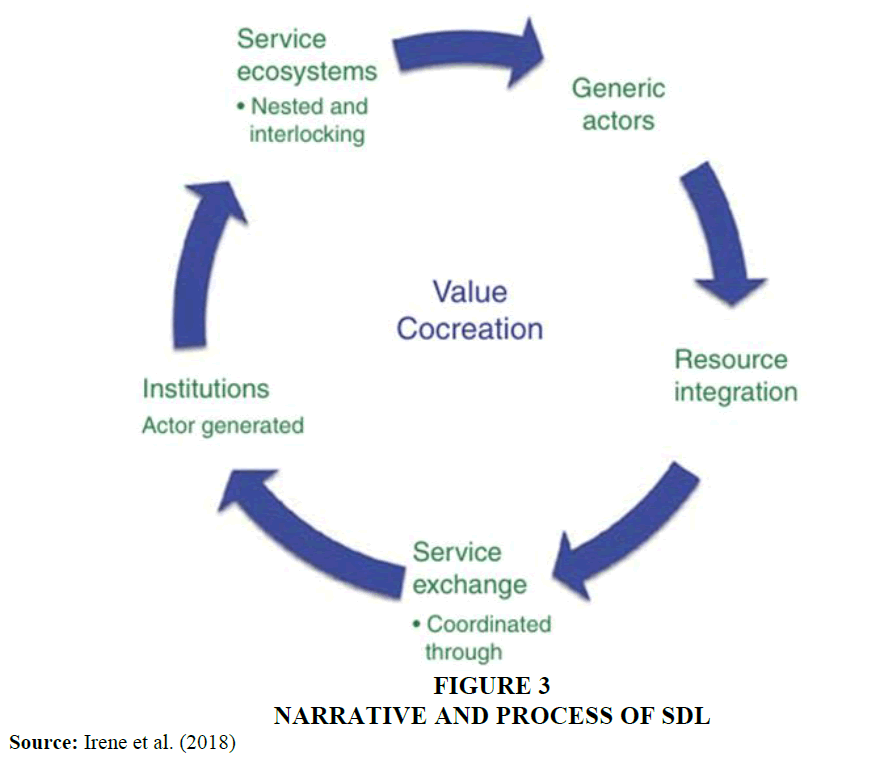
Figure 3 Narrative and Process of SDL
Source: Irene et al. (2018)
This meta-theoretical narrative is intended to apply across all levels of aggregation, from micro to meso to macro, spanning contexts such as dyads, families, organizations, industries, and even cultures. Whereas a good deal of the research on Service-Dominant (S-D) logic to date has focused on articulating and refining this meta-theoretical perspective, hundreds of scholars worldwide have contributed to its evolution.
Recently, Vargo and Lusch (2017) have called for midrange theories rooted in S-D logic to better link theory and practice and to render the framework more empirically testable. This call inspired this special issue and was the central theme of the 2016 Forum on Markets and Marketing, hosted by Warwick University in Venice. Many of the papers presented at that forum form the basis of the articles in this issue, with the five selected contributions representing substantial steps forward in rendering S-D logic more applicable and practically relevant.
Associated constructs: Resource integration, Convergence product quality, Convergence service quality
Resource Integration
Resource Advantage Theory posits that there exist two levels of firm resources: basic resources and higher-order resources, with the latter emerging from the synergistic combination of basic resources (Hunt & Morgan, 1995). Drawing on this antecedent framework, Madhavaram and Hunt (2008) proposed a hierarchical structure of firms’ operant resources, specifying that these were categorized into three levels: basic, composite, and interconnected resources. Although their work illustrated some examples of composite and interconnected resources that could emerge from the synergy between the basic and higher-order resources, an exhaustive list of all possible composites and integrations was not provided.
In this study, we define the convergence quality of a convergent product as a firm resource, which is an outcome of synergistic interaction among basic resources. Technology convergence defies the traditional product and service boundaries by putting multiple functionalities and offerings into a single product (Yoffie, 1997). For example, a smartphone represents a convergent device hosting various product functionalities like a calculator, torch, television, iPod, modem, and remote control, and facilitating various services such as telecommunications, messaging, and internet access in one platform.
In the context of this research, the convergent product is the value proposition of the firm, which is a converged bundle of products and services (Park & Koh, 2017). In this regard, convergence quality can be defined as the combination of convergent product quality and convergent service quality. It forms part of the resources of the firm, arising from the synergetic interaction between basic operant and operand resources.
Such convergent products with substantial customer value can be developed only when a firm has convergence competencies, which a firm gets from the product innovation capability, learning platform capacity, knowledge creation ability, and technological competence. Such elements thus represent the interconnected and composite resources of a firm (Madhavaram & Hunt, 2008).
Moreover, according to Perceptual Symbol Systems Theory (Barsalou, 1999), consumers are likely to perceive products along multiple dimensions rather than as a single holistic construct. Thus, this research proposes two dimensions, namely, (1) Convergent Product Quality and (2) Convergent Service Quality, as major drivers of the overall convergence quality.
Convergence product quality
From this point of view, digital convergence has brought about transformative changes across industries with increasing strategic importance of convergent products. Companies view these products as a source of gaining and sustaining competitive advantage (Gill, 2008; Gill & Lei, 2009). In such a convergence-driven environment, firms compete by offering superior quality products to gain a distinctive edge over others in the marketplace (Park & Koh, 2017).
According to Garvin (1984), product quality is an intrinsic characteristic of goods that relates to the presence/absence of measurable characteristics of a product. In most instances, quality is measured from two perspectives: (1) objective quality, which is concerned with the physical aspects of measurement of the product, and (2) subjective quality, which is concerned with the evaluation of the product from a cognitive and behavioral standpoint by the consumer. A product's objective quality is believed to be one of the determinants of organizational success. Several product researchers have suggested that subjective quality itself has a substantial impact on the adoption and perceived value of convergent products (Hartmann, 2006; Moore, 2006).
A convergent product is a product in which new functions from multiple product categories/convergent product areas has been incorporated, and is, in part, a product of technological development. While technology constantly changes the nature of the product, it also shifts notions of quality and perfection (Zeithaml, 1988). The traditional understanding of product quality must therefore be reinterpreted in light of convergent products. Means–End Theory suggests that customers perceive products based on abstract dimensions of quality rather than concrete features. This paper thus defines quality of the convergent product as the subjective degree of product excellence as perceived by the customer.
To help further conceptualize convergent product quality, this study draws on the framework suggested by Lee et al. (2011), who identified three categories and six dimensions of high-technology products:
Performance attributes - that is, usefulness, ease of use, and innovativeness of technology;
Appearance attributes – referring to visual appeal and prototypicality; and
Communication attributes —represented by self-expression.
Beyond these dimensions, coolness has emerged as an essential attribute of technology products (Warren & Campbell, 2014; Raptis et al., 2017; Sundar et al., 2014). It reflects the consumer's perception of the positive and desirable quality of a product (Bird & Tapp, 2008; Heath & Potter, 2004; Pountain & Robins, 2000). This study will also include coolness as another and important measure of convergent product quality.
In this respect, ease of use, as one of the performance attributes of technology products as suggested by Lee et al. (2011), corresponds to the notion of being effortless, already acknowledged as an indicator that defines coolness (Pountain & Robins, 2000). On these grounds, ease of use is combined with coolness. In a similar fashion, innovativeness, as another performance attribute, has been found to be closely related to coolness (Noh et al., 2014; Bird & Tapp, 2008), thus justifying its combination under the same construct.
Among the appearance attributes, visual appeal refers to the aesthetic characteristics of a product and shares the definition of classical aesthetics (Raptis et al., 2017), which is also a part of coolness (Raptis et al., 2017). Therefore, visual appeal also combines with coolness. On the other hand, coolness represents originality (Sundar et al., 2014), which opposes prototypicality. As convergent products focus on innovation, novelty, and originality (Sundar et al., 2014), prototypicality becomes a less useful dimension in the context of technological convergence.
Regarding the communication attribute, products that are easy to use and enhance customer self-expression tend to be perceived as desirable, and desirability serves as an antecedent of perceived coolness (Bruun et al., 2016; Raptis et al., 2016). Consequently, self-expression is also integrated with coolness. In summary, this synthesis results in two primary dimensions of convergence product quality: Usefulness, and Coolness.
Convergence service quality
The arrival of converged products has substantially altered the cost and profit equation for service oriented organizations. The involvement of customers in co-creating the service with technological interfaces has enabled organizations to benefit from both cost reductions and improvements in corporate performance. (Bitner et al., 2010)). As such, convergence in technologies has become an essential enabler for sustaining business success (Bolton et al. 2007).
As devices have become smaller and more efficient, the functionality of converged products, has expanded to include various component and features of self-service technologies (SSTs), such as ATMs, vending machines, and ticketing kiosks, thereby transforming service delivery and improving customers' self-service experience (Lin & Hsieh, 2011).
These devices allow customers to co-create a service whenever they want, wherever they are whether checking into an airline ticket, banking service, and government service. Technology-enabled interfaces like self-service kiosks enable customers to create and customize services on their own and further establish customers' roles as active participants in service co-creation processes. Meuter et al. (2000)
At present, appropriate instruments to clearly capture the service quality dimensions of convergent products are lacking. Traditional service quality indicators cannot effectively capture the unique experiential and perceptual aspects associated with convergence technology-based services. For instance, Wolfinbarger and Gilly (2003) suggested that conventional service quality dimensions need to be redefined in order to clearly reflect the customer–technology interaction.
Convergence service quality is conceptualized in this study by drawing on the self-service technology literature (Zeithaml et al., 2002) and on the service quality framework proposed by Lin and Hsieh (2011). Lin and Hsieh identified security, functionality, assurance, convenience, customization, enjoyment, and design as key service quality dimensions. However, several of these dimensions have been questioned in previous studies: for example, security/privacy has exhibited little explanatory power (Barrutia et al., 2013), while functionality, being essentially related to system availability, has currently reached a high level of standardization (Barrutia et al., 2014).
The assurance dimension is related to firm reputation and reliability and is thus less applicable here since the resources considered rely on technology convergence. Design aspects have already been included in the coolness dimension for convergence product quality (Raptis et al., 2016). Instead of customization, personalization is used here, which has been identified as one of the critical determinants of self-service technology quality (Zeithaml et al, 2002). There is also the replacement of enjoyment with entertainment, which has been regarded as one of the essential attributes of convergent products (Sheng & Teo, 2012).
Therefore, the three core dimensions-personalisation, convenience, and entertainment-of convergence service quality are identified as major representatives of customers' perceptions of service quality within a convergence-based environment.
Organizational culture behaviour as moderator
The interplay of organizational culture and SDL has recently attracted scholarly interest in an attempt to explain the way cultural orientations shape value co-creation and relational trust. Collectively, the studies reviewed emphasize that organizational culture is not a background factor; rather, it is an active moderator that improves the effectiveness of SDL implementation and trust-building mechanisms across service ecosystems.
Taghizadeh (2020) and Clauss & Laudien (2021) underline that the acceptance of SDL principles essentially depends on the prevailing organizational culture. Combining conceptual and empirical analyses, they prove that cultures characterized by collaboration, openness, adaptability, and continuous learning substantially favor the proliferation of SDL practices. This is because such cultures intrinsically encourage resource integration and engage actors relevant to co-creation. The authors argue that organizational culture acts as a strategic enabler in assuring SDL transitions from a mere theoretical framework to a practical management approach. This finding supports a rationale for positioning culture as a moderating construct in the SDL–trust relationship, where culture strengthens the link between service logic and relational outcomes.
Ullah (2025) and Maijala (2024) further extend the discussion by investigating how shared values, participative leadership, and communication norms shape the behavioral dynamics of co-creation. Through their systematic reviews and mixed-method analyses, they note that a strong cultural orientation-shaped by trust, participation, and openness-builds effective collaboration among the stakeholders. These studies also provide support for the view that shared goals and values at an organizational level beget mutual trust more naturally and hence enhance the perceived value of outcomes co-created. These results imply that culture has a mediating and moderating role regarding the depth of actor engagement and general quality of the co-creation processes of service ecosystems.
Daskou et al. (2023) and Sohaib (2023) present empirical evidence to support the behavioral dimensions of organizational culture serving as drivers of co-creation. Their quantitative studies prove that participative and trust-based cultural behaviors, such as employee involvement and cross-functional collaboration, substantially improve the quality of the relationship and the effective flow of communication. These cultural attributes further allow for the congenial sharing of responsibilities, mutual respect, and openness-required elements in accomplishing continued value co-creation. They identify that trust and collaboration-based cultures will not only strengthen the SDL–trust linkage but result in better organizational performance with long-term sustainability Table 6.
| Table 6 Organizational Culture Behaviour as Moderator | |||||
| Authors (Year) | Methodology | Aim of the Study | Determinants | Insights / Findings | Main Contribution |
| Taghizadeh (2020); Clauss & Laudien (2021) | Conceptual and empirical review using organizational case data and SDL framework analysis | To identify the role of organizational culture in facilitating Service-Dominant Logic (SDL) adoption and successful value co-creation. | Collaboration, openness, adaptability, learning orientation | A culture characterized by open communication, adaptability, and learning enables organizations to effectively apply SDL principles in co-creation processes. | Demonstrates that organizational culture acts as a foundational enabler of SDL adoption, providing support for including culture as a moderating construct in the SDL–trust relationship. |
| Ullah (2025); Maijala (2024) | Systematic literature review and mixed-method analysis | To explore how cultural orientation, shared values, and leadership behaviours influence co-creation outcomes. | Shared values, communication norms, participative leadership | Strong cultural orientation fosters effective stakeholder collaboration and mutual trust, which improves co-created value. | Provides theoretical justification for the inclusion of organizational culture behaviour as a moderator influencing the relationship between SDL and trust-building. |
| Daskou et al. (2023); Sohaib (2023) | Empirical quantitative analysis using survey data on co-creation behaviour | To investigate the impact of participative and collaborative cultural behaviours on co-creation performance and relational trust. | Employee participation, cross-functional collaboration, relational behaviour | Participative and trust-based cultures enhance relationship quality, communication, and value co-creation outcomes. | Reinforces the hypothesis that a strong co-creation-oriented culture strengthens the SDL–trust linkage and enhances sustainable organizational performance. |
Collectively, these studies establish that organizational culture behaviour operates as a moderating variable that amplifies the positive effects of SDL on trust and value co-creation. A culture embedded with collaboration, openness, and shared values aligns the cognitive and emotional orientations of actors, thereby fostering an environment conducive to innovation and continuous learning. This synthesis positions culture not as a peripheral variable but as a core strategic asset that bridges the gap between SDL theory and organizational practice.
Methodology Used in Prior Studies
The literature review indicates a clear dominance of quantitative research methods in studies examining trust and value co-creation under the Service-Dominant Logic framework, particularly in relation to organizational culture behaviour. This is followed by qualitative approaches, which account for 20 out of 100 studies, and experimental methods, representing 16 out of 100 studies, highlighting a comparatively limited but growing use of diverse methodological designs in this research domain.
Hartwig et al. (2021) adopted a conceptual and theoretical approach to examine the application of Service-Dominant Logic (SDL) in technology-based firms, highlighting how customers drive the transition from goods-dominant to service-dominant logic through active participation in value creation, although behavioural and cultural dimensions remain underexplored. Lusch and Vargo (2018) and Vargo (2018), through theoretical conceptualisation, argued that goods function merely as service-delivery mechanisms and positioned value co-creation as holistic and inseparable from service exchange, without offering empirical validation. Similarly, Edvardsson et al. (2011) and Vargo et al. (2023) conducted conceptual reviews to frame value co-creation as a dynamic process within service ecosystems, emphasizing institutional structures while lacking empirical evidence linking trust and organizational culture. Recent conceptual contributions by Vargo and Lusch (2025), Svingstedt & Heide, (2025), and Stead (2025) further underscore the importance of institutional, communicative, and cultural contexts in shaping trust and co-creation, often supported by illustrative case-based insights rather than systematic empirical testing Stead et al., (2025).
Vargo and Lusch (2022), Ranjan and Read (2023), and Ngugi (2024) employed conceptual and theoretical frameworks to explain value co-creation through resource integration and institutional arrangements under Service-Dominant Logic. Their work conceptualizes trust as an embedded relational mechanism within service ecosystems, offering a foundational structure for understanding how trust and co-creation interact, although lacking direct empirical validation. Vargo & Lusch (2022), Ranjan & Read (2023), Ngugi (2024) – Conceptual framework and empirical synthesis; conceptualized co-creation via resource integration and institutional arrangements.
Several studies employ quantitative methodologies to empirically examine SDL and value co-creation. Vera-Martínez (2021) and Loureiro (2013) used perception-based survey designs to show that product–service attributes significantly influence consumer satisfaction and purchase intentions. Busacca and Padula (2005), Vera-Martínez and Ornelas (2019), and Canguende-Valentim and Vale (2023) applied survey-based Structural Equation Modelling (SEM) to demonstrate that high attribute performance enhances perceived value and brand loyalty, with satisfaction acting as a mediator. Lemke et al. (2011), using an empirical quantitative approach, examined customer experience quality under SDL and found that experience quality reflects need fulfilment and satisfaction during firm–customer interactions, although trust and culture were not incorporated as moderating variables.
More recent quantitative studies explicitly integrate trust and organizational culture. Vera-Martínez et al. (2025) employed SEM-based quantitative modelling to reveal that service experiential attributes enable value co-creation under SDL, with trust and satisfaction driving behavioural intentions. Idrisu (2025) used a quantitative SEM approach to show that organizational culture mediates the relationship between trust and firm performance and value co-creation, while Liu et al. (2024), through a cross-sectional SEM study, demonstrated that organizational capabilities and culture foster trust and co-creation, leading to competitive advantage in cultural enterprises. Additional survey-based quantitative research by Ohman et al. (2025), Tuan et al. (2025), Zhou et al., (2024), Kundi (2021), Kombo (2025), and Sondari et al. (2025) highlights the moderating or mediating roles of organizational culture, leadership, and systems in shaping trust-based value co-creation across diverse contexts such as digital leadership, e-commerce, healthcare, hospitality, and knowledge-intensive organizations. Nguyen (2024), Sohaib (2023), Ullah (2025) – Structural modelling and case-based analysis; explored trust as a facilitator of collaboration and resource integration. Royo-Vela (2024), Ocloo (2021) – Survey-based quantitative analysis and comparative case studies; examined trust formation in virtual and hybrid co-creation environments.
Royo-Vela (2024), Sohaib (2023), Nguyen (2024), and Ocloo (2021) conducted quantitative survey-based studies, predominantly analysed using Structural Equation Modelling (SEM), to examine trust as an outcome of value co-creation. Their findings indicate that co-creation intensity, customer engagement, perceived fairness, and relational interaction significantly enhance trust, positioning trust as a performance-enhancing outcome within Service-Dominant Logic (SDL) frameworks (Mahajan, 2025).
Nguyen (2024), Sohaib (2023), and Ullah (2025) employed quantitative structural modelling techniques to investigate trust as an antecedent facilitating collaboration and resource integration. These studies reveal that trust improves communication transparency, mutual dependence, and stakeholder commitment, thereby enabling sustained co-creation and innovation in SDL-driven service networks.
Royo-Vela (2024) and Ocloo (2021) used survey-based quantitative methods to analyse trust formation in virtual and hybrid co-creation environments. Their results show that digital interaction quality, technology reliability, and perceived security significantly influence trust development and participation in value co-creation, highlighting the role of digital platforms in SDL-based service ecosystems.
Hult et al. (2020), Sohaib (2023), and Ullah (2025) applied organizational surveys and quantitative modelling to assess the moderating role of organizational culture behaviour. Their studies demonstrate that participative, open, and innovation-oriented cultures strengthen the relationship between trust and value co-creation outcomes, empirically validating culture as a key moderator in SDL contexts. Royo-Vela (2024), Sohaib (2023), Nguyen (2024), Ocloo (2021) – Quantitative and mixed-methods using surveys and SEM; studied trust evolution through collaborative engagement in co-creation activities. Hult et al. (2020), Sohaib (2023), Ullah (2025) – Quantitative modelling and organizational surveys; assessed how organizational culture moderates trust and co-creation outcomes.
Mixed-method and longitudinal studies provide deeper behavioural insights. Grönroos and Voima (2012), Vargo & Lusch (2016), and Bhattacharya et al. (2019) adopted mixed conceptual–empirical approaches to show that value emerges through use and interaction, with customer engagement enhancing satisfaction and repurchase intentions, though organizational mechanisms remain underdeveloped. Adikari et al., (2021) applied a mixed-method design, combining qualitative interviews and quantitative surveys, to demonstrate how organizational culture shapes trust and value co-creation under SDL and open innovation contexts. Jia et al. (2023), using a longitudinal and experimental methodology, found that negative customer behaviours affect shared value creation, with organizational factors moderating these effects over time in peer-to-peer service settings. Finally, Terblanche & Babin, (2024) conducted an empirical qualitative study from an employee perspective, revealing the “gloomy side” of value co-creation and showing how organizational conditions influence trust, stress, and engagement within service organizations. Sohaib (2023), Nguyen (2024), and Ocloo (2021) adopted mixed-method approaches, combining quantitative survey analysis with qualitative insights or case-based evidence, to explore the dual role of trust as both an outcome and enabler of value co-creation. These studies provide deeper contextual understanding of how trust develops through interaction and facilitates collaboration within complex service ecosystems (Chahal & Mahajan,2015).
Recommendations and Implications
Recommendations
An Integrated SDL–Trust–Culture Framework: In further research, an integrated model should be drawn that connects the SDL, trust, and organizational culture behavior for better capturing the inter-relationships among them and its influence on value co-creation.
Adopt Empirical and Cross-Sector Studies: Future research should adopt a mixed-method or longitudinal design across different industries, such as manufacturing, digital service, and hybrid sectors, to establish the generalizability of SDL and trust-based co-creation.
Differentiate Dimensions of Trust: Future research needs to study the specific effects of cognitive, affective, and institutional trust to have a richer understanding of the roles they play in actor engagement and co-creation outcomes.
Integrate Cross-Cultural Perspectives: It is important that researchers investigate how national, institutional, and organizational cultures can interact with SDL principles to better understand how cultural diversity shapes value co-creation.
Include technological and environmental aspects:
Emerging variables like digital transformation, artificial intelligence, and post-pandemic organizational changes need to be investigated for their impact on SDL-based co-creation mechanisms.
Implications
Theoretical Implications
The study extends SDL as a unifying theoretical framework that connects marketing logic with organizational behaviour and trust-building mechanisms.
It highlights organizational culture as a moderating construct, demonstrating its strategic importance in translating SDL principles into effective relational and performance outcomes.
The findings emphasize that trust operates as both an antecedent and an outcome of co-creation, enriching existing theoretical models of service exchange.
B. Practical Implications
For Managers: Foster participative, transparent, and learning-oriented cultures that enhance collaboration, trust, and resource integration within organizations.
For Organizations: Implement trust-building initiatives—such as open communication systems and stakeholder engagement programs—to sustain long-term relational value.
For Policymakers and Regulators: Design frameworks encouraging ethical governance, institutional trust, and collaborative service innovation across sectors.
Limitations and Conclusion
Limitations of current study
The study relies primarily on secondary literature and theoretical interpretations, limiting the generalizability of findings.
Most reviewed studies focus on service-based or relational industries.
Trust is analysed as a single construct, without distinguishing between cognitive, affective, and institutional trust forms
Conclusion
The overall review of literature on SDL, trust, organizational culture behavior, and customer co-creation presents a coherent yet evolving framework in order to understand how value is created, shared, and sustained within modern service ecosystems. Growing from this perspective is SDL as a theoretical paradigm and a practical guide, shifting the focus from traditional firm-centric models toward relational, collaborative, and network-based systems of value generation. Generally speaking, the reviewed studies identify actor engagement, resource integration, and institutional arrangements as core drivers of value co-creation, positioning SDL as a uniting lens that connects marketing, organizational behavior, and systems theory.
Trust was discussed as a facilitator and an outcome of co-creation, reinforcing the relational nature of SDL. Empirical insights demonstrated how trust evolves with perceptions of fairness, transparency, shared participation, and reciprocity in combination in sustaining cooperative exchanges among actors. These also depend on system reliability, user empowerment, and perceived security in technology-mediated contexts, such as digital and hybrid ecosystems—pointing out that in virtual contexts, trust is one of the most significant enablers of co-created value.
The synthesis thus underlines that organizational culture behavior plays a moderating role in furthering the linkage between SDL and trust, hence the sustainability of the outcomes of co-creation. Cultures characterized by collaboration, openness, adaptability, and learning orientation provide fertile ground for SDL principles to be translated into actionable practices. In such cultural milieus, mutual trust is fostered, communication is enhanced, and actor participation is encouraged towards an enabling institutional environment for continuous value creation. The studies by Taghizadeh (2020), Clauss & Laudien (2021), Ullah (2025), Maijala (2024), Daskou et al. (2023), and Sohaib (2023) collectively confirm that a participative and trust-based culture allows organizations to operationalize SDL effectively, hence deriving both relational and performance-based gains.
Complementing this view, the fundamental proposition stating that “the customer is always a co-creator of value” (FP6), by Vargo and Lusch (2004, 2008), gives a remodeled role to the customer in the SDL framework. The conceptual ambiguity between co-production (customers’ voluntary contribution to production processes) and co-creation, understood as a more general and continuous interaction among actors, has finally been removed. Such a distinction makes clear that co-creation of value cannot be reduced to firm–customer transactions but involves systemic interactions in which several actors-firms, customers, employees, and institutions-make reciprocal contributions to each other's well-being and value actualization.
Put differently, SDL, trust, organizational culture, and customer co-creation form a triadic and dynamic model of value formation. SDL provides the philosophical basis for conceptualizing value as co-created; trust assures relational stability and cooperation; culture is the determinant of behavioral and institutional preparedness, while the process through which value materializes defines customer co-creation. Together, these constructs create a synergistic framework that explains how organizations can achieve sustainable, trust-driven, and culturally aligned co-creation in both physical and digital ecosystems.
References
Adikari, A., Burnett, D., Sedera, D., De Silva, D., & Alahakoon, D. (2021). Value co-creation for open innovation: An evidence-based study of the data driven paradigm of social media using machine learning. International Journal of Information Management Data Insights, 1(2), 100022.
Indexed at, Google Scholar, Cross Ref
Akaka, M. A., Vargo, S. L., & Lusch, R. F. (2013). The complexity of context: a service ecosystems approach for international marketing. Journal of international marketing, 21(4), 1-20.
Indexed at, Google Scholar, Cross Ref
Anderson, E. W., & Mittal, V. (2000). Strengthening the satisfaction-profit chain. Journal of Service research, 3(2), 107-120.
Indexed at, Google Scholar, Cross Ref
Barrutia, J. M., & Gilsanz, A. (2013). Electronic service quality and value: do consumer knowledge-related resources matter?. Journal of Service Research, 16(2), 231-246.
Indexed at, Google Scholar, Cross Ref
Barrutia, J. M., Paredes, M. R., & Echebarria, C. (2016). Value co-creation in e-commerce contexts: does product type matter?. European Journal of Marketing, 50(3-4), 442-463.
Indexed at, Google Scholar, Cross Ref
Bhattacharya, A., Srivastava, M., & Verma, S. (2019). Customer experience in online shopping: a structural modeling approach. Journal of Global Marketing, 32(1), 3-16.
Bitner, M. J., Zeithaml, V. A., & Gremler, D. D. (2010). Technology’s impact on the gaps model of service quality. In Handbook of service science (pp. 197-218). Boston, MA: Springer US.
Indexed at, Google Scholar, Cross Ref
Bruun, A., Raptis, D., Kjeldskov, J., & Skov, M. B. (2016). Measuring the coolness of interactive products: the COOL questionnaire. Behaviour & Information Technology, 35(3), 233-249.
Busacca, B., & Padula, G. (2005). Understanding the relationship between attribute performance and overall satisfaction: Theory, measurement and implications. Marketing Intelligence & Planning, 23(6), 543-561.
Indexed at, Google Scholar, Cross Ref
Canguende-Valentim, C. F., & Vale, V. T. (2023). The effect of value perceptions on luxury purchase intentions: An Angolan market perspective. Journal of Global Marketing, 36(2), 112-126.
Chahal, H., & Mahajan, M. (2016). Role of organisational citizenship behaviour and service-dominant logic in value-creation in higher education university officers’ perspective. NICE Journal of Business, 11(1), 7-37.
Chahal, H., & Mahajan, R. Role of Customer Participation and OCB Exhibition in Co-creation of Value in Higher Education Service Scope. Sustainable Competitive Advantage: A Road to Success, 153.
Chandler, J. D., & Lusch, R. F. (2015). Service systems: a broadened framework and research agenda on value propositions, engagement, and service experience. Journal of Service Research, 18(1), 6-22.
Indexed at, Google Scholar, Cross Ref
Chandler, J. D., & Vargo, S. L. (2011). Contextualization and value-in-context: How context frames exchange. Marketing theory, 11(1), 35-49.
Indexed at, Google Scholar, Cross Ref
Choi, L., & Lotz, S. L. (2018). Exploring antecedents of customer citizenship behaviors in services. The Service Industries Journal, 38(9-10), 607-628.
Edvardsson, B., Tronvoll, B., & Gruber, T. (2011). Expanding understanding of service exchange and value co-creation: a social construction approach. Journal of the academy of marketing science, 39(2), 327-339.
Indexed at, Google Scholar, Cross Ref
Galvagno, M., & Dalli, D. (2014). Theory of value co-creation: a systematic literature review. Managing service quality, 24(6), 643-683
Indexed at, Google Scholar, Cross Ref
Gong, T., Wang, C. Y., & Lee, K. (2022). Effects of characteristics of in-store retail technology on customer citizenship behavior. Journal of Retailing and Consumer Services, 65, 102488.
Indexed at, Google Scholar, Cross Ref
Grönroos, C., & Gummerus, J. (2014). The service revolution and its marketing implications: service logic vs service-dominant logic. Managing service quality, 24(3), 206-229.
Indexed at, Google Scholar, Cross Ref
Grönroos, C., & Voima, P. (2013). Critical service logic: making sense of value creation and co-creation. Journal of the academy of marketing science, 41(2), 133-150.
Indexed at, Google Scholar, Cross Ref
Hartwig, K., von Saldern, L., & Jacob, F. (2021). The journey from goods-dominant logic to service-dominant logic: A case study with a global technology manufacturer. Industrial Marketing Management, 95, 85-98.
Indexed at, Google Scholar, Cross Ref
Humphreys, A. (2010). Megamarketing: The creation of markets as a social process. Journal of marketing, 74(2), 1-19.
Indexed at, Google Scholar, Cross Ref
Hur, W. M., Kim, H., & Kim, H. K. (2018). Does customer engagement in corporate social responsibility initiatives lead to customer citizenship behaviour? The mediating roles of customer‐company identification and affective commitment. Corporate Social Responsibility and Environmental Management, 25(6), 1258-1269.
Indexed at, Google Scholar, Cross Ref
Jia, Y., Chen, Q., Mu, W., & Zhang, W. (2023). Managing the value co-creation of peer service providers in the sharing economy: the perspective of customer incivility. Heliyon, 9(6).
Lee, S., Ha, S., & Widdows, R. (2011). Consumer responses to high-technology products: Product attributes, cognition, and emotions. Journal of business research, 64(11), 1195-1200.
Indexed at, Google Scholar, Cross Ref
Lemke, F., Clark, M., & Wilson, H. (2011). Customer experience quality: an exploration in business and consumer contexts using repertory grid technique. Journal of the academy of marketing science, 39(6), 846-869.
Indexed at, Google Scholar, Cross Ref
Liu, X., Liu, P., & Li, M. (2024). Factors influencing value co-creation in cultural and creative enterprises: An empirical study. Heliyon, 10(15).
Loureiro, S. M. C. (2013). The effect of perceived benefits, trust, quality, brand awareness/associations and brand loyalty on internet banking brand equity. International Journal of Electronic Commerce Studies, 4(2), 139.
Indexed at, Google Scholar, Cross Ref
Lusch, R. F., & Nambisan, S. (2015). Service innovation: A service-dominant logic perspective1. MIS quarterly, 39(1), 155-175.
Indexed at, Google Scholar, Cross Ref
Lusch, R. F., & Vargo, S. L. (2014). Service-dominant logic: Premises, perspectives, possibilities. Cambridge University Press.
Lusch, R. F., & Vargo, S. L. (2018). An overview of service-dominant logic. The SAGE handbook of service-dominant logic, 3-21.
Indexed at, Google Scholar, Cross Ref
Mahajan, R. (2025). Service-Dominant Logic and Perceived Value in Training: A Primary Investigation Among Recent Graduates. Advances in Consumer Research, 2, 541-549.
Noh, M., Runyan, R., & Mosier, J. (2014). Young consumers' innovativeness and hedonic/utilitarian cool attitudes. International Journal of Retail & Distribution Management, 42(4), 267-280.
Indexed at, Google Scholar, Cross Ref
Ostrom, A. L., Parasuraman, A., Bowen, D. E., Patrício, L., & Voss, C. A. (2015). Service research priorities in a rapidly changing context. Journal of service research, 18(2), 127-159.
Indexed at, Google Scholar, Cross Ref
Park, K., & Koh, J. (2017). Exploring the relationship between perceived pace of technology change and adoption resistance to convergence products. Computers in Human Behavior, 69, 142-150.
Indexed at, Google Scholar, Cross Ref
Randall, W. S., Pohlen, T. L., & Hanna, J. B. (2010). Evolving a theory of performance‐based logistics using insights from service dominant logic. Journal of business logistics, 31(2), 35-61.
Indexed at, Google Scholar, Cross Ref
Raptis, D., Bruun, A., Kjeldskov, J., & Skov, M. B. (2017). Converging coolness and investigating its relation to user experience. Behaviour & Information Technology, 36(4), 333-350.
Shaw, G., Bailey, A., & Williams, A. (2011). Aspects of service-dominant logic and its implications for tourism management: Examples from the hotel industry. Tourism management, 32(2), 207-214.
Indexed at, Google Scholar, Cross Ref
Sheng, M. L., & Teo, T. S. (2012). Product attributes and brand equity in the mobile domain: The mediating role of customer experience. International journal of information management, 32(2), 139-146.
Indexed at, Google Scholar, Cross Ref
Sondari, T., Sari, N. Z. M., & Nuraliati, A. (2025). Service-dominant logic in the hotel industry: Pathway to brand awareness and loyalty. Asian Management and Business Review, 231-245.
Indexed at, Google Scholar, Cross Ref
Stead, S., Antons, D., Breidbach, C., Brust, L., Cichy, P., & Salge, T. O. (2025). A service-dominant logic for digital transformation research and practice: systematic review, research agenda, and implementation roadmap. International Journal of Innovation Management, 29(03n04), 2530002.
Indexed at, Google Scholar, Cross Ref
Sundar, S. S., Tamul, D. J., & Wu, M. (2014). Capturing “cool”: Measures for assessing coolness of technological products. International Journal of Human-Computer Studies, 72(2), 169-180.
Indexed at, Google Scholar, Cross Ref
Svingstedt, A., & Heide, M. (2025). Service logic–the key to strategic listening: introducing the framework of strategic listening for value creation. Journal of Communication Management, 29(5), 18-38.
Indexed at, Google Scholar, Cross Ref
Sweeney, J. C., & Soutar, G. N. (2001). Consumer perceived value: The development of a multiple item scale. Journal of retailing, 77(2), 203-220.
Indexed at, Google Scholar, Cross Ref
Terblanche, N. S., & Babin, B. J. (2024). The gloomy side of value co-creation for service employees. Journal of Services Marketing, 38(10), 44-65.
Indexed at, Google Scholar, Cross Ref
Uhrich, S. (2017). Exploring customer-to-customer value co-creation platforms and practices in team sports. In Value co-creation in sport management (pp. 35-59). Routledge.
Vargo, S. L. (2018). Service-dominant logic: Backward and forward. The SAGE handbook of service-dominant logic, 720-739.
Vargo, S. L., & Lusch, R. F. (2008). Service-dominant logic: continuing the evolution. Journal of the Academy of marketing Science, 36(1), 1-10.
Indexed at, Google Scholar, Cross Ref
Vargo, S. L., & Lusch, R. F. (2011). It's all B2B… and beyond: Toward a systems perspective of the market. Industrial marketing management, 40(2), 181-187.
Indexed at, Google Scholar, Cross Ref
Vargo, S. L., & Lusch, R. F. (2014). Inversions of service-dominant logic. Marketing theory, 14(3), 239-248.
Indexed at, Google Scholar, Cross Ref
Vargo, S. L., & Lusch, R. F. (2016). Institutions and axioms: an extension and update of service-dominant logic. Journal of the Academy of marketing Science, 44(1), 5-23.
Indexed at, Google Scholar, Cross Ref
Vargo, S. L., Lusch, R. F., & Akaka, M. A. (2010). Advancing service science with service-dominant logic: Clarifications and conceptual development. In Handbook of service science (pp. 133-156). Boston, MA: Springer US.
Indexed at, Google Scholar, Cross Ref
Vargo, S. L., Wieland, H., & O'Brien, M. (2023). Service-dominant logic as a unifying theoretical framework for the re-institutionalization of the marketing discipline. Journal of Business Research, 164, 113965.
Indexed at, Google Scholar, Cross Ref
Vera-Martínez, J. (2021). Consumer technology brands and the source of their performance. Cogent Business & Management, 8(1), 1969632.
Vera-Martínez, J. (2025). Service Experiential Attributes as the Basis of Customer Value Co-creation in Technology Product–Services: A Service-dominant Logic Perspective. Journal of Creating Value, 11(2), 190-207.
Indexed at, Google Scholar, Cross Ref
Warren, C., & Campbell, M. C. (2014). What makes things cool? How autonomy influences perceived coolness. Journal of Consumer Research, 41(2), 543-563.
Indexed at, Google Scholar, Cross Ref
Yan, J., Ye, K., Wang, H., & Hua, Z. (2010). Ontology of collaborative manufacturing: Alignment of service-oriented framework with service-dominant logic. Expert Systems with Applications, 37(3), 2222-2231.
Indexed at, Google Scholar, Cross Ref
Zhou, Y., Kumar, S., & Furuoka, F. (2024). Enhancing customer value co-creation and stickiness in social commerce: integrating PLS-SEM and NCA for deeper insights into customer-to-customer dynamics. Humanities and Social Sciences Communications, 11(1), 1-15.
Indexed at, Google Scholar, Cross Ref
Received: 24-Feb-2026, Manuscript No. AMSJ-26-16878; Editor assigned: 26-Feb-2026, PreQC No. AMSJ-26-16878(PQ); Reviewed: 06-Mar-2026, QC No. AMSJ-26-16878; Revised: 12-Mar-2026, Manuscript No. AMSJ-26-16878(R); Published: 24-Mar-2026